Click here to read important disclaimer & disclosures Click here to see more about Gladiator Metals
District-Scale High-Grade
Copper in the Yukon
TSX-V: GLAD | OTCQB: GDTRF | FSE: ZX7
How Gladiator Metals Is Reviving One of Canada’s Most Productive Copper Belts
Project: Whitehorse Copper Project, Yukon, Canada
— STILL TRADING BELOW $2.00 —
Click Here to Read Sponsor Disclosure
The Copper Market Has a Supply Problem — and
It’s Getting Worse
Copper is no longer just an industrial metal. It is now a strategic material, essential to:
- Power grids
- Electric vehicles
- Renewable energy
- Data centers and AI infrastructure
Every major energy transition scenario points to the same conclusion: we will need far more copper than current mines can supply.
And yet, the global mining industry has not been finding enough new large, high-grade copper deposits to replace aging production.
That’s why projects that combine:
- High grades
- Large scale
- Stable jurisdictions
- Near-surface mineralization
Are increasingly rare — and increasingly valuable.
Which brings us to a largely forgotten copper district in Canada’s Yukon.
What makes this moment different is not just copper demand — it’s where that demand must be sourced from. Governments, utilities, and manufacturers are now prioritizing secure, domestic, and politically stable copper supply to support grid expansion, electrification, and the explosive power requirements of AI data centers.
As a result, large, high-grade copper projects in Tier-1 jurisdictions with existing infrastructure are no longer optional — they are becoming strategic necessities.
The Whitehorse Copper Belt: A Historic Producer
Left Dormant for Decades

Gladiator Metals (TSX-V: GLAD)(OTC: GDTRF) is focused on advancing the flagship Whitehorse Copper Project located just outside the town of Whitehorse in Yukon Territory, Canada — an established Tier-1 mining jurisdiction.
The project produced around 330 million pounds of copper between 1967 and 1982. The high-grade ore — 10 million tonnes of it at 1.5% copper, plus gold and silver credits — came from both open pit and underground workings under the banner of major operator Hudbay.
In total, the Whitehorse Copper Belt has more than 100 years of mining history, with past production of:
- 267 million pounds of copper
- 225,000 ounces of gold
- 2.8 million ounces of silver
Between the late 1960s and early 1980s, Hudbay Mining operated multiple copper mines across this belt, producing at grades that would be considered exceptional by today’s standards.
Then copper prices collapsed. Exploration stopped. Mines closed.
And for more than 40 years, this prolific copper system received almost no modern exploration.
No district-scale geophysics. No deep drilling. No modern modeling.
Until now.
Gladiator Metals: Consolidating and Modernizing
an Entire Copper District
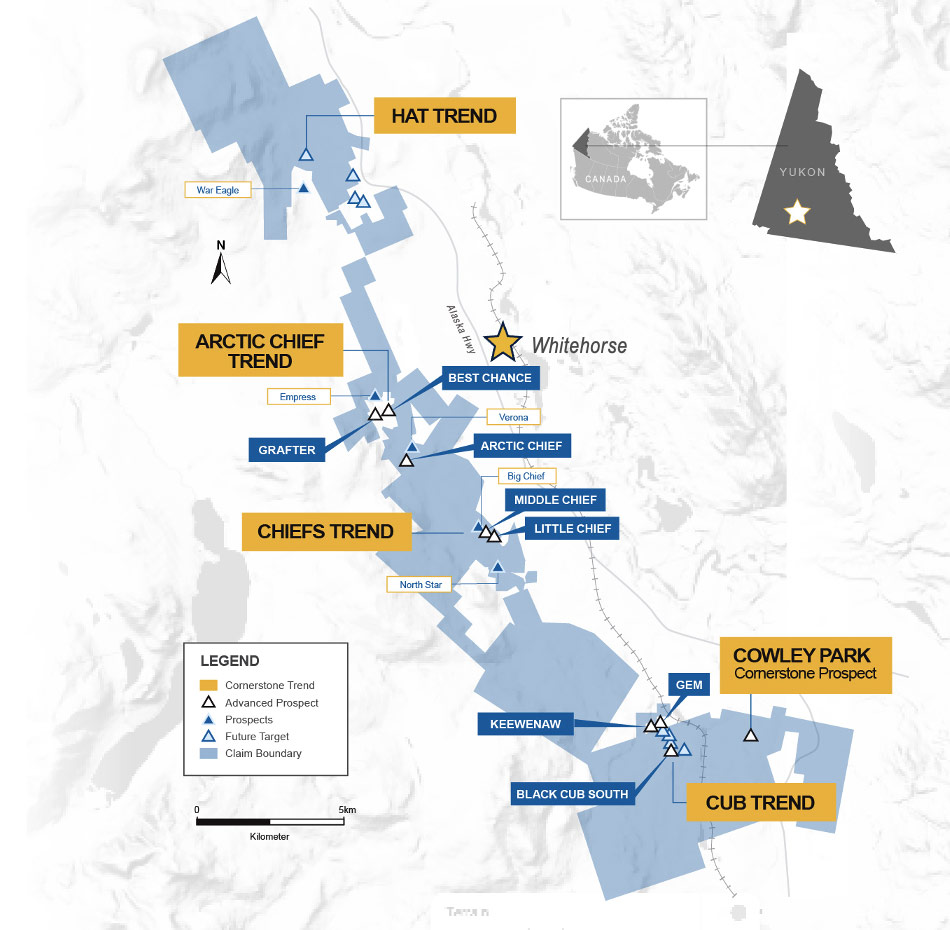
Gladiator Metals controls a 133 square kilometer land package covering roughly 35 kilometers of continuous strike length across the Whitehorse Copper Belt.
Within this corridor, the company has identified multiple mineralized trends, including:
- Cowley Park (cornerstone prospect)
- Chiefs Trend (Middle Chief & Little Chief)
- Arctic Chief Trend (including Best Chance and Grafter)
- Cub Trend (including Gem, Keewenaw, Black Cub South)
Instead of betting on a single isolated deposit, Gladiator is pursuing a district-scale resource strategy, similar to how many of the world’s largest copper camps were originally developed.
The goal is not simply to find a deposit — but to demonstrate repeatable mineralization across the belt, building toward a multi-deposit copper district.
Cowley Park: The Emerging Cornerstone Resource
At the southern end of the belt sits Cowley Park, now the most advanced and intensively drilled area of the project.
More than 400 drill holes have been completed here (including historic holes), defining:
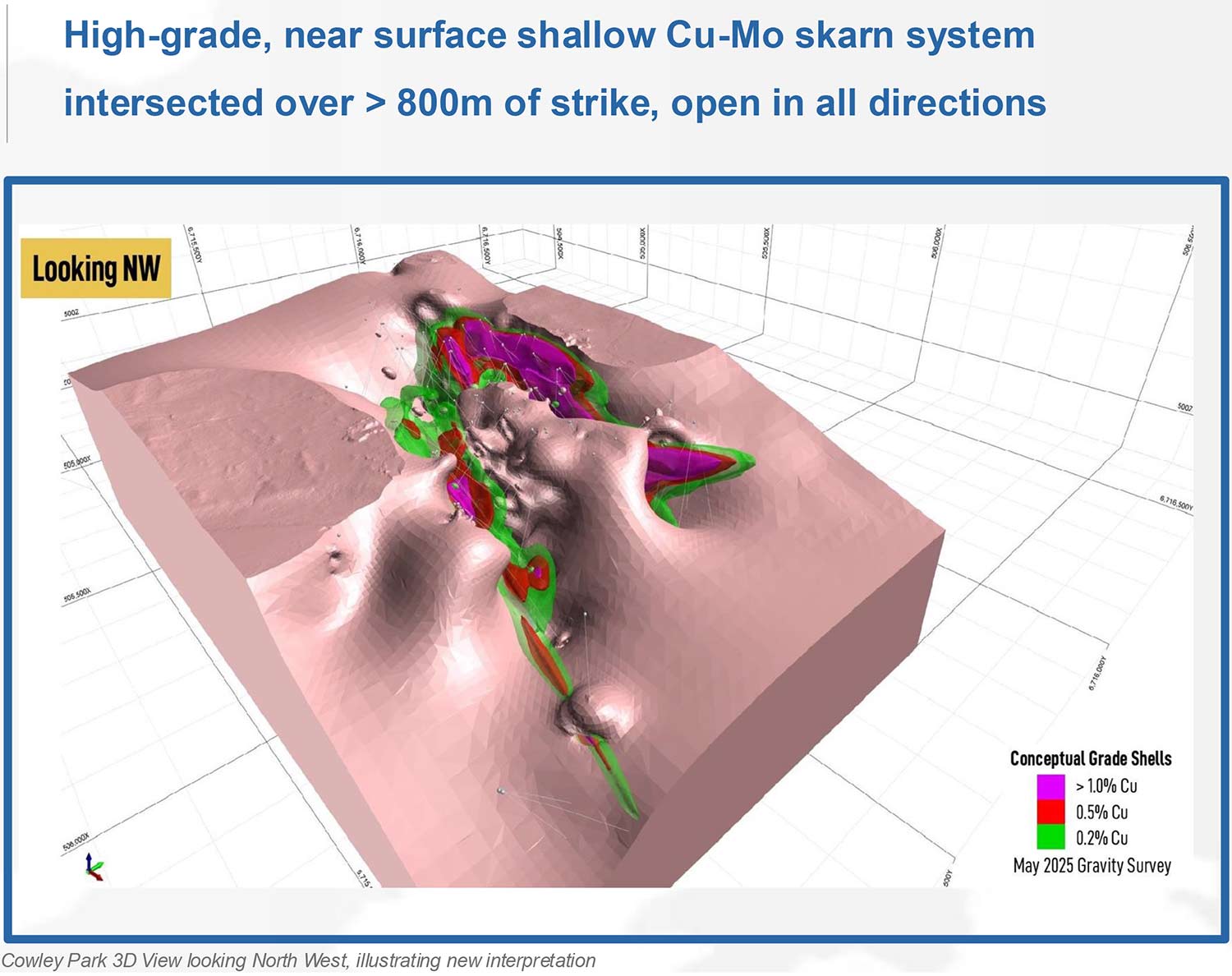
- Shallow, near-surface copper-molybdenum skarn mineralization
- Over 800 meters of confirmed strike length
- Open in all directions
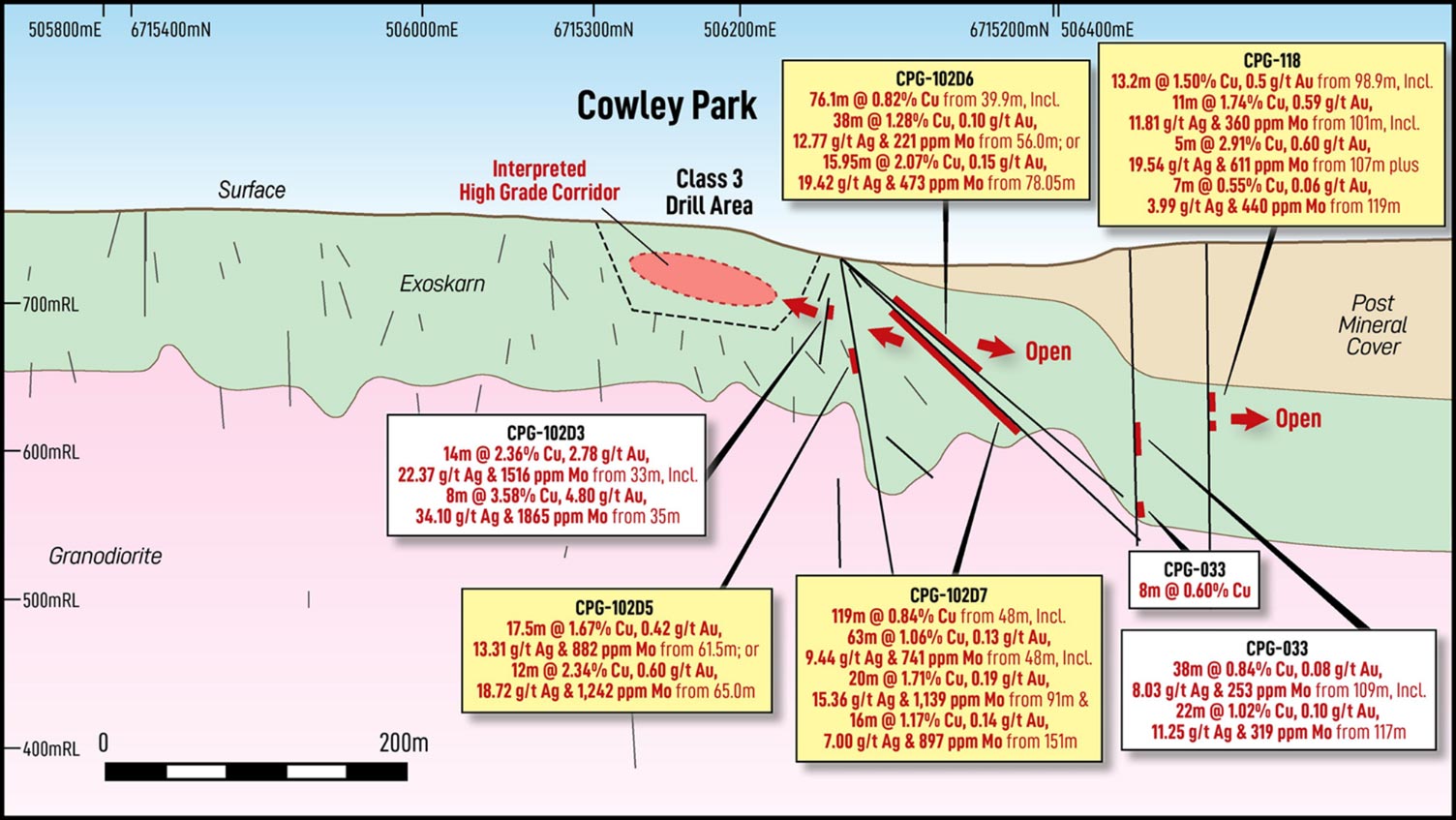
Grades are consistently strong, commonly in the 1.0% to 1.5%+ copper-equivalent range, with meaningful molybdenum, gold, and silver credits.
Recent drilling continues to confirm:
- Broad mineralized widths
- Excellent continuity
- Expansion along strike and at depth
In other words, Cowley Park is behaving exactly the way you want a future open-pit or bulk underground copper system to behave.
High Grades, Broad Widths, and Still Growing
Recent intercepts at Cowley Park include:
- 58.7 meters @ 1.94% copper, including
- 11.1 meters @ 6.0% copper
- 27 meters @ 3.07% copper
- 26 meters @ 3.60% copper
- Multiple zones exceeding 1% copper over tens of meters
These are not narrow vein intercepts. These are thick, continuous zones of mineralization — exactly what resource geologists look for when modeling large-scale copper systems.
Just as important: step-out drilling continues to push the system outward, with mineralization now extending more than 250 meters farther east along the southern limb — and still open.
CEO Jason Bontempo, who you’ll hear from below, said the program is “proving up high-grade copper mineralization further along strike to the east and to near surface with improving gold grades and high-grade molybdenum over broad widths… showing the high-grade near-term resource potential of the Cowley prospect which demands more drilling to test its ever-growing size.” He added that results confirm they have “not yet reached the boundaries of resource potential of Cowley,” now extended eastward with higher gold grades.
Cowley Park has not yet found its boundaries.
A Surprise Discovery at Depth: Signs of a Porphyry System
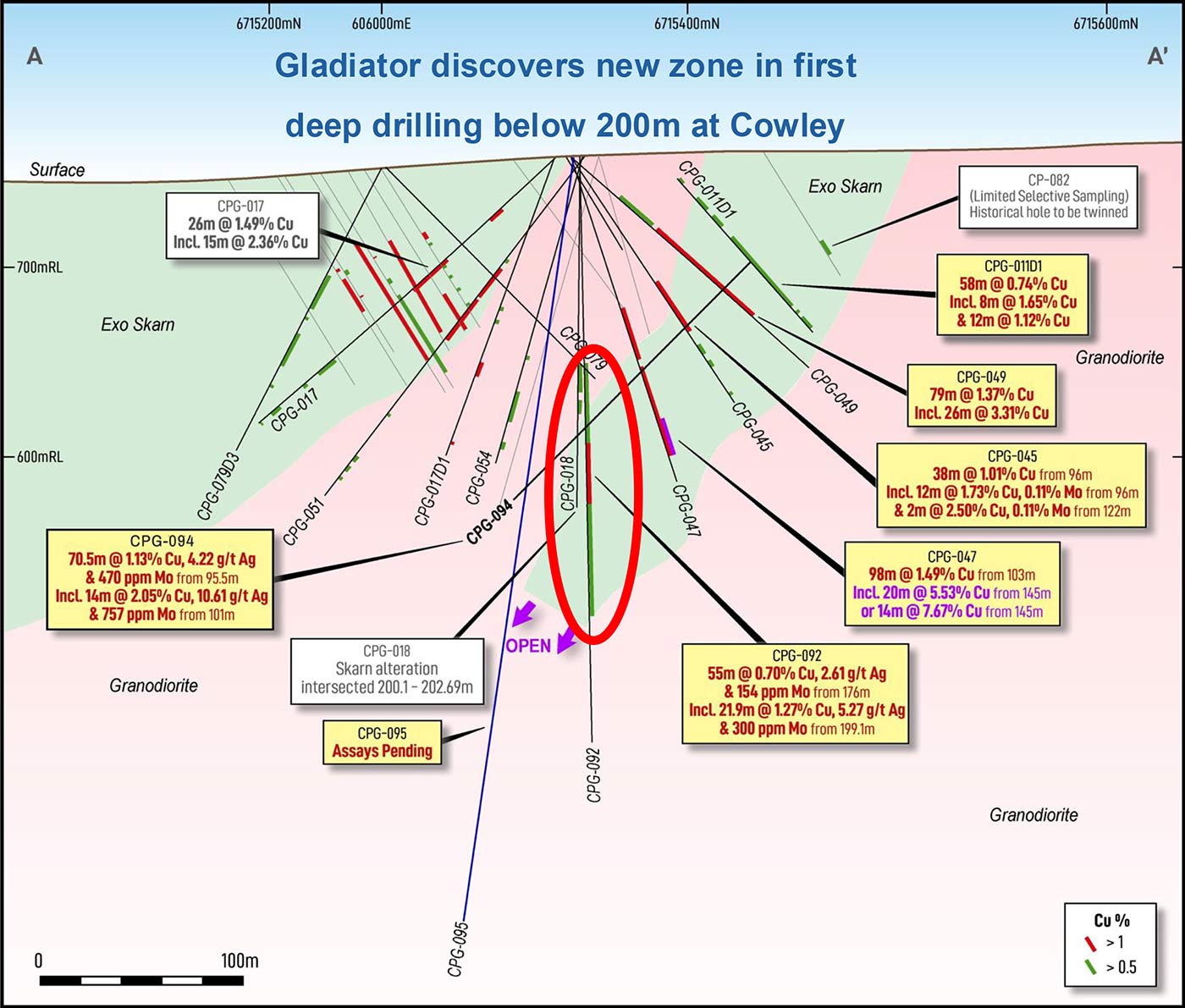
While most early drilling focused on shallow skarn mineralization, Gladiator recently tested deeper targets below 200 meters.
What they found changed the geological model.
Instead of skarn alone, drilling intersected:
- Bornite and chalcopyrite
- Hosted within altered granodiorite
- Over a 180-meter wide interval
This is significant, because it suggests the possibility of an underlying porphyry copper system feeding the skarn mineralization above.
Porphyry systems are responsible for many of the world’s largest copper deposits.
While Gladiator remains focused on defining near-surface skarn resources first, the presence of copper mineralization in intrusive rocks opens the door to a much larger long-term exploration story.
Finding What Historic Miners Couldn’t: Blind Targets Revealed by Modern Geophysics
Historic miners followed what they could see at surface.
Gladiator is using modern tools to find what lies beneath.
The company has deployed:
- Gravity surveys (to detect dense skarn bodies)
- Induced polarization (IP) surveys (to detect sulfide mineralization)
- Downhole electromagnetics
The results have been striking.
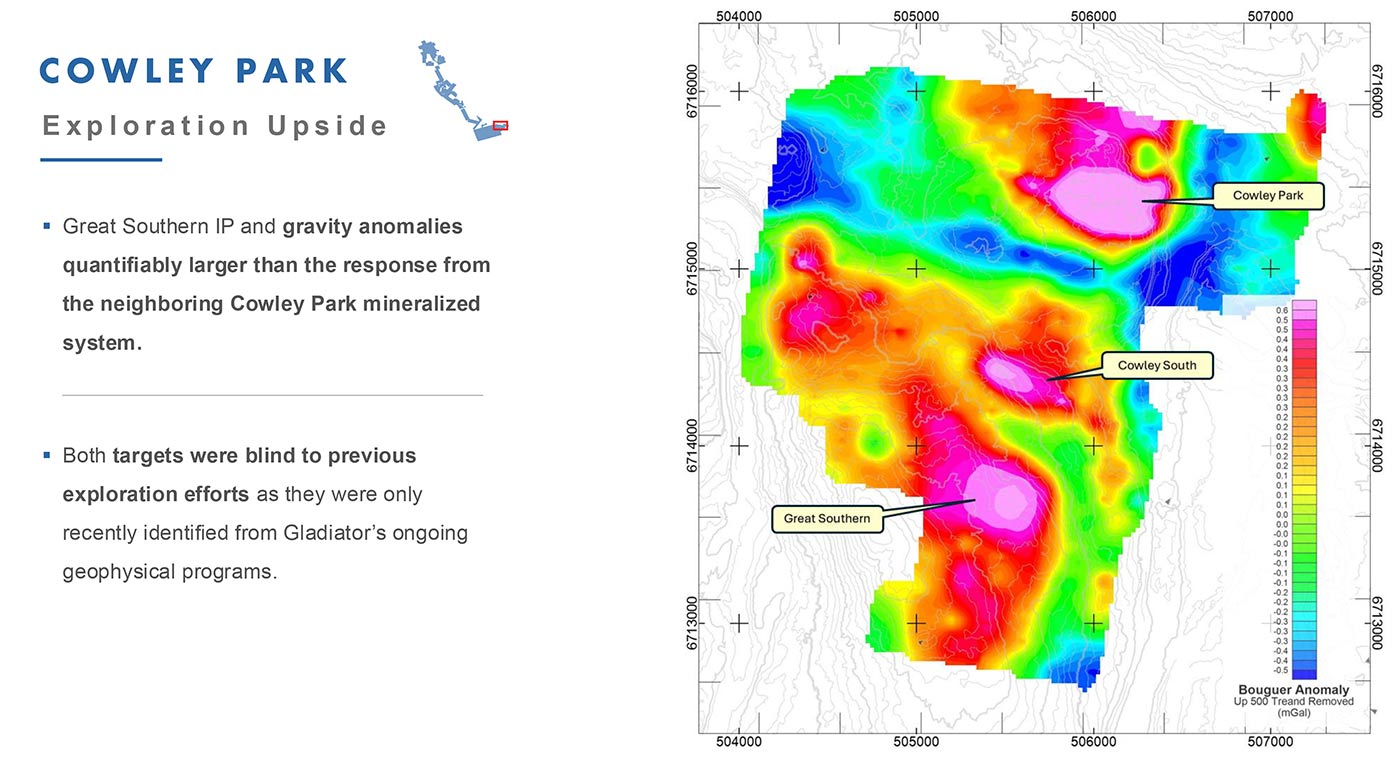
Several gravity and IP anomalies larger than the Cowley Park response itself have now been identified — and these targets were completely blind to past exploration.
Two of the most compelling are:
- Great Southern
- Cowley South
Both are scheduled for drill testing as soon as permitting allows higher-density drilling.
This is how districts are built: find one deposit, then find the next, and the next.
Chiefs Trend: High-Grade Copper
Where Mines Once Operated
Moving north along the belt, Gladiator controls the historic Little Chief and Middle Chief mines, which together produced:
- 8.5 million tonnes @ ~1.5% copper
- Plus gold credits of nearly 1 gram per tonne
Historic mining focused mainly on underground extraction, leaving up-dip mineralization largely untested and significant strike extensions unexplored.
Modern drilling has now confirmed high-grade copper skarn, intrusive-related copper mineralization, and multiple unmined zones between Middle Chief and Little Chief.
Recent intercepts include:
- 49.8 meters @ 3.06% copper
- 54.1 meters @ 2.05% copper
- 41.1 meters @ 2.22% copper
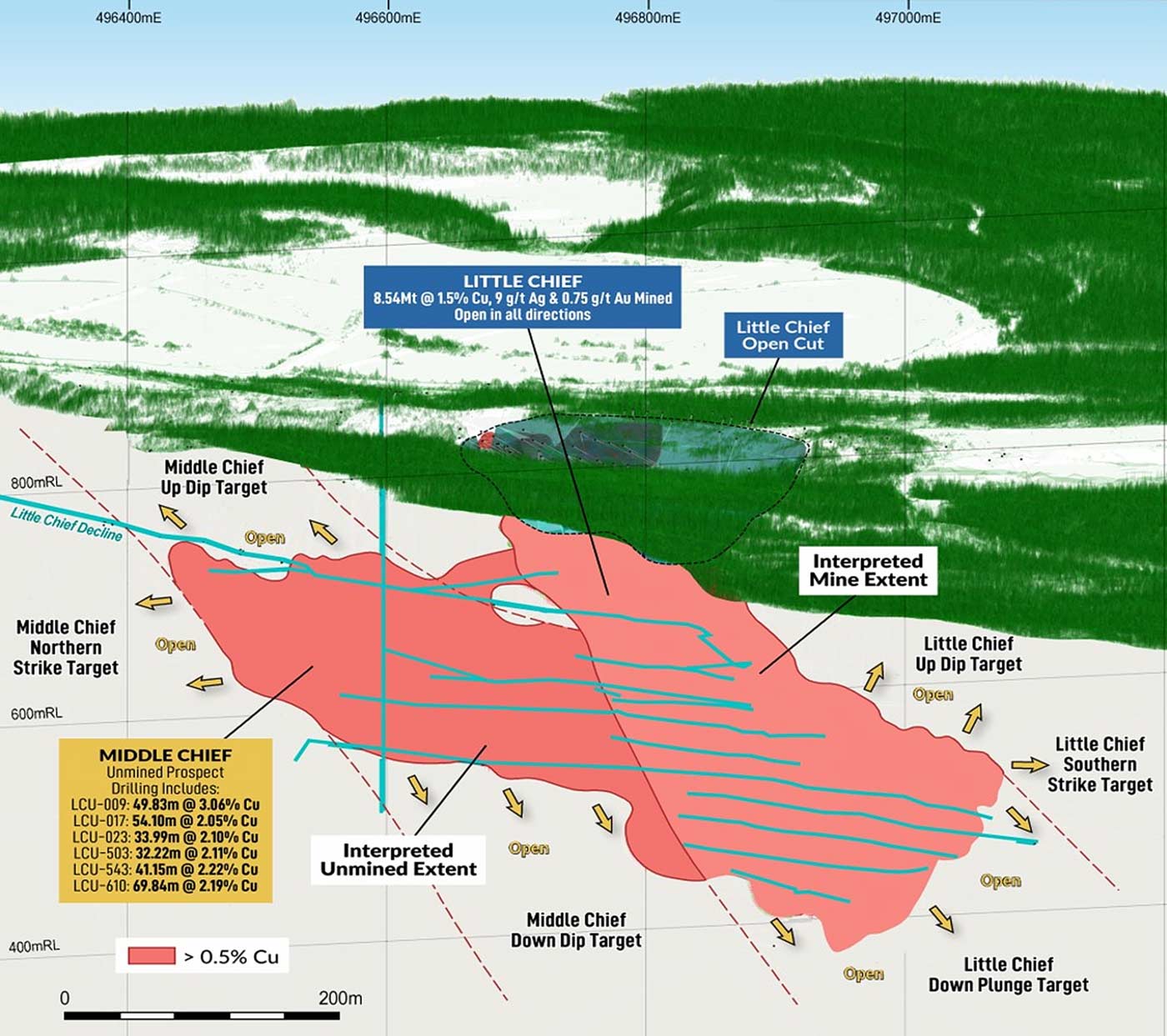
These are exceptional grades for bulk copper systems — and they remain open.
Geophysics has highlighted numerous targets along the 3km Chiefs trend, with multiple, previously unknown copper-gold skarn and intrusive related mineralized trends identified in first drilling.
These zones will continue to be proved up in 2026, adding to future high-grade copper resources.
What makes the Chiefs Trend especially important is that it demonstrates clear continuity between historic production and modern discovery.
Historic mining only exploited a fraction of the system, largely focusing on underground extraction and leaving extensive up-dip and along-strike mineralization untested.
Modern drilling and geophysics now suggest the Chiefs Trend could ultimately support multiple resource domains, reinforcing the idea that the Whitehorse Copper Belt hosts repeatable, scalable copper systems rather than isolated deposits.
Arctic Chief and Best Chance:
More High-Grade Zones Emerging
Farther north still, the Arctic Chief Trend extends over roughly 2.5 kilometers and includes the historic Best Chance and Grafter prospects.
Here, historic drilling and recent work show broad copper-gold mineralization, multiple zones exceeding 1% copper, and gold-rich intercepts near surface.
Recent results include:
- 77 meters @ 0.70% copper from near surface
- Including 18 meters @ 1.10% copper
- Additional high-grade gold-bearing intervals
Drone magnetics and surface sampling have now expanded the number of targets along this trend, suggesting that Arctic Chief may ultimately host multiple resource-scale zones.
Strategically, Arctic Chief serves as further proof that high-grade copper mineralization persists well beyond the most heavily drilled areas of the belt.
With limited historic drilling and multiple zones already showing scale and grade from surface, Arctic Chief represents another opportunity for Gladiator to add meaningful tonnes outside of Cowley.
As drilling density increases, this trend has the potential to evolve from a collection of prospects into a standalone resource contributor within the broader district.
The Cub Trend: A Brand-New
High-Grade Discovery Emerges
Just as important as expanding known systems is proving that an entire belt can continue to deliver new discoveries.
That is exactly what Gladiator accomplished at the Cub Trend in January 2026, with the announcement of a previously unknown zone of high-grade copper-gold skarn mineralization discovered through maiden drilling.
The Cub Trend lies along the same 35-kilometer Whitehorse Copper Belt and includes several historic workings, most notably the Black Cub South open pit, which was partially mined in the past but never fully delineated using modern techniques.
What Gladiator has now demonstrated is that significant mineralization remained hidden beneath shallow cover, untouched by historic exploration.
The new discovery, now referred to as Cub East, was identified by targeting overlapping gravity and induced polarization (IP) anomalies beneath shallow till cover — mineralization that was completely blind to earlier miners.
A five-hole maiden drill program totaling 1,411 meters intersected high-grade copper-gold-magnetite skarn in all five holes, immediately confirming the presence of a new mineralized body adjacent to the historic Black Cub South pit.
Highlights from the initial drilling include:
- 44.2 meters grading 1.69% copper, 0.93 g/t gold and 15.39 g/t silver, including
- 27 meters of 2.56% copper, 1.44 g/t gold and 23.85 g/t silver
- 17.7 meters grading 1.76% copper, 0.69 g/t gold and 13.62 g/t silver, including
- 13.7 meters of 2.20% copper
- 16.3 meters grading 1.51% copper, including
- 9.3 meters of 2.45% copper
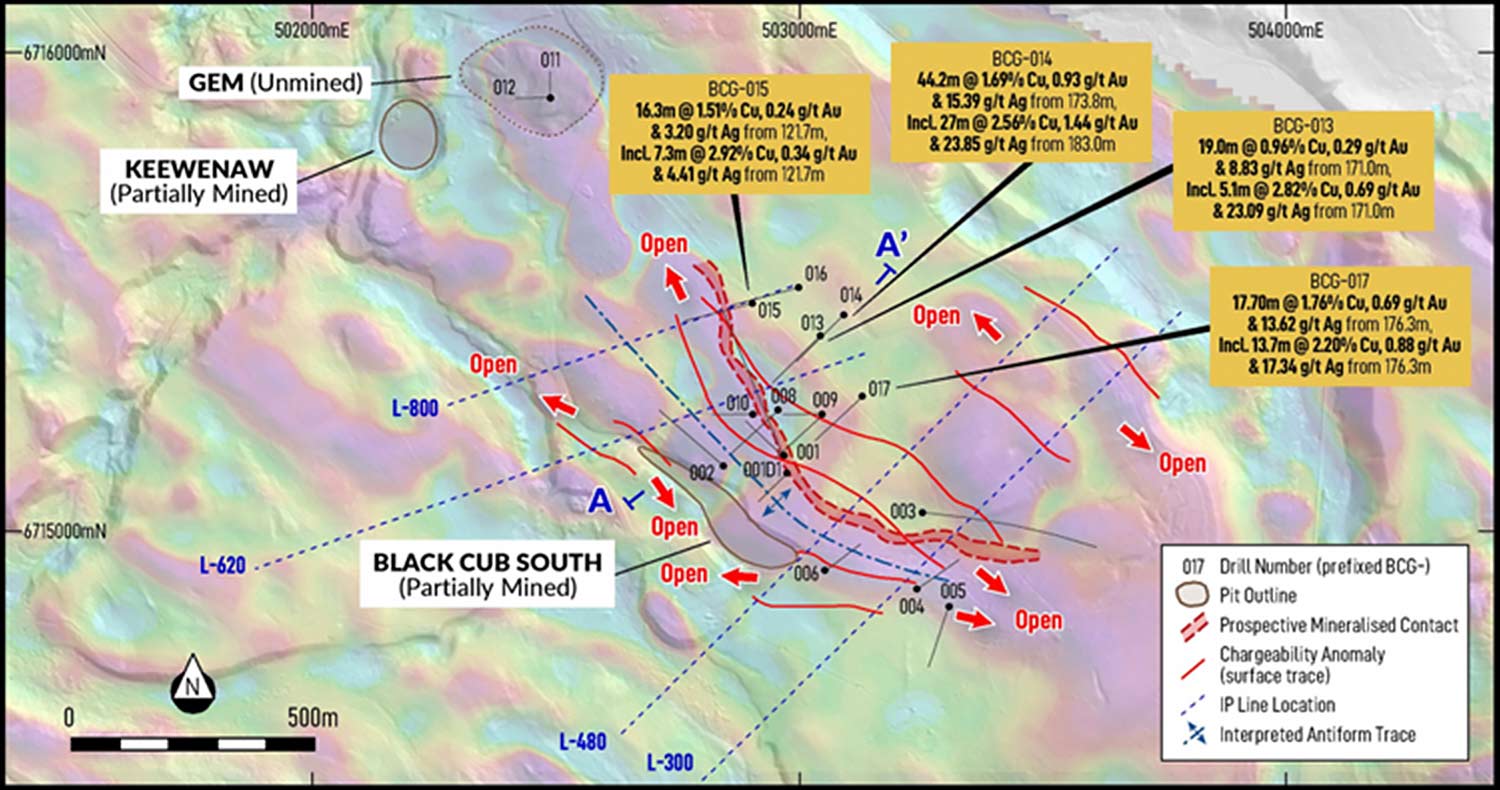
These are thick, high-grade intercepts, consistent with the best results seen elsewhere in the Whitehorse Copper Belt, and importantly, they occur outside the limits of historic mining.
Early drilling at Cub East has already outlined mineralization over more than 300 meters of strike length and 300 meters down-dip, with the system remaining open in all directions.
Even more compelling, the coincident gravity and IP anomaly that led to the discovery extends over at least 800 meters, suggesting the currently drilled area represents only a portion of a much larger mineralized system.
Additional high-tenor chargeability anomalies identified to the south point to further upside and follow-up targets that have yet to be drilled.
In short, Cub East appears to be another repeatable skarn system, not an isolated occurrence.
Validating Gladiator’s Exploration Strategy
The Cub discovery underscores a central thesis of this report:
The Whitehorse Copper Belt is not a one-deposit story.
With Cowley emerging as a cornerstone resource, Chiefs and Arctic Chief demonstrating high-grade continuity, and now Cub delivering a brand-new blind discovery, Gladiator is systematically proving that this is a multi-deposit copper district — the kind that has historically attracted major mining companies and commanded premium valuations.
The Cub discovery is important for more than just its grades.
It fully validates Gladiator’s exploration approach, which combines:
- Detailed gravity surveys to identify dense skarn bodies
- Induced polarization surveys to map sulfide-rich zones
- Step-out drilling guided by coincident geophysical responses
Management has noted that mineralization was intersected within approximately 10 meters of the modeled geophysical targets, underscoring the effectiveness of this low-cost, high-precision targeting method.
This same approach has now been proven successful at Cowley, Chiefs, and Cub, dramatically increasing confidence that additional blind discoveries remain to be found across the belt.
With the success of maiden drilling at Cub East, Gladiator has elevated the Cub Trend to a priority target within its fully funded 2026 exploration program.
Planned work includes:
- Follow-up drilling to extend Cub East along strike and up-dip
- Testing additional IP and gravity anomalies along the >1.5 km Cub Trend
- Advancing Cub toward future resource definition alongside Cowley, Chiefs, and Arctic Chief
The fact that Cub now joins multiple other trends with confirmed high-grade copper mineralization reinforces the district-scale nature of the Whitehorse Copper Project.
Infrastructure: A Rare Advantage
in Copper Exploration
One of the most overlooked strengths of the Whitehorse Copper Project is its location.
Unlike many remote copper projects, Gladiator benefits from:
- Immediate proximity to the city of Whitehorse
- Existing road access throughout the belt
- Grid hydroelectric power
- Skilled local workforce
- A deep-water port at Skagway, Alaska, about two hours away
This means:
- No fly-in camps
- Lower exploration costs
- Potentially lower future capital and operating costs
For large copper deposits, infrastructure can matter just as much as grade.
And Gladiator has both.
Plus it has access to a skilled local workforce, with experienced providers, vendors and local laboratories.
First Nations Partnerships and Community Support
The Whitehorse Copper Project lies within the traditional territory of the Kwanlin Dün First Nation and the Ta’an Kwäch’än Council.
Gladiator has already:
- Signed a capacity funding agreement with Kwanlin Dün
- Completed public consultation for upgraded permitting
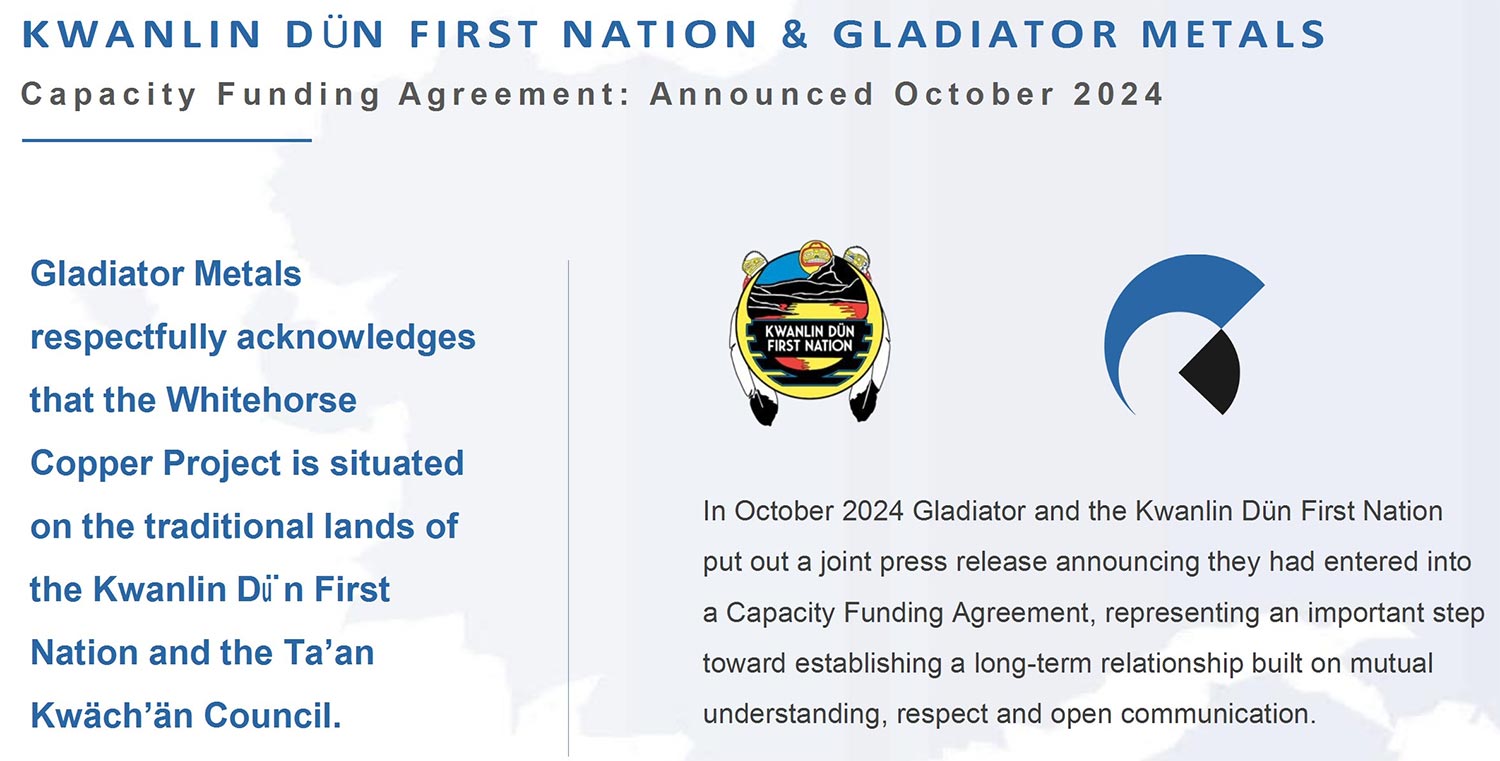
It is now working toward a formal Exploration Cooperation Agreement.
Importantly, this project is the only major mineral development opportunity within Kwanlin Dün territory, giving the community a strong interest in long-term success.
Strong partnerships at this stage dramatically reduce future permitting and social risk.
Well Funded and Fully Focused on Drilling
Gladiator currently holds roughly C$25 million in cash, representing an unusually strong treasury for a company at this stage.
That funding supports:
- ~50,000 meters of drilling completed 2025
- Another minimum 50,000 meters planned for 2026
- Multiple drill rigs operating simultaneously
- Ongoing geophysical surveys
Just as important: the company’s share structure is relatively clean, with:
- ~100 million shares outstanding
- No warrant overhang
- Significant insider and institutional ownership
This allows the company to pursue aggressive exploration without constant dilution.
How Gladiator Compares to More
Advanced Copper Developers
Several copper companies operating in similar geological environments now command valuations many times higher than Gladiator’s current market cap.
Examples include:
- Foran Mining — ~C$2 billion market cap
- Marimaca Copper — ~C$1.3 billion
- Arizona Sonoran Copper — ~C$500+ million
- Meridian Mining — ~C$500+ million
These companies are generally:
- At prefeasibility and definitive feasibility stages
- With defined resources
- In construction or development phases
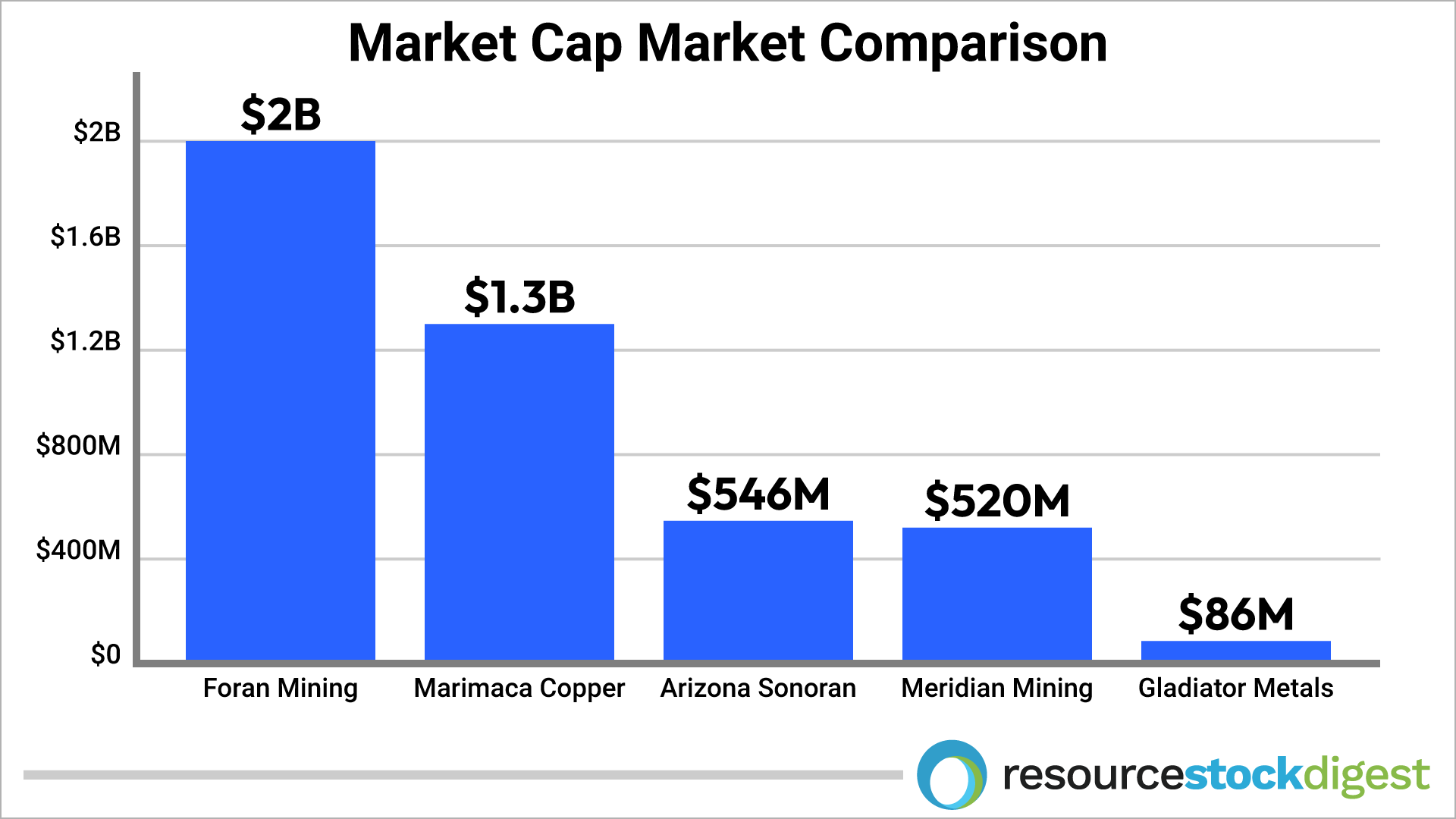
Gladiator is earlier — but that is exactly where the largest percentage re-ratings historically occur.
With a market cap around C$100 million — and shares trading below $2.00 — Gladiator is still valued as a high-risk explorer, even as it advances toward resource definition across multiple prospects.
Let’s have a chat with management to see how they’re going to unlock that value.
Exclusive Interview with Gladiator Metals
CEO & Director Jason Bontempo
There are few copper companies in the junior space that can match the copper exploration and discovery acumen and capital markets expertise of the Gladiator Metals team.
Marcus Harden is President. He brings 20-plus years of industry experience, including key roles in multiple discoveries globally with three projects currently operating.
The team also includes VP of Exploration Kell Nielsen, who brings 30-plus years of experience in project generation and exploration and who was instrumental in the discovery, development, and management of several large resource projects. Those include the Ngualla Rare Earths Deposit (Tanzania), the Selenge Iron Project (Mongolia), the Diamba Sud Gold Project (Senegal), and multiple projects for Placer Dome including the delineation of the ~7MOz Wallaby Gold Mine (Australia).
The Gladiator Metals board is rounded out by:
- Shawn Khunkhun: Current CEO and director of Dolly Varden Silver and founding director of Goldshore Resources. Shawn has raised over C$1 billion in equity for resource companies.
- Darren Devine: Founder of K92 Mining, founder of Underworld Resources, and chairman of Dolly Varden Silver.
For a deeper dive into the flagship Whitehorse Copper Project, our own Nick Hodge sat down for an exclusive interview with CEO and Director Jason Bontempo. Jason is based in Australia and boasts 20-plus years in public company management as a chartered accountant.
Please enjoy the candid conversation.

Nick Hodge: I'm Nick Hodge with Resource Stock Digest. I'm sitting down with Jason Bontempo. He's the CEO and director of Gladiator Metals, which is developing and exploring the Whitehorse Copper Project in the Yukon, which is coming on, pretty fast and furious as a as a jurisdiction. Jason, thanks for being with me today.

Jason Bontempo: It's great to be here, Nick. Thank you.
Nick Hodge: Let’s get right into Gladiator and assume the reader is well-versed in the copper scene. They're aware that it's at record-high prices and has even gone over $6.00/lb. They're aware that there's structural shortages forecast for the next several years. They’re aware it’s the key metal needed for electrification and the build-out of AI data centers. I don't think we need to talk about the macro picture for copper. We get that. I wanted to hear from you specifically about Gladiator Metals and give you the opportunity to start out with essentially the elevator pitch to introduce yourself and the project.
Jason Bontempo: Yeah, sure. Thank you, Nick. Well, Gladiator has been advancing and working the Whitehorse copper belt for the last two and a half years. It is essentially a thirty-kilometer-long high grade copper mineralised belt, primarily mineralised with what we call skarn mineralization at surface.
It has been laying dormant for almost 40 years. It was previously a producer in the late 1960s to the early 1980s. It produced from the Little Chief Mine. And that produced 10.5 million tonnes at 1.5% copper and almost a gram per tonne gold. It was a very good mine and very much established or contributed to the growth of Whitehorse City. The project runs along the western margin of Whitehorse. Whitehorse is effectively to the north, but we've been primarily working the southern portion of the belt.
At a very high level, what we see is very much a world class asset. What we see is large scale potential. Originally, we were targeting 100 million tonnes of over 1% copper from surface. And what we're seeing now is the potential for a lot more than that.
There's just a number of near-term prospects along the belt, particularly the southern portion, where there is outcropping at surface. That's what we've been working on. And particularly a lot of work has gone to the the very southern portion of the belt where we had a lot of historic drilling at Cowley. And that is certainly proving to be what we will be focused on: delivering maiden resource this year.
We keep drilling it and we have been drilling it — and it keeps growing and extending. It's not finished. It's open along strike. It's open at depth. And that's just at the one spot.
We have a number of advanced areas along that southern portion of the belt that we've been working. And what we can see for 2026, where we will be doing more drilling at these prospects, is revealing where the next resources come from and effectively showing how the belt's going to deliver what we believe will be a globally significant copper resource.
Nick Hodge: Can you put that into context for me? We jumped a little ahead of where I wanted to be, but that's fine. So here's the last slide of your presentation here.
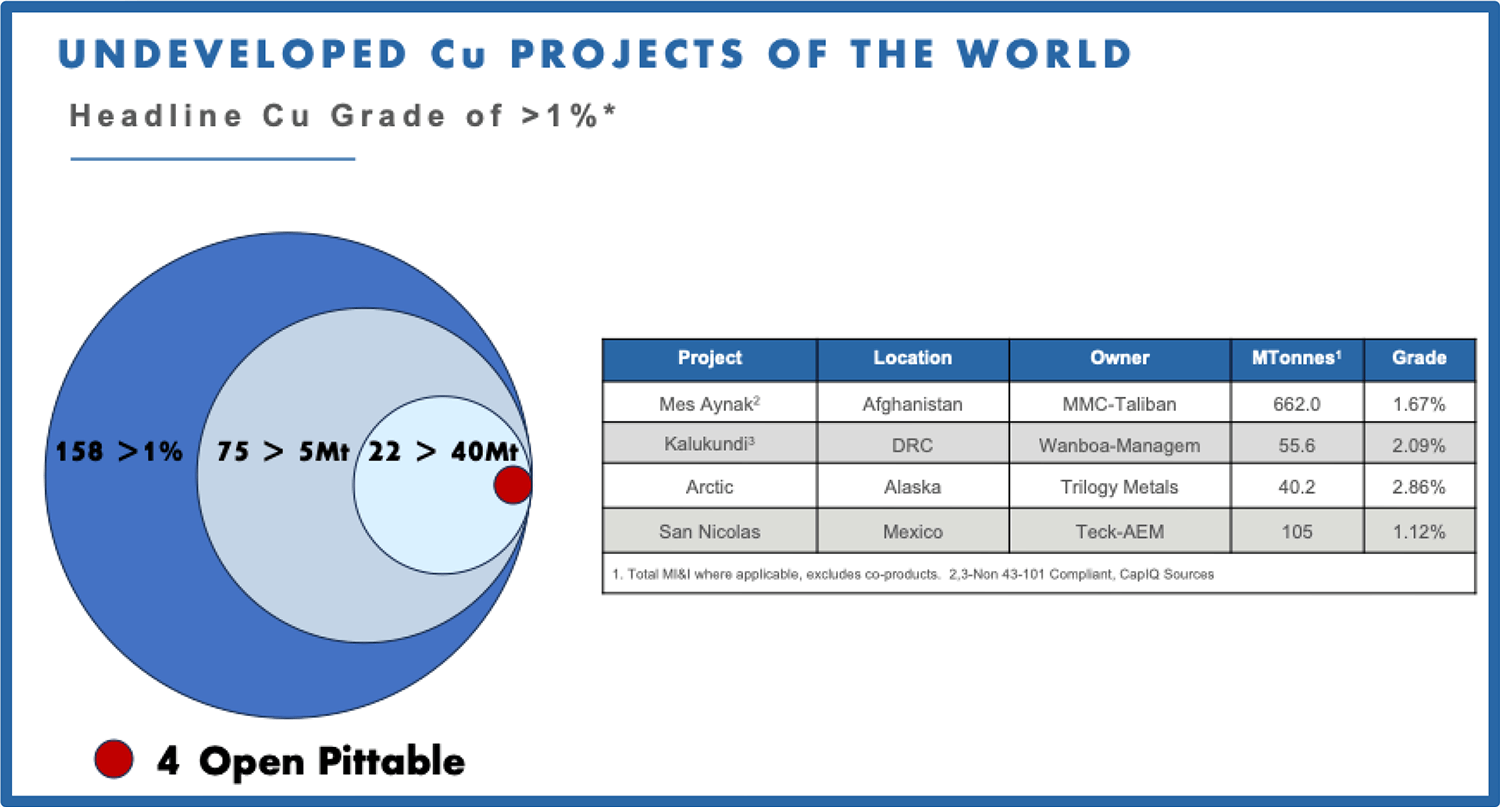
You just mentioned you're looking for a world class copper resource. Can you put that into global context for us relative to what we're seeing on the screen here?
Jason Bontempo: Yeah, well, we did quite a detailed search looking at undeveloped copper projects around the world that would have a headline grade of one percent plus from surface and be greater than forty million tonnes. And we essentially came up with four, of which some of them are in challenging jurisdictions like Afghanistan and the Congo.
And you probably have heard a little bit about some of the others recently in the news with their spectacular valuation increases. But Cowley will be sitting in that sort of world class category of deposit. And that is just the Cowley deposit. What we're sort of seeing now as we've been working the belt is the skarn mineralization is quite prolific up and down the belt, and we can see ourselves delineating and drilling out a lot more than that at a number of areas along that belt. The southern portion might be 20 kilometres and advantageously sitting right next to excellent infrastructure in the city of Whitehorse, with its Alaskan highway, access to power and water and a very, very experienced labor force as well. We believe it’s a critical advantage to be located where we are versus other more remote projects.
Nick Hodge: I was in Whitehorse just a couple of years ago. I did the Yukon tour. It's obviously got a legacy of mining. And with recent elections there and with the way critical minerals minerals and metals are important globally, I think we're gonna continue to see mining as a focus in the Yukon.
Let me slow down a bit. Let me ask you about your share structure and the cash that you have, and then we'll talk about your plans for drilling and the resource. On the slide below we can see a couple of projects that are more developed with market caps ranging from $500 million to a couple of billion.
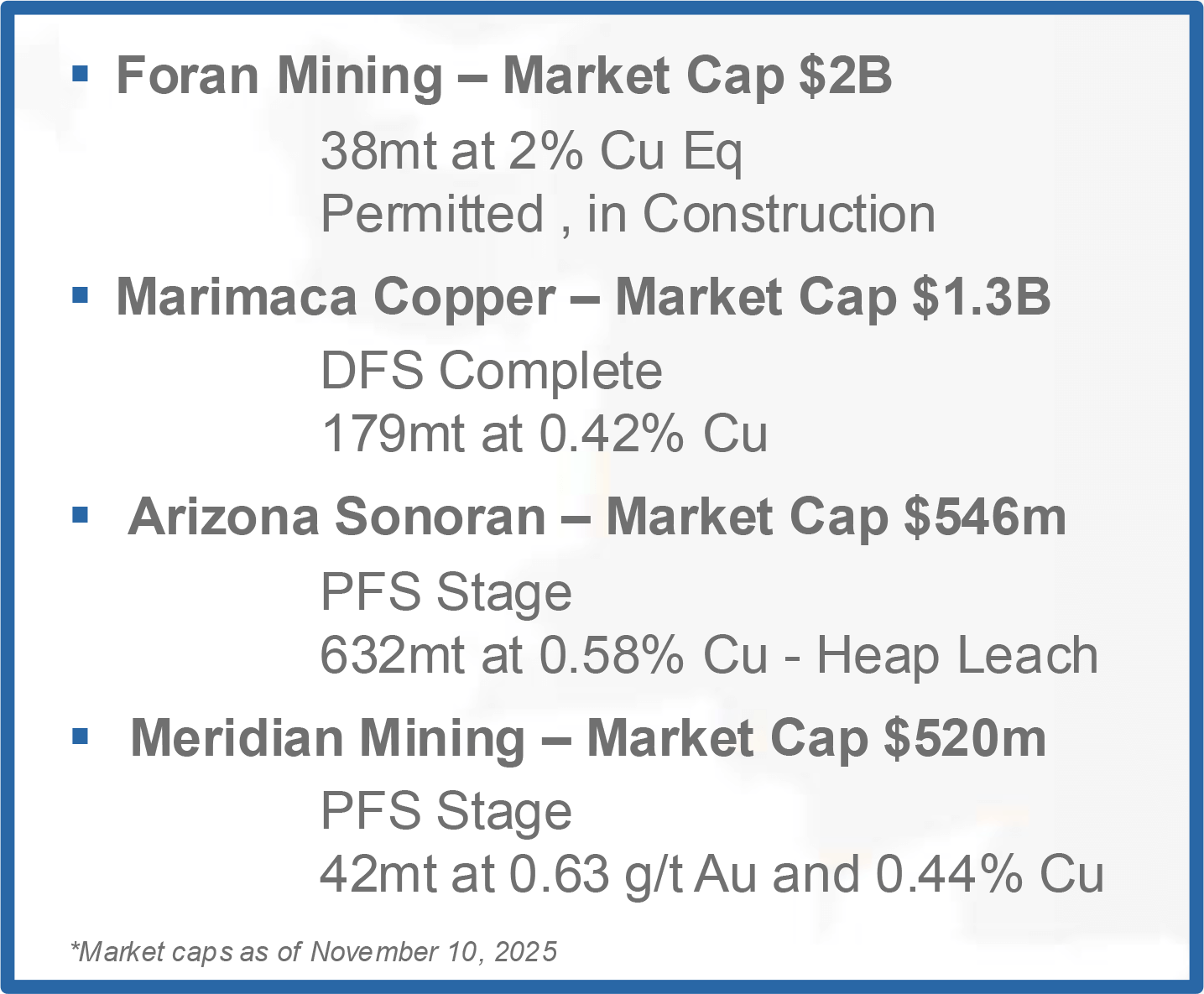
You're sitting with a C$100 million valuation. You've got about 100 million shares out. You just raised some capital. Can you tell us about that capital raise and your share structure for a second?
Jason Bontempo: Sure. Yes. So 100 million shares on issue. And we recently raised in September 2025. We were well supported by our existing sophisticated institutional investors with a combination out of Canada and Australia. We were supported by a number of our long standing, high net worth, sophisticated resource investors out of Canada. So we currently sit on ~C$25 million dollars in the treasury. We are fully funded for 2026 and we're fully funded to execute on advancing the project.
Nick Hodge: Let's talk about the execution. I think you drilled something like 50,000 meters in 2025. You've got four rigs on-site. You want to do another 50,000 in 2026, which you just said you're fully funded for.
It's going to get exciting because you started to do some geophysics, gravity, chargeability studies that have allowed you to hone in on the mineralization, whereas before you were drilling blind. So that's what I want to talk about next. Can you describe those techniques for us? How have you been able to zero in on this skarn mineralization that you have?
Jason Bontempo: Yeah. Okay. So look, what we've been working on is where the skarn has been outcropping at surface.
From the Little Chief mine right down to the Cowley area, historically skarn was outcropping and that's where we have been focused for the first year and a half. In the last year, we've significantly advanced the project where we've conducted a significant amount of geophysics. And that geophysics is allowing us now to not only recognise that outcropping skarn at surface, but being able to see through what is a very shallow cover along the belt, maybe ten metres. It's not very deep at all, but it allows us to see through that.
So there were two very significant technical achievements for us in 2025.
First is that we've conducted geophysics where we're using gravity. That means gravity is looking for the density and the higher the density, what we have found, it's most likely copper skarn mineralization. So in the last ten gravity targets that we've drilled, we've hit skarn every single time.
To sharpen our focus on that gravity of skarn mineralisation, we've now added what we call the IP or induced polarisation, which effectively measures chargeability and conductivity. That makes for even more interesting targets.
When you overlay the gravity and the IP like this it becomes clear.
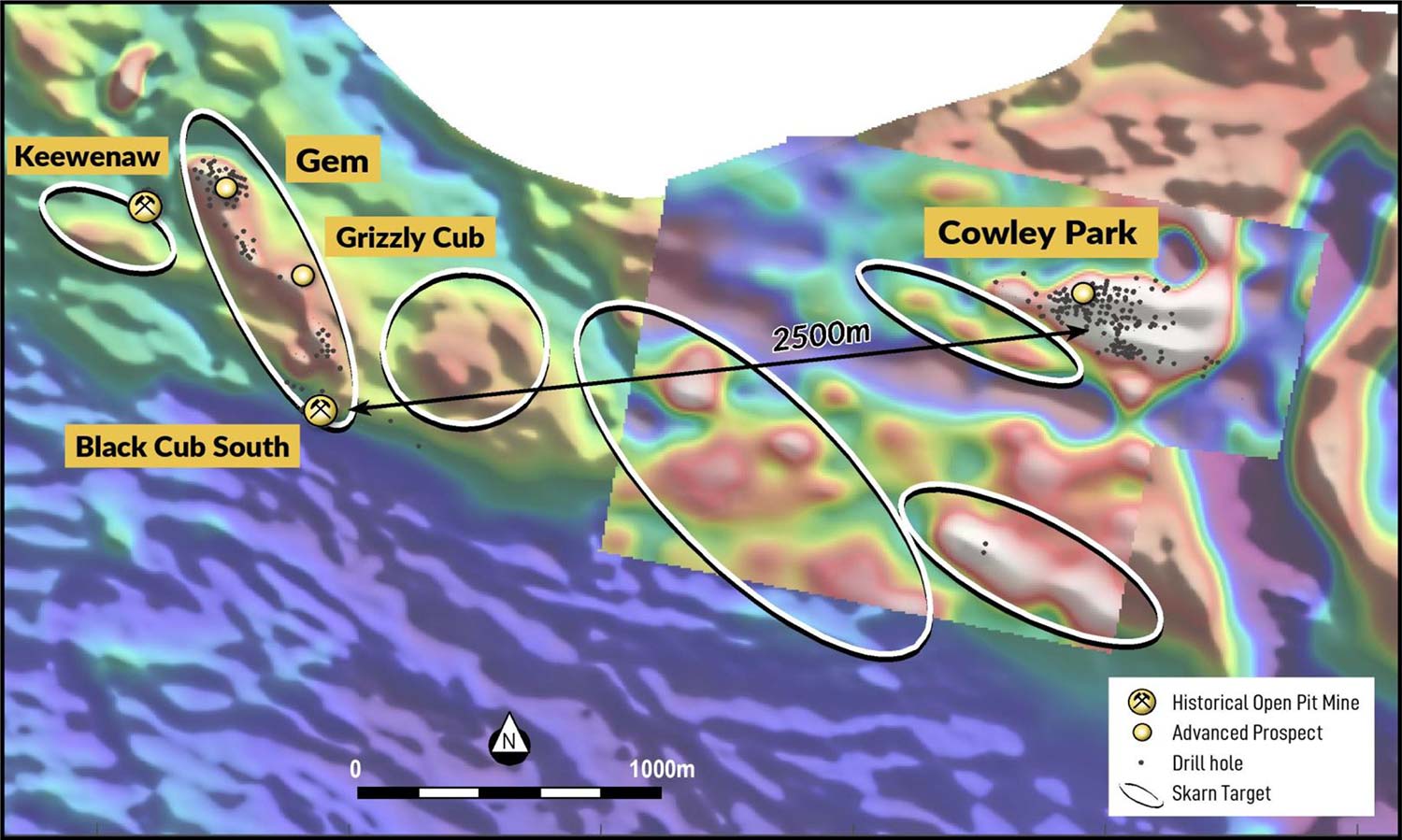
What you see here to the northeast is Cowley. That's known — there's over three hundred drill holes. We know that there's a copper deposit there for sure.
But what the gravity and the IP has relates to gravity or chargeability is now Cowley South and Great Southern. And these are very, very interesting targets that we can't wait to drill in 2026. It just clearly shows in a very, very small area of the belt, the huge potential of high grade tonnes at surface that this method is showing us.
In addition to that, the second technical advancement has been that we've drilled a bit deeper. So we've really only focused on 0-150 meters of depth, which is very, very shallow.
But last year we decided to drill a few deeper holes below 150 meters. And what we have found is that we've started to intersect and hit mineralization below the skarn contact. What we’re now hitting is mineralization in only the granite. And that was a real surprise to everyone.
It got everyone very excited because that drilling was showing porphyritic signatures and allowed us to start vectoring towards the porphyry that's feeding all this copper.
So not only is this a world class project based on the skarn mineralization alone that we loved and that we were working, but now we've got this huge added bonus of seeing the copper in the granite. Hopefully that will now lead us to a potential porphyry discovery.
Now that's a longer term play. There's a lot of low-hanging fruit at the moment, as you can tell at the skarn, but it just makes for a truly very unique copper project in North America for sure, particularly because it's close to infrastructure.
Nick Hodge: So you mentioned a resource estimate coming in 2026. Are you waiting to complete that next 50,000 meters of drilling before you do the resource? Are you gonna be able to get a resource out in the first half of 2026?
Jason Bontempo: Yes, towards the second quarter, but that's really based on Cowley. If Cowley continues to deliver along strike and at depth, then we'll make a judgment call as to whether we can actually call a resource on it. Because if it's continuing to grow, we might just allow it to grow.
One of the things to really look forward to is the successful receipt of a positive recommendation for our Class Three drilling permit. We've been successfully operating under Class One exploration permits, but now we will need a Class Three, which allows us to conduct higher drilling density on our mineral claims. That's the number one reason. It also allows us to gain access to areas we couldn't drill in the past without creating trails and roads. So that elevated exploration permit gives us that and that'll allow us to do the drill density.
And we're very delighted that we went through that Class Three public consultation process, got the positive recommendation because it was two ticks. It was one that we get to now do this work at Cowley with a higher density, but also it was a very public consultation and we got a lot of support for it. That was a really good tick as well for us.
Nick Hodge: And you expect that early in 2026, right?
Jason Bontempo: Yes, the department does have a process to go through for the issuance of that Class Three, so we'd like to think that we'll get it in the second quarter and then we'll hit the ground running straight away.
Nick Hodge: Okay, you mentioned the infrastructure advantage by nature of being in Whitehorse with the history of mining. I want to talk about a couple of other things that come with Whitehorse. One is the group from which you got the project and that you're earning into the project from. And that's Coyne and Sons, which not a lot of people know is a local drilling family, if I remember correctly.
They are shareholders. They have been supportive from what I understand. Can you speak to H. Coyne & Sons and their involvement and support?
Jason Bontempo: Sure. The Coyne family, a very long standing successful family business in the city of Whitehorse, started by their father Howard Coyne and now run by Jim and Rob Coyne primarily.
I've known the Coynes since the mid-2000s where they drilled out a gold deposit for me in China, which has now become a mine.
In Whitehorse, they had consolidated this entire belt that we’re working on at Gladiator. When Hudbay sold these claims in the late 90s, the Coyne family bought some claims, then over the next twenty years they consolidated the whole belt.
We got together in 2022 on this project. The huge advantage of working with the Coynes is they're very established in the city. They have a lot of infrastructure. They have Kluane Drilling, which is a global drilling business, something like 1,500 employees and 250 rigs. And so it's been a huge advantage operationally to work with them. And they're obviously our drillers, but also the Coynes — Jim and Rob — are citizens of our primary First Nation, the Kwanlin Dün First Nation.
They provided a great entry into meeting and establishing a relationship with the Kwanlin Dün back in late 2022. And we've been working very closely with the Kwanlin Dün over the last three years. They're super interested in the Whitehorse Copper Project as the only resource project that lies within their traditional lands. They are a very sophisticated, organised and commercial First Nation. They have been very successful in real estate development and renewable energy infrastructure with wind farms. They also operate gravel quarries, which are all along our belt. When you're looking at 200-300 million tonnes of potential copper just at surface, that's a huge in-situ value that is very interesting for them. So we've already had our first capacity funding agreement with them. We signed that in October 2024, and now we are very close to working towards an exploration cooperation agreement with them, which we're very much looking forward to getting into play.
So it’s been very good working with the Coynes and also working with Kwanlin Dün.
Nick Hodge: What else can we look forward to in terms of news flow for the next couple of weeks and months in 2026 given that you've got a lot of meters drilled and are continuing to drill even now?
Jason Bontempo: There is news coming! There's news that will come from the significant drilling that's been occurring on the eastern side of the Cowley deposit.
We also have a number of drilling results that are coming from other prospect areas that we've drilled in the last three months.
Drilling that started in January, which we're really excited about, will start to touch these big geophysical targets south of Cowley.
And then it will be more drilling. A lot of drilling at Cowley where we will be looking towards that drilling density for resources. We'll be advancing the Chiefs area, where we've been intersecting a lot of skarn mineralization at surface and there's not many holes. That's about drilling out that big two kilometre strike and working out what sort of potential resource is there. And then, further north of the Chiefs, there's Best Chance and there's Arctic Chief.
At Best Chance, we’ve already seen big widths of high grade copper from surface. And when you look at the silhouette of the outline of Best Chance, it is very similar to Cowley, yet there's only three holes into it, whereas Cowley’s got three hundred holes. Is there another fifty million tonnes there? That's the sort of questions we’re asking and the work that we're doing.
If we can get to post resource proving up where other resources are coming along the belt, can we be a four or five times multiple this time next year? Can we be even more if this geophysical technique is really working and we're finding new blind deposits?
Who knows? But we're not going to die wondering. We’ve got the money in the bank and we're going to be drilling.
So it certainly is very exciting. I'd like to think that we're underpinned with what we know about the deposit and the project.
I'd like to think that there's a lot more upside in the project and a very mitigated downside. That’s the way I look at it.
Nick Hodge: Great. You did a wonderful job of summing up. At a ~C$100 million market cap with no warrant overhang — which is something we didn't mention, no warrants on issue — and plenty of drilling ahead, there is certainly room for the valuation to move higher compared to some of those peers.
You also have a change in government in the Yukon, and in fact, in North America and globally, with a realization that we need these critical metals and minerals, especially copper, for grid build out and electric vehicles. So that’s another tailwind. Best of luck as you continue to drill and prove what you have there at Whitehorse.
Jason Bontempo: Thank you, Nick. Appreciate it.
Nick Hodge: Thanks, Jason.
The Takeaway:
A Rare Combination in Today’s Copper Market
Gladiator Metals offers investors exposure to something increasingly hard to find:
- High-grade copper
- Near-surface mineralization
- District-scale upside
- Strong infrastructure
- Stable jurisdiction
- Strong community relationships
- Fully-funded aggressive exploration
And shares are trading for less than $2.00 as the company transitions from exploration toward resource definition, while still discovering new targets along a highly prospective belt.
In major copper cycles, it is often at this stage — just before formal resources are published — that valuations begin to move sharply higher.
Gladiator sits squarely in that window today: pre-resource, fully funded, actively drilling, and still making new discoveries across a district-scale copper belt.
As additional drill results are delivered and the path toward a maiden resource becomes clearer, the market will increasingly be forced to re-evaluate whether a ~C$100 million valuation properly reflects the scale, grade, and strategic positioning of the Whitehorse Copper Project.
For investors seeking leverage to copper with genuine discovery upside, Gladiator Metals is positioning itself at exactly the right moment.
With copper poised for a strong upward push, now’s an excellent time to begin conducting your own due diligence on Gladiator Metals Corporation — symbol GLAD on the Toronto Venture Exchange and symbol GDTRF on the US-OTCQX.
A great place to start is the Gladiator Metals corporate website.
There, you can sign up to receive updates directly from the company, view the most recent Corporate Presentation and much more.
Be sure to also follow our latest interviews and exclusive coverage on the company here.
— Resource Stock Digest Research
Click here to see more from Gladiator MetalsIMPORTANT DISCLAIMER & DISCLOSURES
Resource Stock Digest, as a publisher, is not a broker, investment advisor, or financial advisor in any jurisdiction.
Please do not rely on the information presented by Resource Stock Digest as personal investment advice.
If you need personal investment advice, kindly reach out to a qualified and registered broker, investment advisor, or financial advisor.
The communications from Resource Stock Digest should not form the basis of your investment decisions. Examples we provide regarding share price increases related to specific companies are based on randomly selected time periods and should not be taken as an indicator or predictor of future stock prices for those companies.
Gladiator Metals has sponsored this report.
The information in this newsletter does not constitute an offer to sell or a solicitation of an offer to buy any securities of a corporation or entity, including U.S. Traded Securities or U.S. Quoted Securities, in the United States or to U.S. Persons. Securities may not be offered or sold in the United States except in compliance with the registration requirements of the Securities Act and applicable U.S. state securities laws or pursuant to an exemption therefrom.
Any public offering of securities in the United States may only be made by means of a prospectus containing detailed information about the corporation or entity and its management as well as financial statements. No securities regulatory authority in the United States has either approved or disapproved of the contents of any newsletter. Neither Resource Stock Digest nor any employee of Resource Stock Digest is registered with the United States Securities and Exchange Commission (the “SEC”): as a “broker-dealer” under the Exchange Act, as an “investment adviser” under the Investment Advisers Act of 1940, or in any other capacity. Resource Stock Digest, its owners, directors, and employees are also not registered with any state securities commission or authority as a broker-dealer or investment advisor or in any other capacity.
HIGHLY BIASED:
In our role, we aim to highlight specific companies for your further investigation; however, these are not stock recommendations, nor do they constitute an offer or sale of the referenced securities. Resource Stock Digest has received cash compensation from Gladiator Metals and is thus extremely biased. It is crucial that you conduct your own research prior to investing. This includes reading the companies' SEDAR and SEC filings, press releases, and risk disclosures. The information contained in our profiles is based on data provided by the companies, extracted from SEDAR and SEC filings, company websites, and other publicly available sources.
Resource Stock Digest, and its owners, directors, employees, and members of their households may own shares of Gladiator Metals. Therefore, Resource Stock Digest is extremely biased. Measures are in place such that no shares will be sold during the active awareness campaign.
HIGH RISK:
The securities issued by the companies we feature should be seen as high risk; if you choose to invest, despite these warnings, you may lose your entire investment. You must be aware of the risks and be willing to accept them in order to invest in financial instruments, including stocks, options, and futures.
NOT PROFESSIONAL ADVICE:
By reading this, you agree to all of the following: You understand this to be an expression of opinions and NOT professional advice. You are solely responsible for the use of any content and hold Resource Stock Digest, and all partners, members, and affiliates harmless in any event or claim. While Resource Stock Digest strives to provide accurate and reliable information sourced from believed-to-be trustworthy sources, we cannot guarantee the accuracy or reliability of the information. The information provided reflects conditions as they are at the moment of writing and not at any future date. Resource Stock Digest is not obligated to update, correct, or revise the information post-publication.
FORWARD-LOOKING STATEMENTS:
Certain information presented may contain or be considered forward-looking statements. Such statements involve known and unknown risks, uncertainties, and other factors that may cause actual results or events to differ materially from those anticipated in these statements. There can be no assurance that any such statements will prove to be accurate, and readers should not place undue reliance on such information. Resource Stock Digest does not undertake any obligations to update the information presented or to ensure that such information remains current and accurate.