Click here to read important disclaimer & disclosures Click here to see more about Generation Mining
Canada’s PGM+Copper Giant

TSX: GENM | OTCQB: GENMF
Canada’s Next Billion-Dollar
Critical Metals Mine
With Copper, Palladium, Platinum, Gold, and Silver in One Fully Permitted Project — Plus Backing from Industry Leaders — GENM is Set to Power North America’s Critical Metals Supply Chain
— Shares Still Below US$0.50 —
C$1 BILLION CRITICAL METALS ASSET TRADING AROUND C$150 MILLION
Anchored by NYSE-Listed
Wheaton Precious Metals & Sibanye-Stillwater
— #1 Undervalued Shovel-Ready Story of 2025-26 —
Click Here to Read Sponsor Disclosure
Marathon Project: Canada’s Next Critical Metals Mine
Fully Permitted - Multi-Metal - Backed by Industry Majors
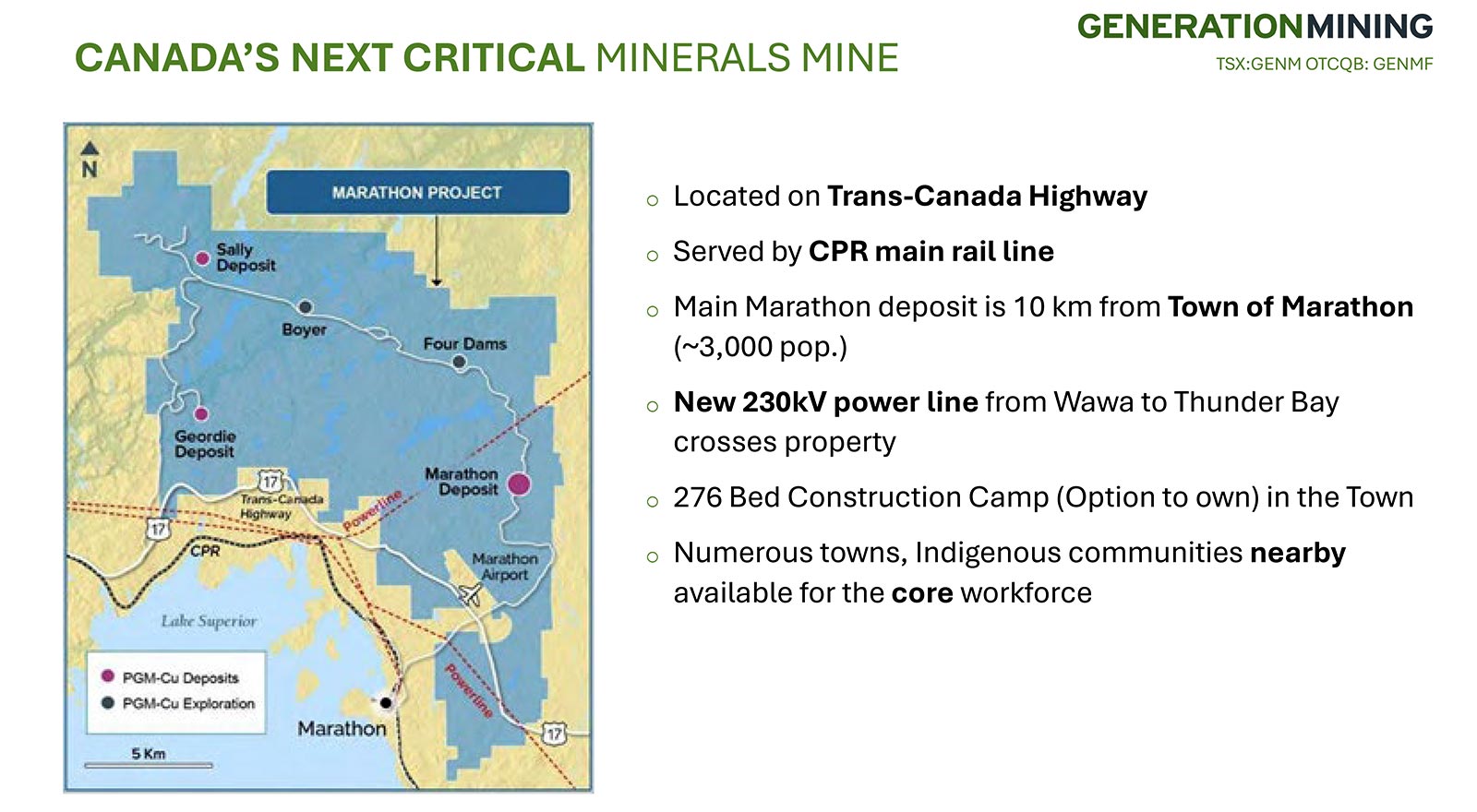
Few development-stage projects in North America check all the boxes like Generation Mining’s (TSX: GENM)(OTCQB: GENMF) flagship, 100%-owned Marathon Copper-Palladium Project in Ontario, Canada.
Located in a Tier-1 mining district with excellent infrastructure and strong community support, Marathon is a fully permitted, large-scale asset hosting a rare blend of copper, palladium, platinum, gold, and silver — the very metals powering both the clean-energy transition and modern industrial demand.
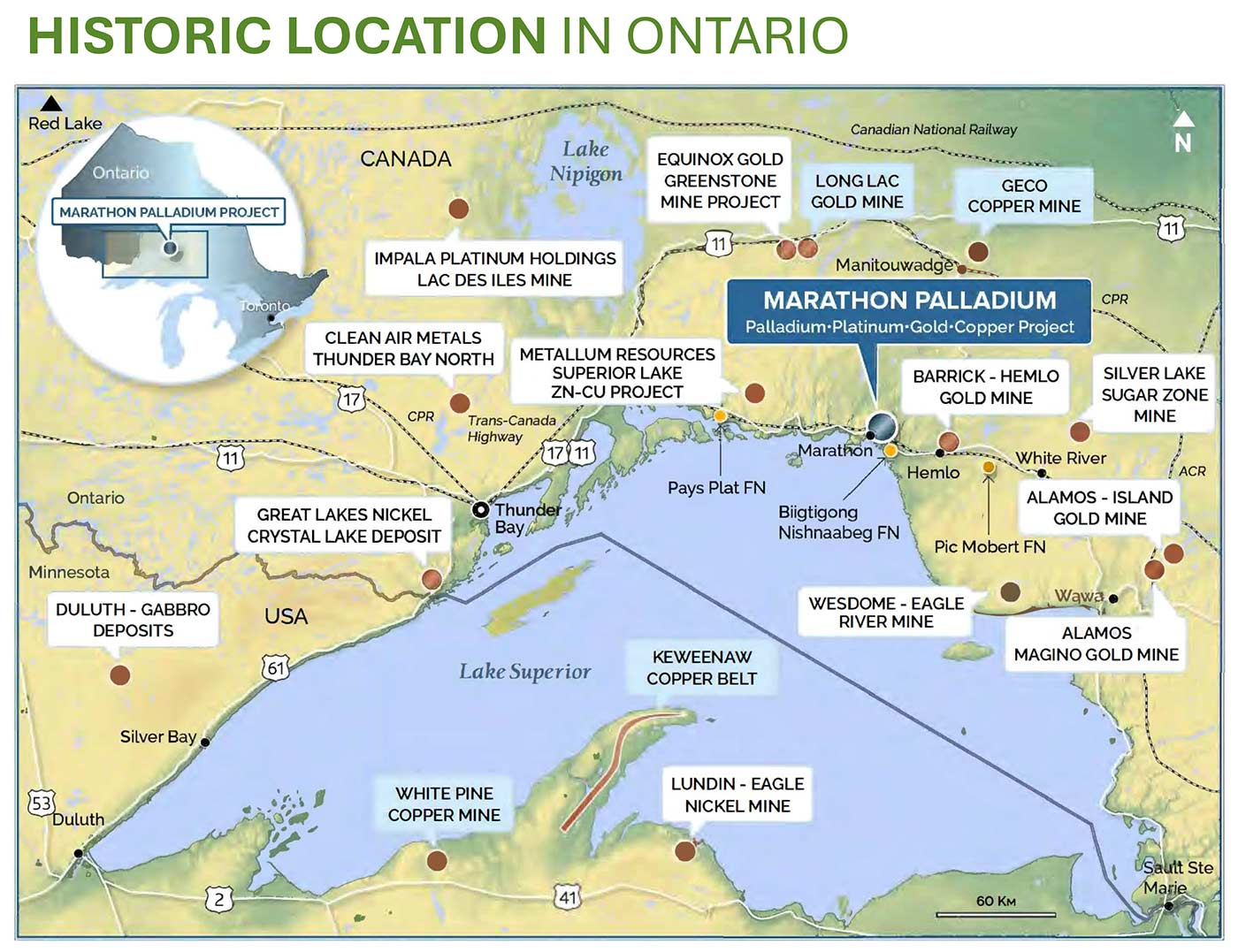
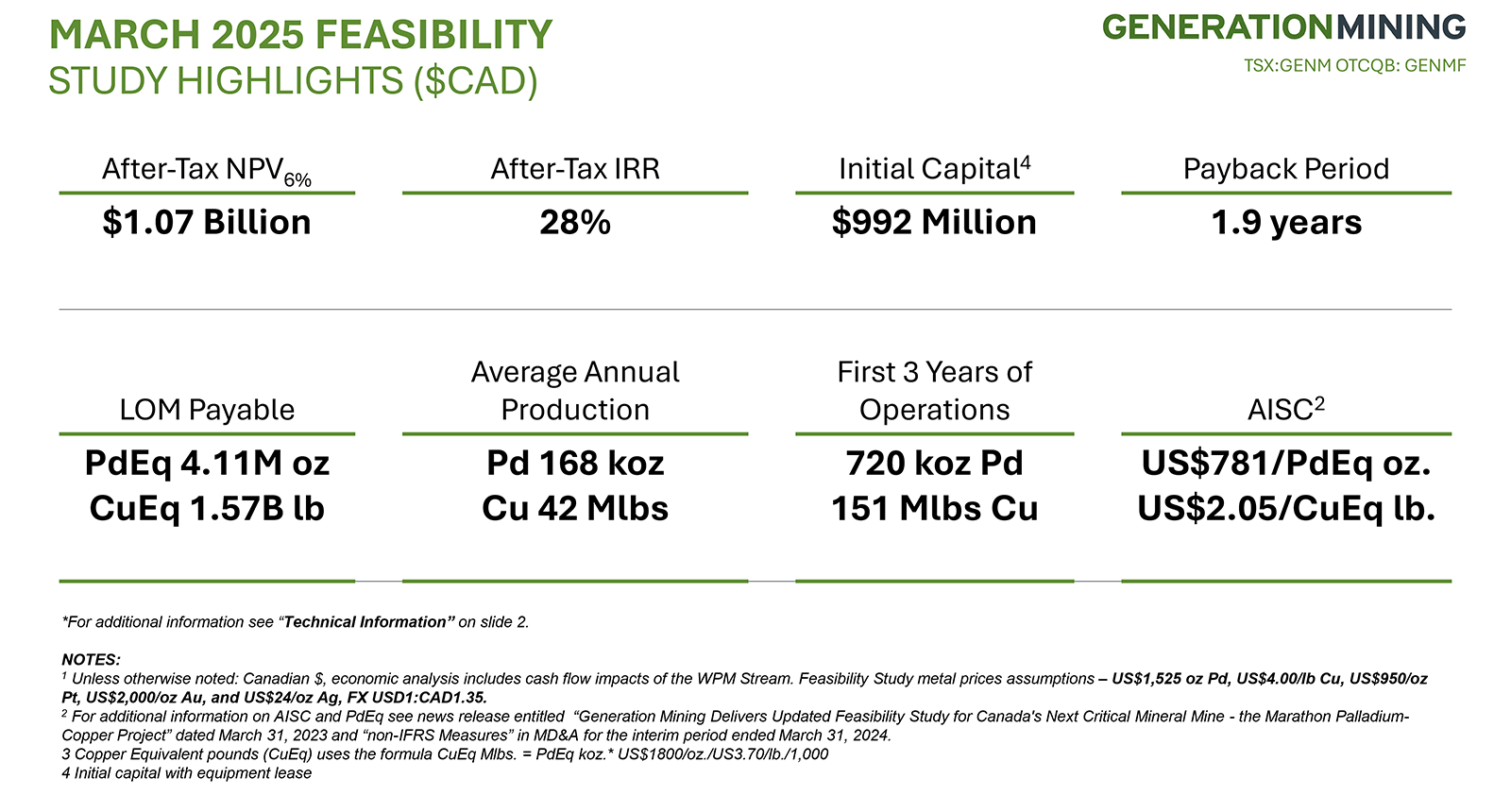
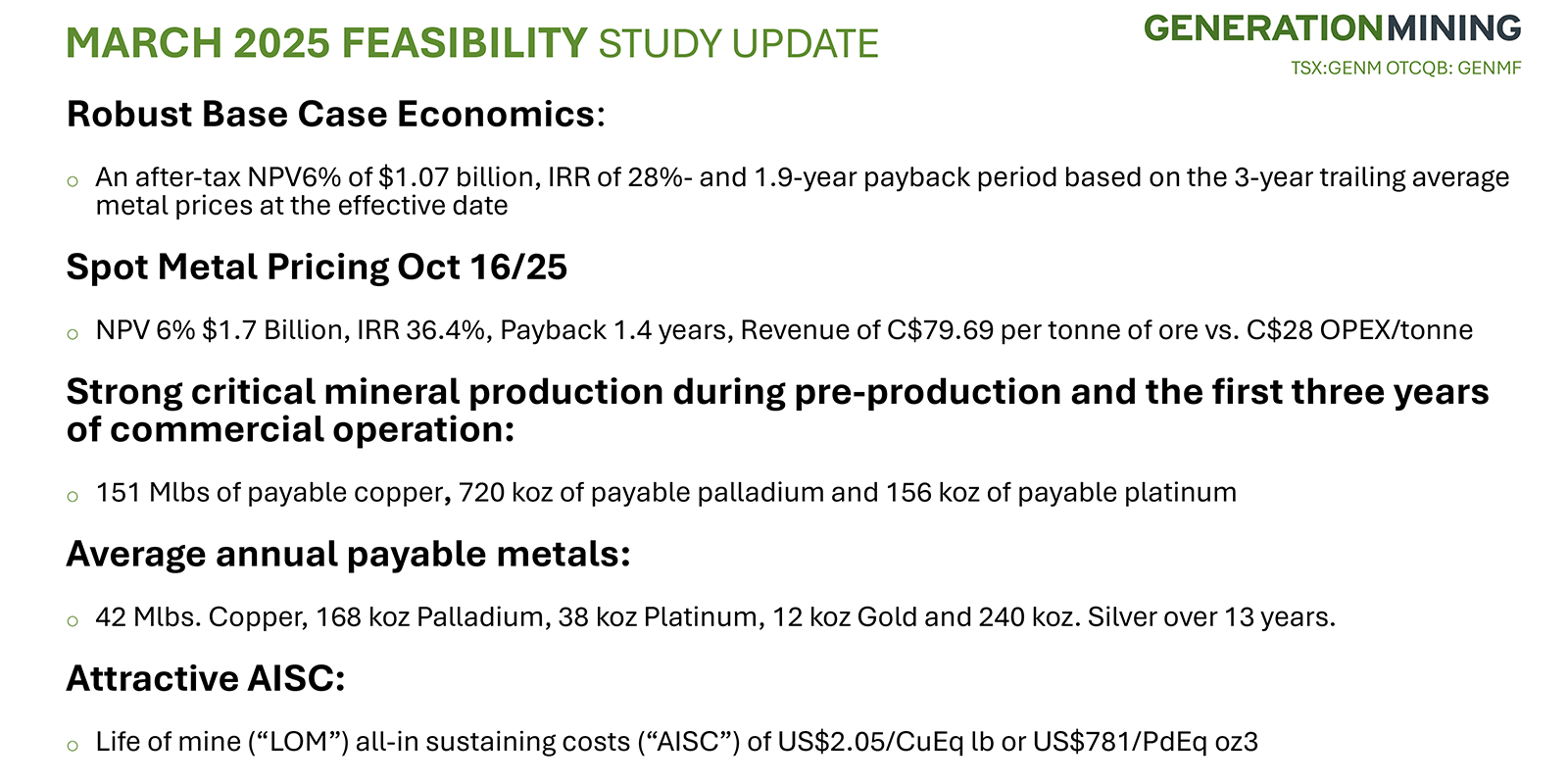
A March 2025 Feasibility Study update outlines robust economics:
- C$1.07 billion NPV (6%)
- 28% IRR
- 1.9-year payback
- 13-year mine life
Projected Production (Life of Mine):
- 532 million lbs copper
- 2.16 million oz palladium
- 488,000 oz platinum
- 160,000 oz gold
- 3 million oz silver
Fully permitted, construction-ready, and strategically located, Marathon stands out as one of the very few global-scale projects ready to advance into development.
The project sits adjacent to the Trans-Canada Highway with direct access to rail, port, and grid power — making it one of the most logistically advantaged undeveloped assets in North America.
And at a market capitalization below C$150 million, Generation Mining trades at less than one-eighth of Marathon’s C$1.07 billion NPV, underscoring a clear disconnect between intrinsic value and current valuation.
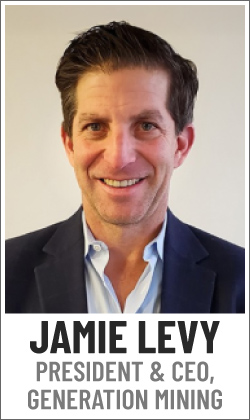
President & CEO Jamie Levy calls it,
“...a rare case where a project this large and this advanced still trades at a fraction of its intrinsic value.”
That disconnect is what makes the timing so compelling.
With copper, gold, and PGMs (platinum-group metals) all strengthening, the market is once again turning its attention to shovel-ready projects with near-term development potential… with Marathon checking every single box.
Next, we’ll look at how key partnerships with industry leaders Wheaton Precious Metals and Sibanye-Stillwater reinforce Marathon’s financial foundation and underscore its billion-dollar potential.
Strategic Backing: Wheaton & Sibanye
Global Partnerships Adding Capital, Credibility, and Confidence
Few things de-risk a development project like the support of global industry leaders… and Generation Mining has two of the best in the business.
Wheaton Precious Metals (NYSE: WPM) and Sibanye-Stillwater (NYSE: SBSW) — both multibillion-dollar, NYSE-listed mining powerhouses — have not only endorsed the Marathon project’s potential but have also helped lay the groundwork for its path to production.
Wheaton, one of the world’s largest precious-metals streaming companies, has been a steadfast partner since 2021 through a long-term streaming agreement covering a portion of Marathon’s gold and platinum output.
Under the agreement, Wheaton committed an upfront payment of US$240 million to GENM, including US$40 million already advanced and the remaining US$200 million payable upon construction.
That capital support — together with Wheaton’s technical oversight — provides Generation Mining with a solid foundation as it advances toward construction and long-term production.
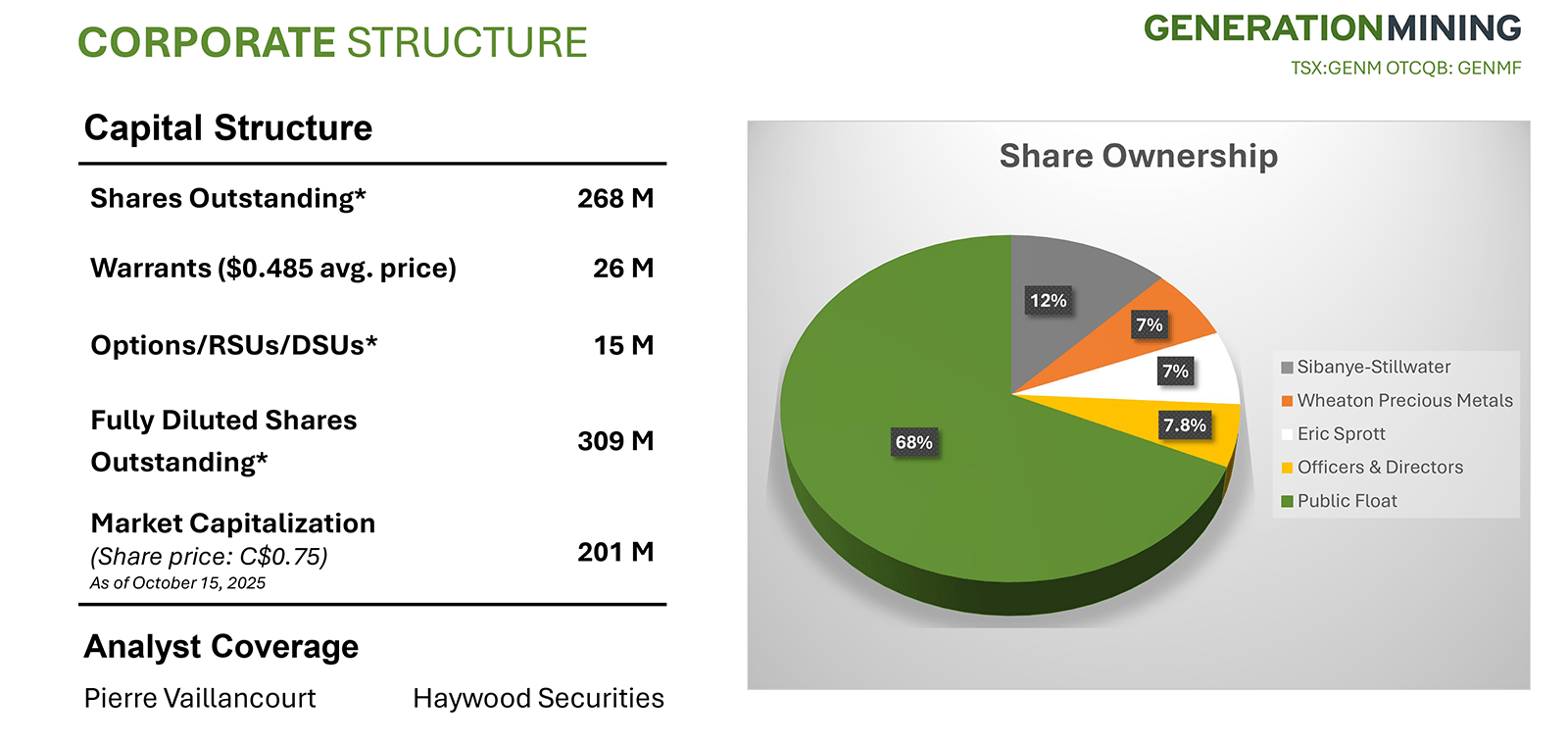
Meanwhile, Sibanye-Stillwater — an early project partner through its PGM expertise and investment — continues to back GENM with a roughly 12% equity stake in the company.
That continuing position underscores Sibanye’s confidence in both the asset and the team behind it.
Together, these relationships bring not only funding and technical depth but also global visibility — placing Generation Mining firmly on the radar of institutional investors, major producers, and leading global financiers alike.
As Chairman Kerry Knoll explains,
“When you have names like Wheaton and Sibanye involved, it signals to the market that the project has been scrutinized and stands up to world-class standards.”
In our upcoming exclusive interview, Kerry expands on how these relationships have de-risked and positioned Marathon for the exciting development phase ahead.
Next, we’ll take a closer look at the unique polymetallic mix that makes the Marathon project such a compelling, diversified critical metals play — and why its blend of copper, palladium, platinum, gold, and silver provides rare leverage across the 2025-26 commodities supercycle.
Right Metals Mix:
Copper, Palladium, Platinum, Gold & Silver
The Marathon Project isn’t built around a single metal — and that’s what makes it so compelling.
It’s a true polymetallic system anchored by copper and palladium and complemented by high-value co-products in platinum, gold, and silver — the very metals fueling both the clean-energy transition and the global industrial economy.
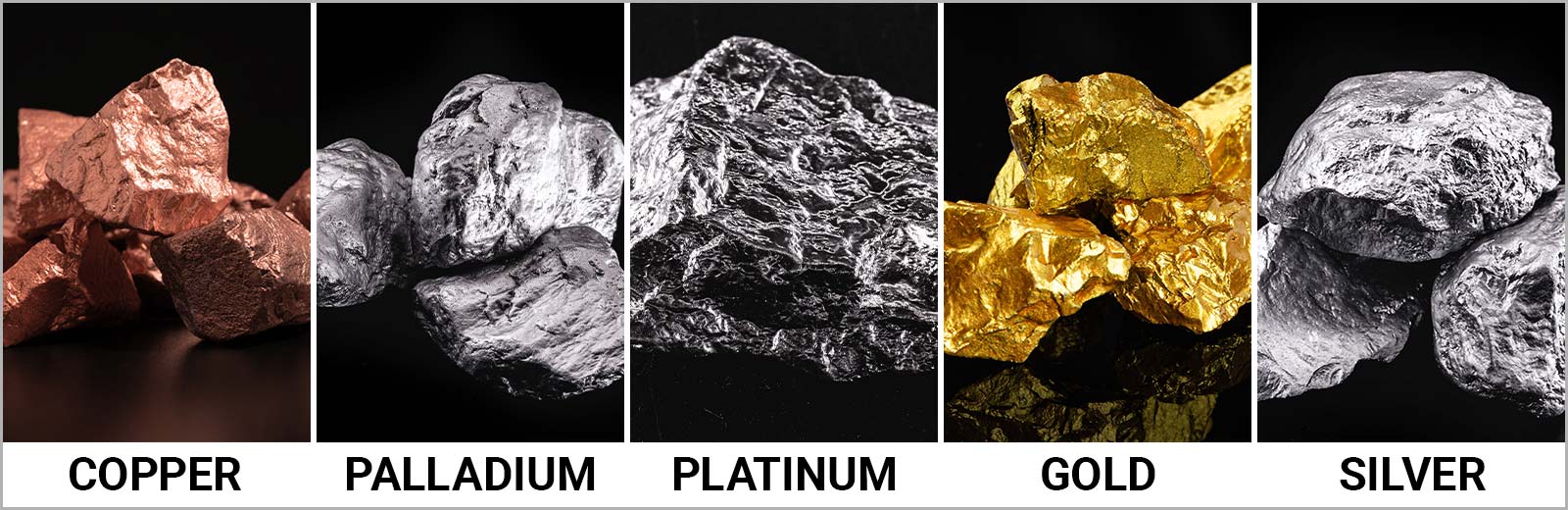
Together, palladium and platinum — collectively known as PGMs (platinum-group metals) — remain critical to the automotive, hydrogen, and fuel-cell sectors, ensuring cleaner energy conversion and reduced emissions.
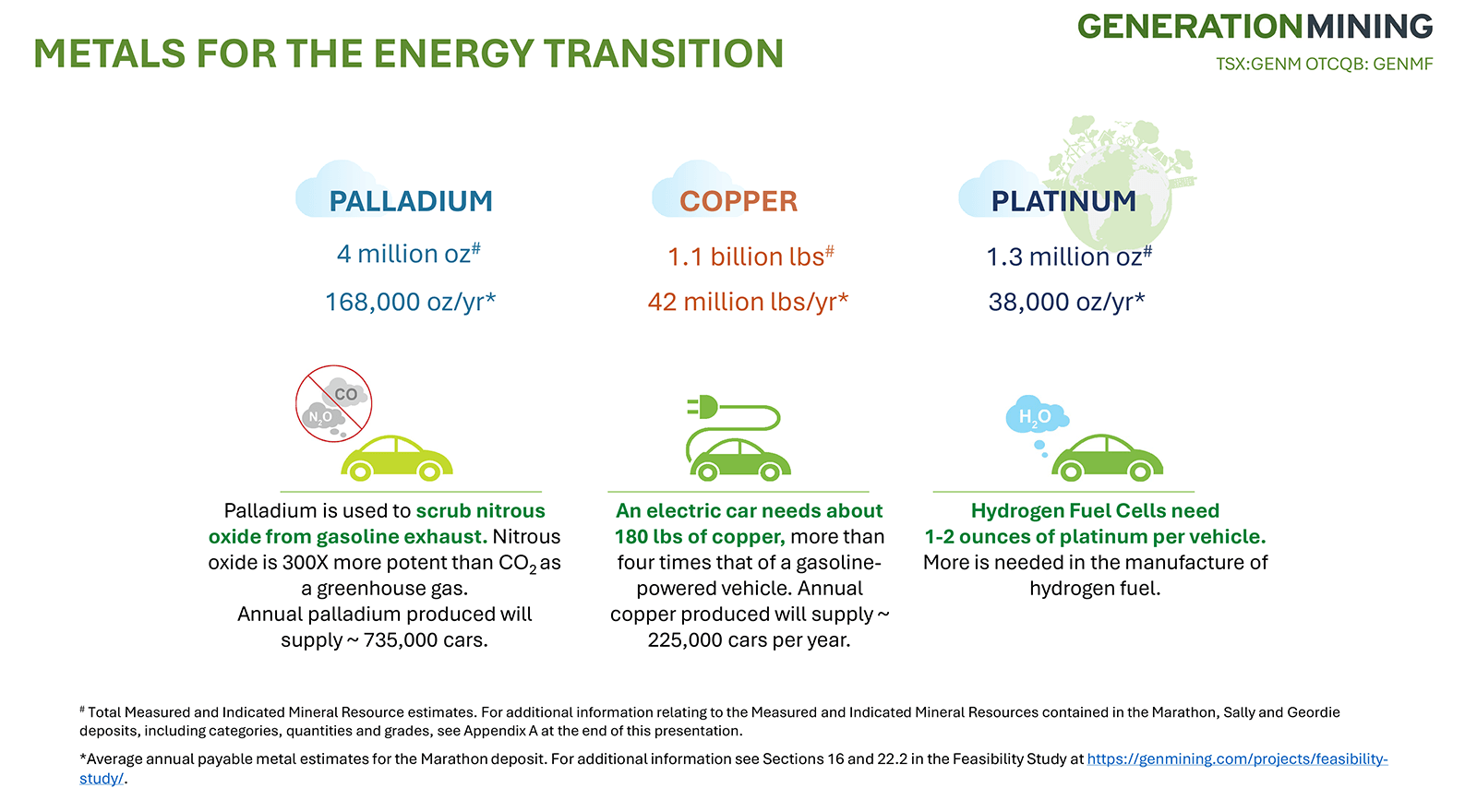
Global PGM markets are already in sustained deficit with platinum demand exceeding supply by roughly one million ounces annually and palladium inventories similarly tight.
Plus, above-ground stockpiles are being drawn down rapidly, underscoring how few new North American sources exist to fill the gap.
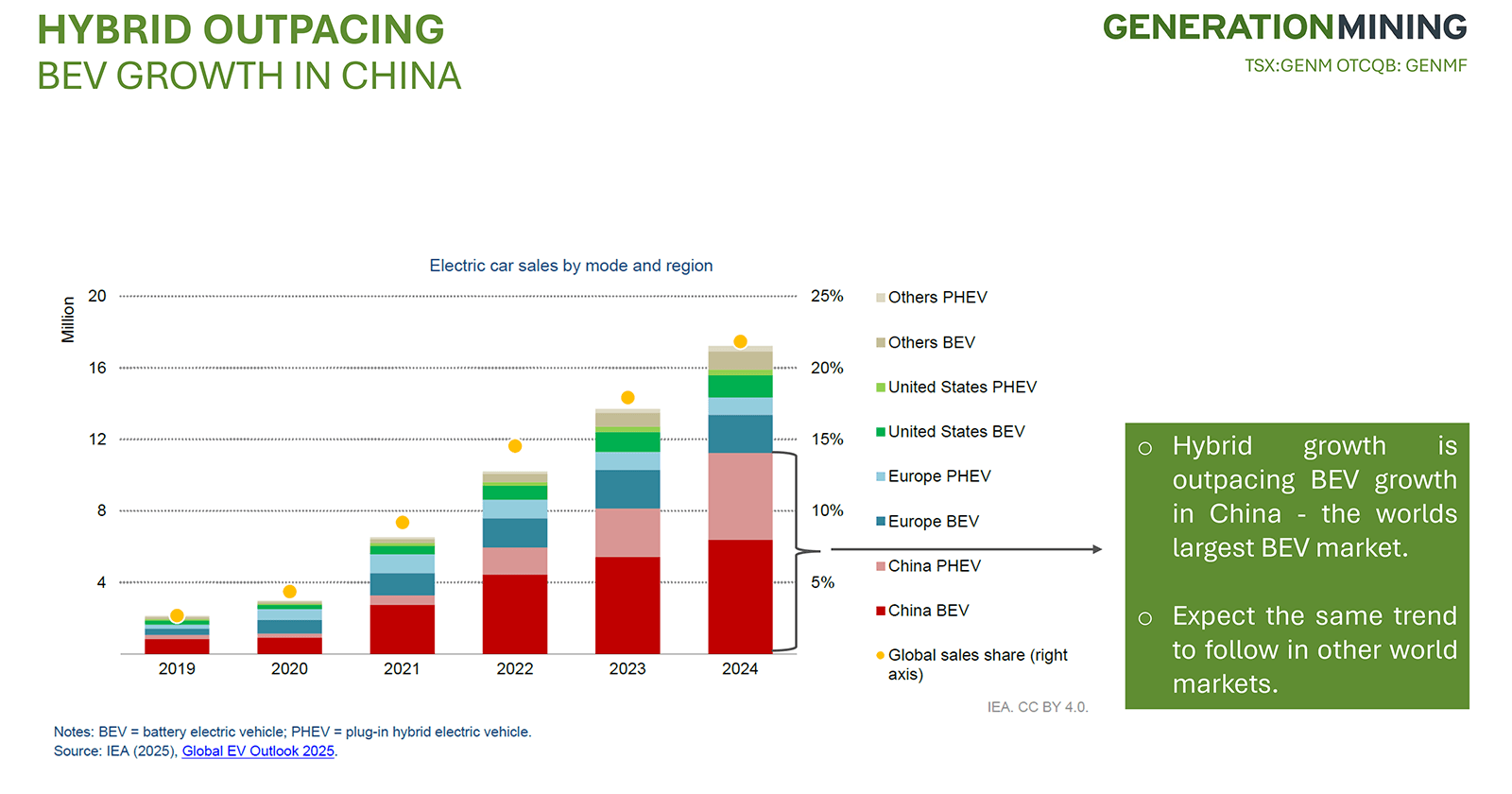
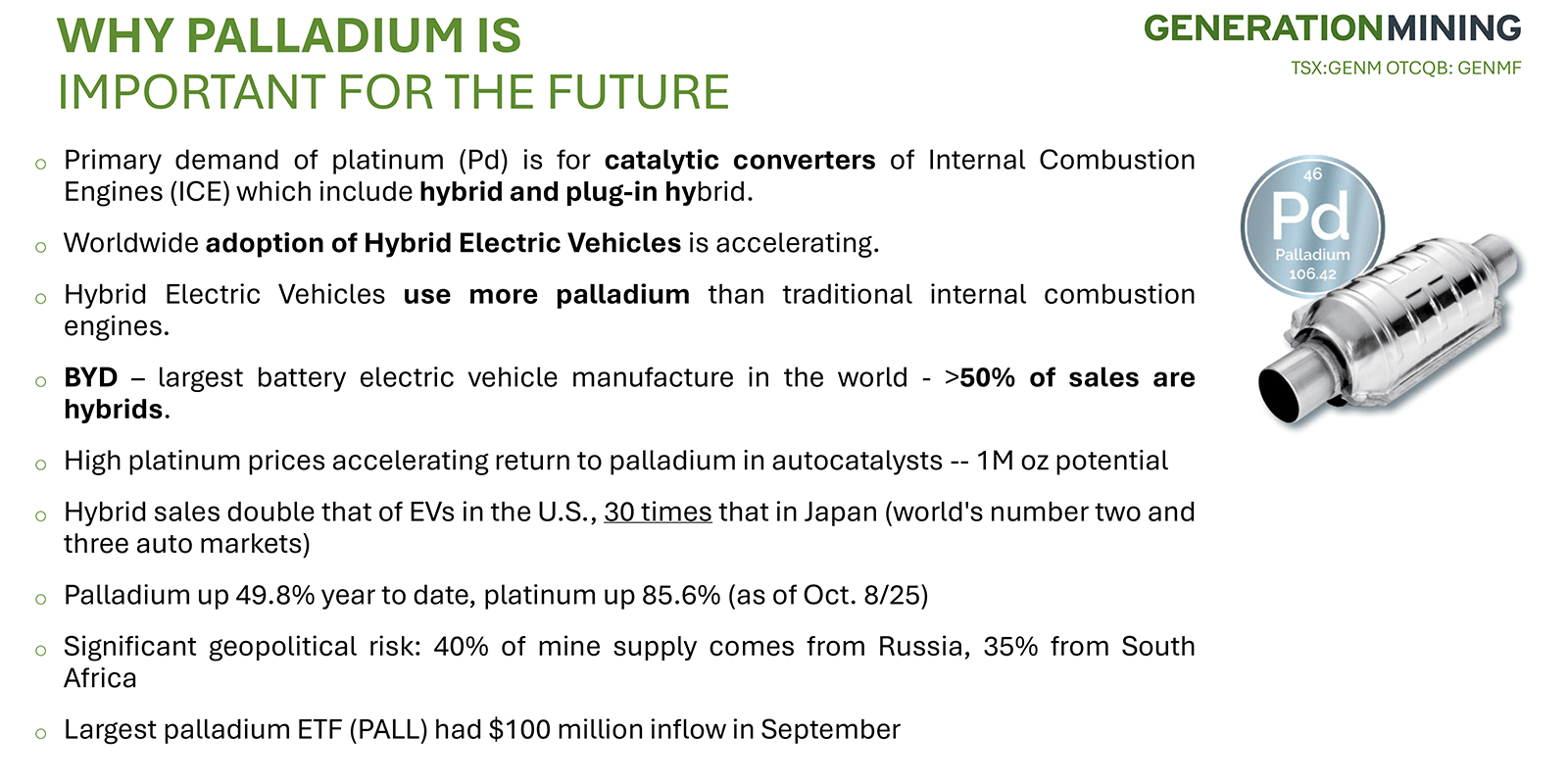
With automakers pivoting back toward hybrids and tightening emissions standards in China, Europe, and North America requiring higher PGM loadings, demand for platinum and palladium is surging again — particularly as hybrid production rises.
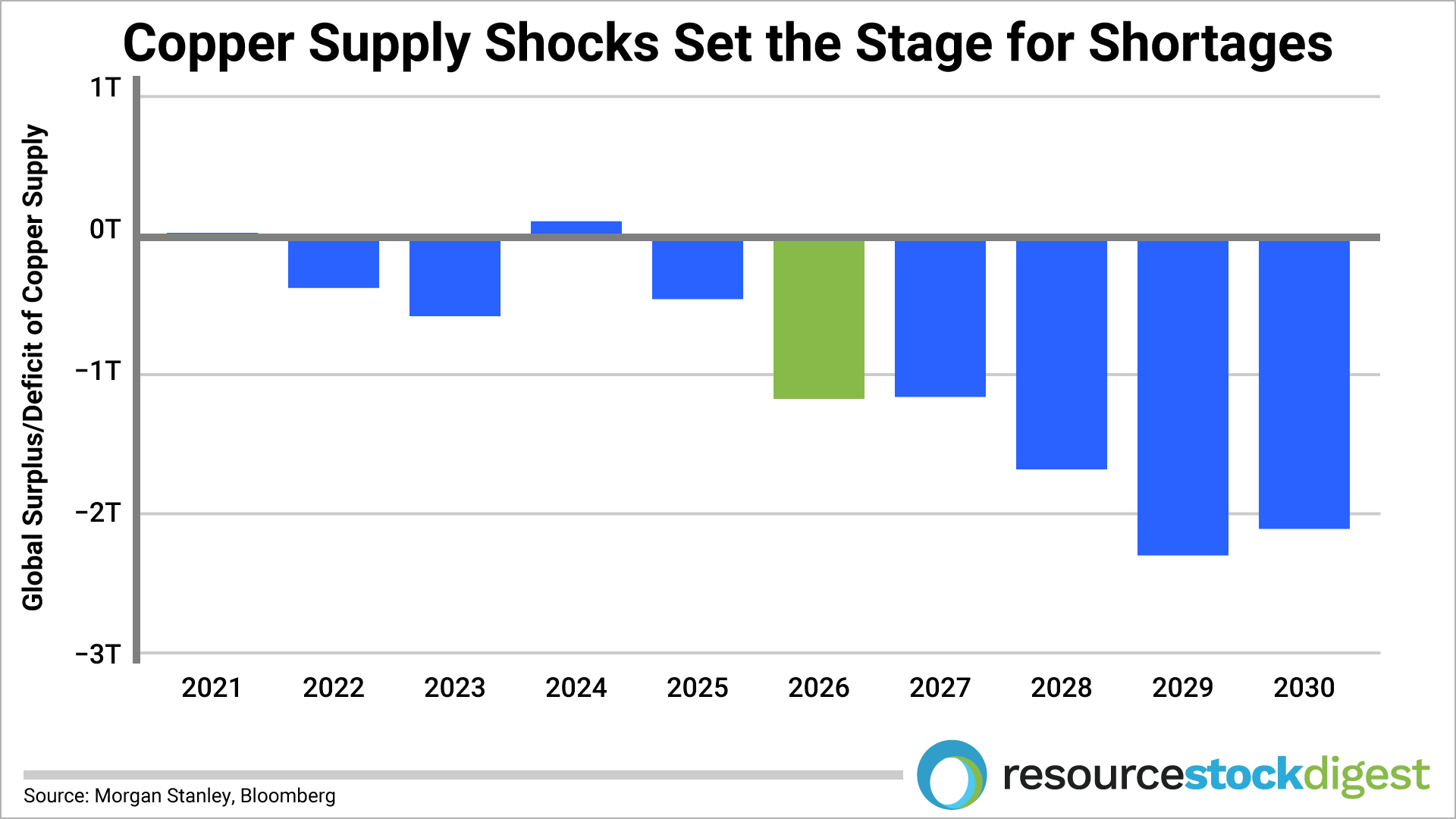
Meanwhile, copper just surged to a record US$11,200 per ton amid mine disruptions from Chile to Indonesia and a Morgan Stanley forecast calling for the most severe global deficit in more than two decades heading into 2026.
Against that favorable backdrop, here’s how Marathon stacks up across the metals landscape:
- Copper: Hitting record highs as global electrification accelerates.
- Gold: Hovering just below all-time highs amid record government debt and currency volatility.
- Silver: Tracking gold’s surge with renewed industrial and investor demand.
- Palladium & Platinum (PGMs): Rebounding strongly in 2025 as automotive, hydrogen, and hybrid markets recover.
Importantly, roughly 75% of global platinum and 40% of palladium supply comes from South Africa, with most of the remainder sourced from Russia — both regions facing structural and geopolitical headwinds.
That makes Marathon’s PGM supply exceptionally strategic as North America pushes to onshore critical metals production while reducing reliance on foreign adversaries.
Palladium — 30 times rarer than gold and historically priced higher per ounce — remains indispensable to emissions control, hydrogen technologies, and next-generation electronics, reinforcing its long-term strategic importance.
As President & CEO Jamie Levy explains,
“The metal mix makes Marathon uniquely positioned for both the clean-energy transition and the next leg of the precious-metals cycle.”
Those complementary strengths — industrial demand and monetary leverage — give Generation Mining a dual exposure that few developers can match.
The flagship Marathon Project is built to thrive across commodity cycles, benefiting equally from growth in green technology and strength in traditional safe-haven metals.
Chairman Kerry Knoll adds,
“Having copper and palladium at the core with strong gold and silver credits gives us resilience — and the kind of optionality most developers can only wish for.”
With near-record prices across multiple metals, Marathon’s diversified foundation gives Generation Mining extraordinary leverage to today’s broad-based metals bull market.
Next, we’ll look at how those strong fundamentals translate into robust project economics and why full permitting in a Tier-1 jurisdiction gives Generation Mining a clear path toward production.
Project Economics & Path to Development
With the Marathon Project fully permitted and shovel-ready, Generation Mining now stands at the threshold of construction — supported by strong project economics in one of the most favorable mining districts in the world.
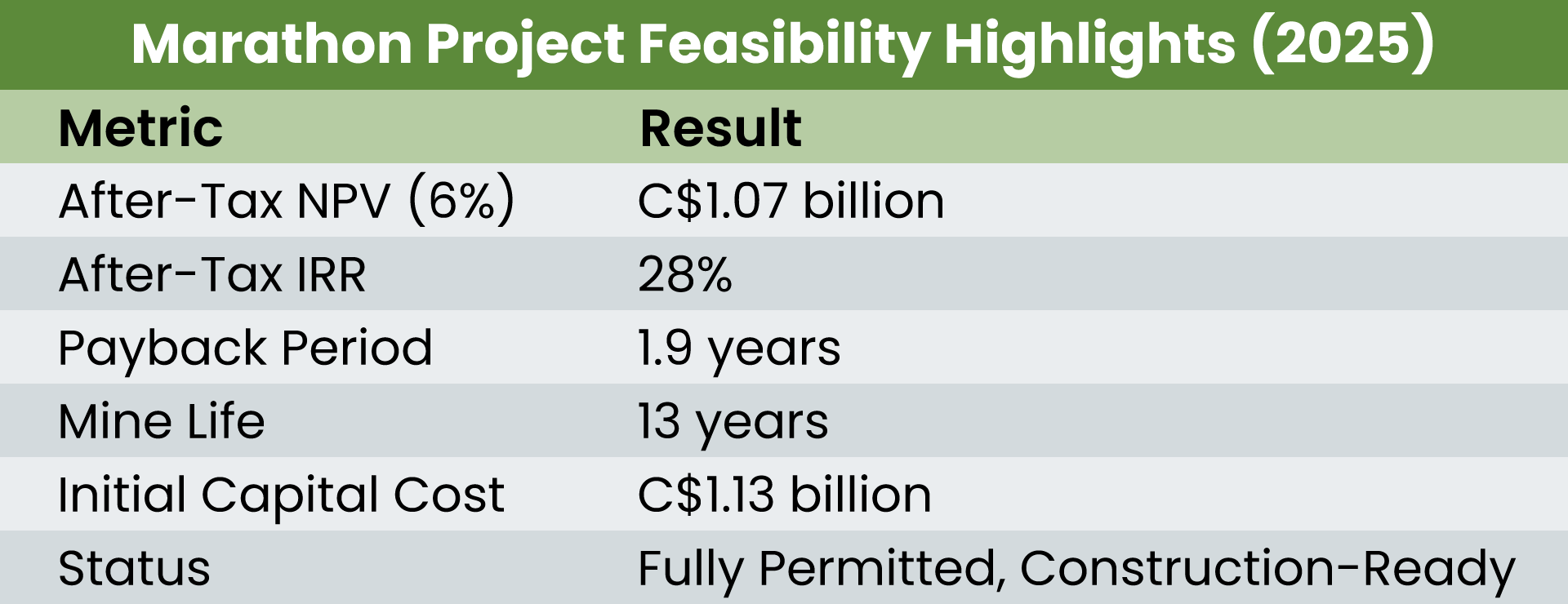
Importantly, these economics were modeled at commodity prices well below current market levels.
With copper, gold, and silver near record highs — and PGMs rebounding sharply — Marathon’s leverage to higher metals prices is unmistakable.
The project is designed as a large-scale open pit operation feeding a conventional mill for the production of both copper concentrate and a precious-metals-rich PGM concentrate.
With infrastructure already in place — including road, rail, port, and grid power access — Marathon ranks among the most advanced development-stage critical metals projects in Canada.
Equally important, full federal and provincial permitting is complete, giving Generation Mining a true first-mover advantage as North America faces tightening supply of critical minerals.
Building on a foundation of strong economics and Tier-1 permitting, the company continues to advance detailed engineering and project financing discussions to position Marathon for a potential construction decision.
In June 2025, Generation Mining completed a C$11.5 million bought-deal financing led by Stifel Nicolaus Canada Inc. and Haywood Securities Inc.
The financing — priced at C$0.37 per unit with attached warrants exercisable at C$0.48 — was oversubscribed, reflecting growing institutional interest in the Marathon Project as it advances toward a construction decision.
Proceeds are earmarked for project development and general working capital, further strengthening Generation Mining’s near-term positioning.
Importantly, this raise complements the existing US$240 million streaming agreement with Wheaton Precious Metals, of which US$200 million remains available upon a formal construction decision — a potential cornerstone of the project’s future financing strategy.
Together, these funding avenues provide a clear and credible pathway for Generation Mining to advance Marathon toward production.
As Chairman Kerry Knoll emphasizes,
“You can count on one hand the number of fully permitted, billion-dollar projects ready to build in Canada — and Marathon is one of them.”
At a market capitalization of less than C$150 million, Generation Mining trades at a mere fraction of its intrinsic value — especially when compared to major producers active in the same region, such as Newmont and Impala Canada.
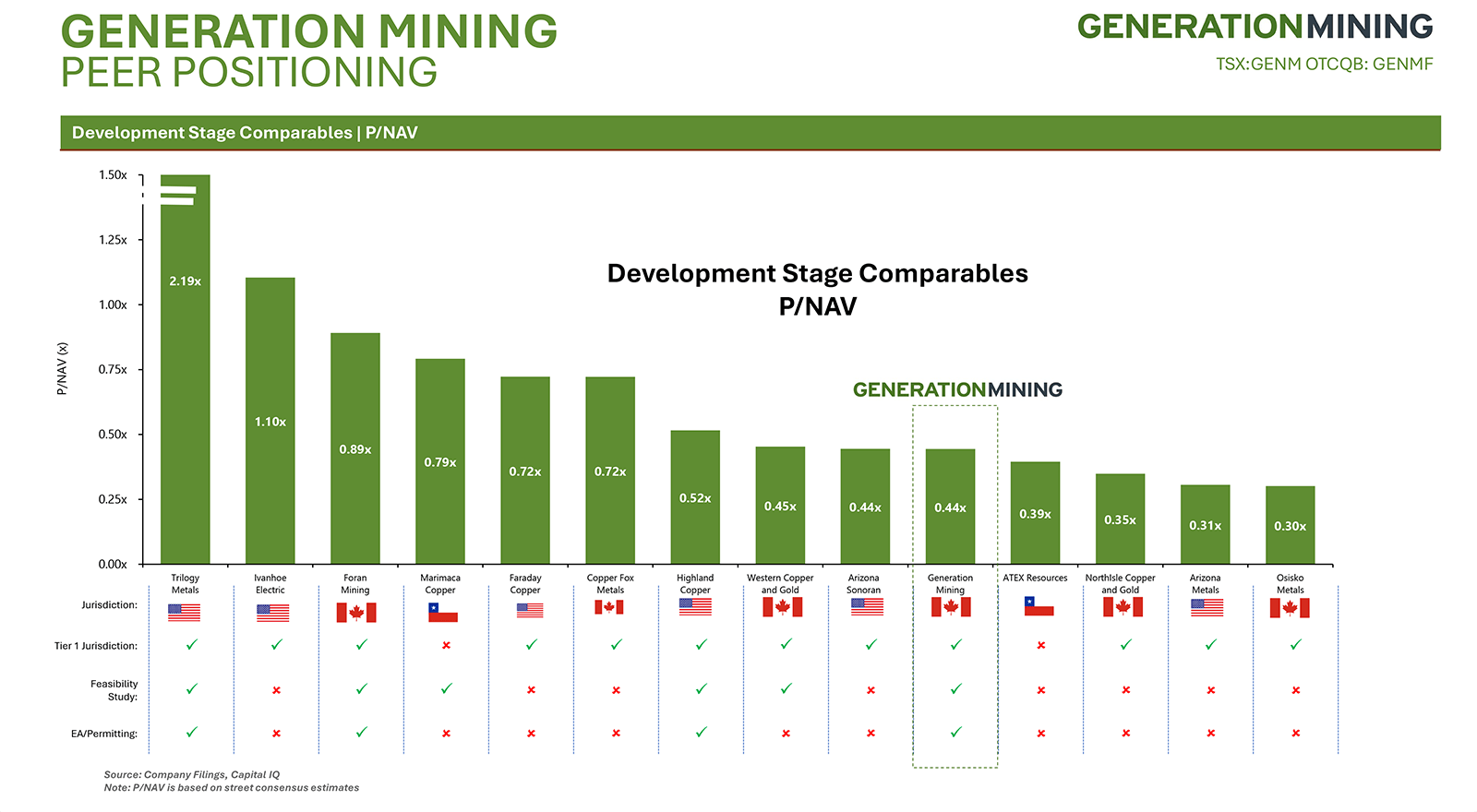
With strong economics, permitting complete, and unwavering support from both Wheaton and Sibanye, Generation Mining is built for production at precisely the right moment in the 2025-26 commodities supercycle.
Now, let’s turn to our exclusive interview with Chairman Kerry Knoll who shares his perspective on how Generation Mining is poised to capitalize on the moment at hand.
Exclusive Interview with Generation Mining
Chairman Mr. Kerry Knoll
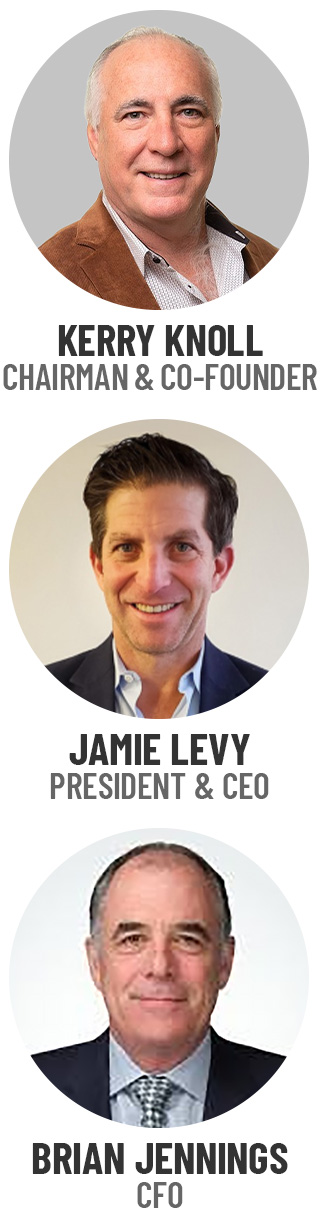
Generation Mining’s leadership team reads like a who’s who of mining professionals, blending grassroots discovery acumen with the operational and financial expertise needed to take Marathon from discovery to full-fledged producer status.
Chairman and co-founder Kerry Knoll brings more than four decades of industry experience, having founded multiple publicly traded mining companies. He spearheaded a US$700 million financing — one of the largest ever achieved by a Canadian junior — that successfully brought the Thompson Creek molybdenum mine in Idaho into production.
President & CEO Jamie Levy adds over 25 years of corporate development and capital markets experience, having previously led Pine Point Mining through its successful acquisition by Osisko Metals.
CFO Brian Jennings, a CPA with more than 30 years of experience, has guided numerous mining companies through feasibility, construction, and production — providing the financial discipline critical to advancing a project of Marathon’s scale.
Supported by a veteran technical and operations team spanning geology, metallurgy, and engineering, Generation Mining possesses the leadership and operational expertise to advance Marathon from developer to producer.
Now, let’s turn to Chairman Kerry Knoll whose insights reveal how Generation Mining is poised to capitalize on the next leg of the critical metals bull market to the benefit of stakeholders. Please enjoy!

Gerardo Del Real: This is Gerardo Del Real with Resource Stock Digest. Joining me today is cofounder and chairman of Generation Mining (TSX: GENM)(OTCQB: GENMF) — Mr. Kerry Knoll. How are you today, sir?

Kerry Knoll: I’m doing great, Gerardo. How are you?
Gerardo Del Real: I am fantastic. Look, the last two years have really accelerated the premiums and the demand for critical metals projects in top-tier jurisdictions that benefit from government support and infrastructure. There are not a lot of those, and you happen to be sitting on one.
And so I think a good place to start is what you've been doing the last couple of years and how you've been able to position the Marathon Project to benefit from all of those boxes Generation Mining checked off years ago when advancing the exploration side of Marathon.
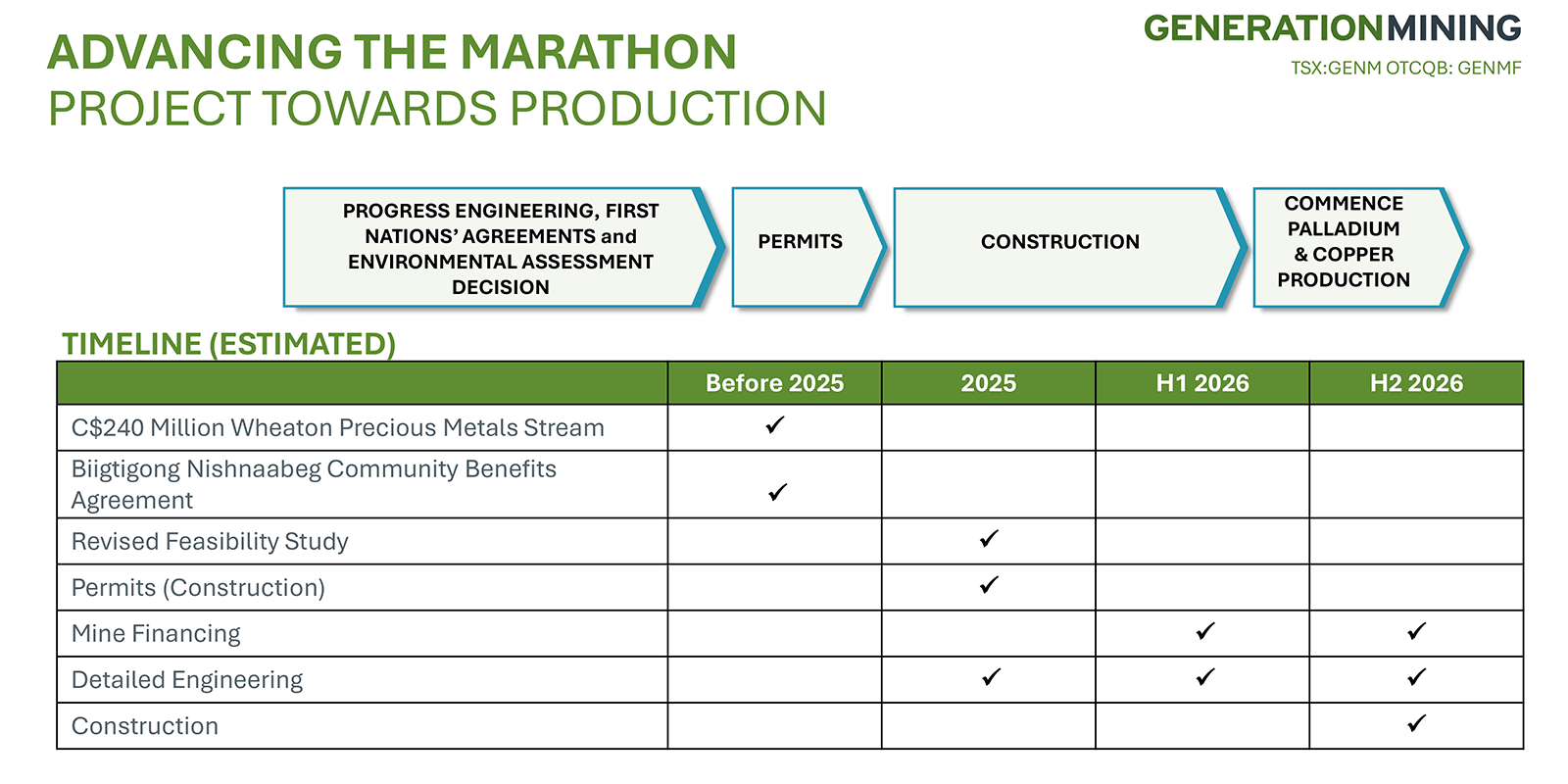
Kerry Knoll: Yes, the last couple of years, we’ve been focused on a couple of things, mainly permitting. And the permitting, unfortunately, took longer than we had hoped and planned. And as that time dragged on, the 2023 Feasibility Study needed to be updated. We completed that update in March of 2025. And then, in May, we received our final permits to construct the mine.
To my knowledge, that makes us the only unconstructed critical minerals mine that's fully permitted in Canada. And when I say critical minerals, there are two main minerals we're producing.
The first one is palladium. And fortunately for us, palladium is one of the top-performing commodities this year. It's up about 30% since January and well within the range of what we need to have a profitable mine.
The other half of our main mineral stream in our mine is copper. And, of course, copper is all over the news these days. The federal government announced that, of their five big initiatives across the country, two of them will be to help financially support copper mines.
They haven’t announced ours but we’ve been in deep discussions with them now for almost two years about that very thing, and we expect them to be a big part of the eventual financing of our mine. We haven't finalized the terms yet but we're working on that and they are very receptive.
Gerardo Del Real: The March Feasibility Study update shows a project boasting an after-tax NPV of just over C$1 billion. And here you sit with a market cap of only around 12% of that.
And so the question is how do you take a company with a market cap of roughly C$150 million and get the funding to construct what clearly is a very feasible project that’s in-demand, and, I believe, going to continue to attract even more demand?
Kerry Knoll: That's a very good question, Gerardo. And in my own background of mine building over the years, I’ve raised that much money before for a company that we founded about 20 years ago called Blue Pearl Mining.
We raised US$700 million in 2006, which, at the time, was the largest raise, I believe, in the history of junior mining in Canada. So I’ve done it with a company that had around C$100 million in market capitalization at that time.
Gerardo Del Real: And here we go again!
Kerry Knoll: Absolutely, we have parallels here.
And I believe one of the reasons for our current low market capitalization is the palladium component. I believe the market had pretty much written off palladium. When the PGM went from US$2,000 down to US$900 an ounce, everyone said, ‘Well, electric cars are taking over. We're not going to need palladium any longer.’ But the truth is, electric cars are not taking over. They’re a big factor… but they're not taking over.
What is taking over, though, is hybrids. And hybrids are outselling electric cars more than two-to-one, and they require more palladium than a regular internal combustion engine car — up to 20% more in some cases.
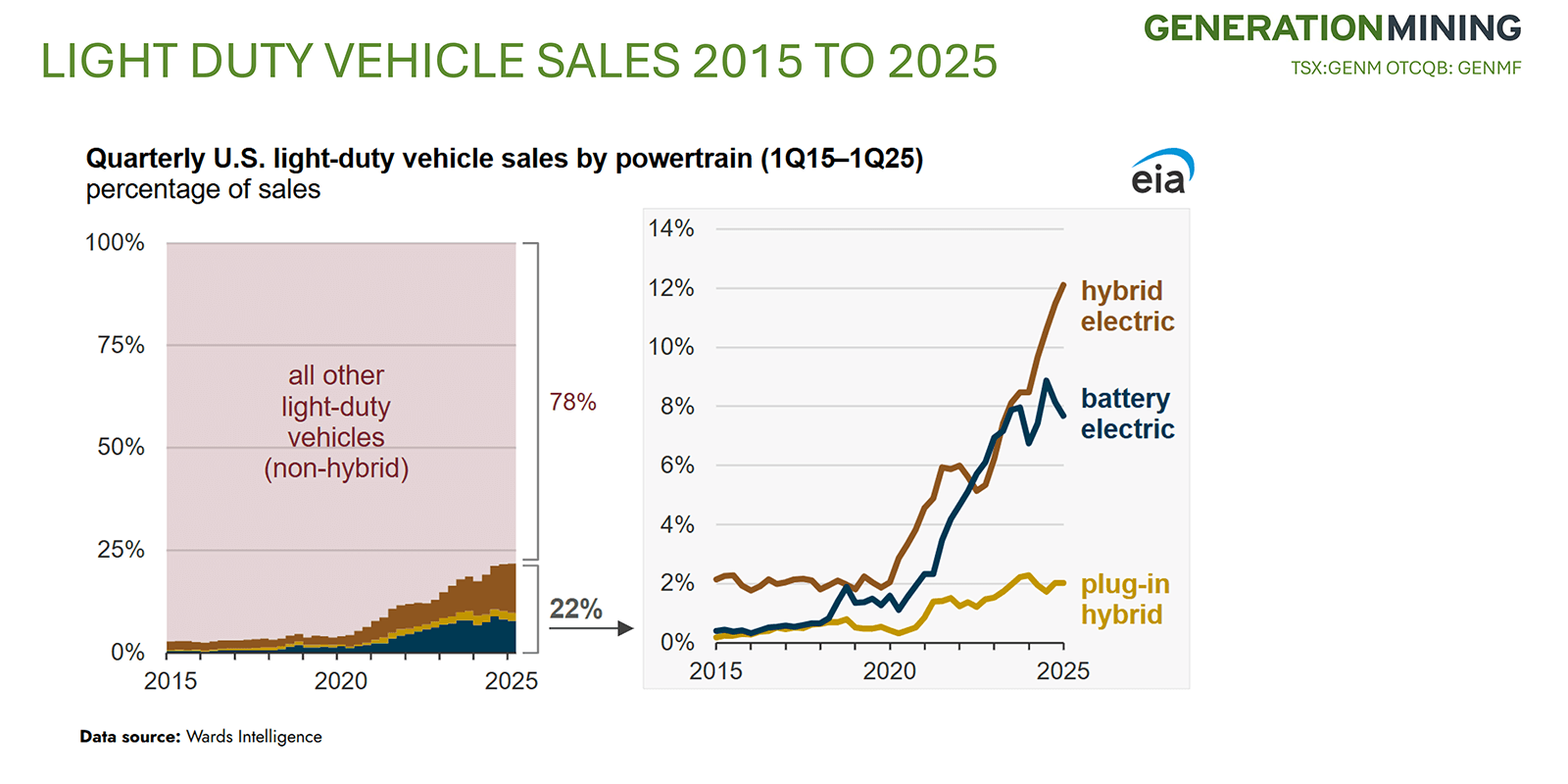
Now, that won't entirely mitigate the issue with electric cars but it will cut into it in a big way. That’s one of the reasons why you're seeing palladium come back. As EV mandates fall worldwide, you’re no longer hearing people say, ‘By 2035, everything will be electric.’ That ship has sailed.
The other thing, of course, is the amount of money we need to raise. And people are very skeptical. So let me talk about that. A couple of years ago, we received a mandate letter from a syndicate of banks — including SocGen and ING; two banks that lend heavily to mining construction around the world — for US$400 million, or around C$540 million, of the C$1 billion CapEx that we need.
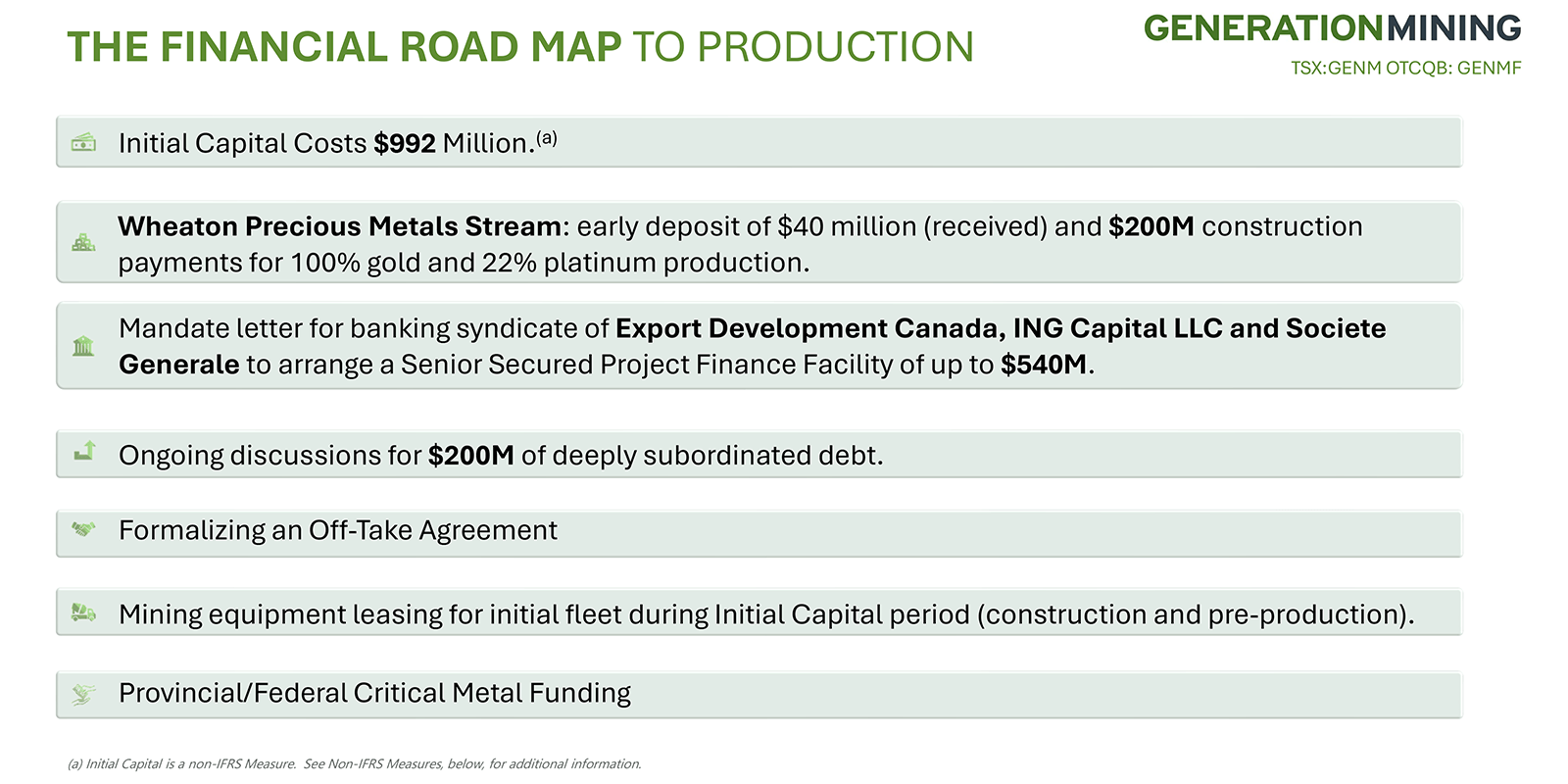
We’ve announced and have started taking some money on our US$240 million streaming deal with Wheaton Precious Metals. We've taken US$40 million so we have US$200 million more to bring in to add to that. And, of course, there's up to US$100 million in the leasing of equipment that we can get to knock off of that CapEx number as well.
So now, we're up to north of US$700 million, and that's where the government is going to come in. We're talking large amounts of money. They want to see us get credit approval from the banks before we go any further with them… and I don't blame them.
They rely on independent banks to do a lot of the due diligence that’s necessary so that they don't have to make a decision that’s political in nature. They want to see real hard due diligence being done. And we've had that due diligence going on.
Consultants from that syndicate of banks, which we reengaged with over the summer, completed their site visit to Marathon in late August. And so that process is ongoing and, with a bit of luck, I believe we’ll have that credit approval before the end of the year. So everything is moving along.
That being said, we're probably going to have to do an equity raise at some point. We're also badgering the province. The province did a shout-out to the federal government saying, ‘Hey, you guys need to help out these critical mineral mines in Ontario,’ and listed five of them, including ours.
And ours is the only one that's permitted.
They indicated that, if the federal government does help, they're going to help also. So there could be another source of funds there. And we're not talking about grants; we're talking about low-interest loans, some kind of creative equity, that sort of thing.
There are a lot of different possibilities on the table that we’re negotiating. Jamie Levy, our president, and Brian Jennings, our CFO, have been hard at work on that. And it’s going to be an ongoing thing because it's a great deal of money, and it's going to take some time and some paperwork and some lawyering and some accounting — but I'm pretty confident we can pull it all off.
And this critical minerals push we're all hearing about is real. Copper worldwide is going to hit the wall. Canada does produce a bunch of copper. But if we want to continue our manufacturing base, and start making more products ourselves in Canada, with these tariffs on copper wire, for example — we're going to need the copper.
And we don't want to have to rely on China. The US isn’t going to export any copper. There aren't too many places to import copper from. I mean, we can get some out of Africa but the Chinese seem to have tied that up. So having a local source is really key.
We also need a local source of palladium because every internal combustion engine and hybrid vehicle built in Canada needs palladium. And the only palladium mine in Canada is closing… so we're going to be importing palladium again.
And so I believe it would do well for our government to support another source of domestically produced palladium, and they've said that they agree with that.
Gerardo Del Real: Yes, and look, your market cap, again, is around C$150 million. I love introducing, and in this case, reintroducing stories to our audience that allows for their own due diligence and an opportunity to make a lot of money if they get it right.
To highlight that, at a current C$150 million market, I'm looking at your updated Feasibility Study, and your average production of just the copper alone is estimated to be roughly 42 million pounds per annum. And if you multiply that by five bucks per pound, you’d be looking at copper revenues alone that are twice your current market capitalization.
You mentioned between now and end-of-year wanting to see some of those funding commitments come to fruition. If that happens, I believe the rerate here is going to be substantial, and I also think 2026 is going to be a transformative year for Generation Mining. Anything to add to that, Kerry?
Kerry Knoll: Only that I agree with you, Gerardo. This is the time we're going to build the mine. We’re looking forward to it… and we’re looking forward to a rerating for our shareholders and for ourselves.
Gerardo Del Real: A lot of skin in the game with this team, folks. Kerry, thank you so much for your time. Let's do it again soon.
Kerry Knoll: Sounds good. Thank you, Gerardo.
The Generation Mining Opportunity
With permitting complete and a clear path toward financing and construction, Generation Mining (TSX: GENM)(OTCQB: GENMF) is ready to turn Marathon into Canada’s next billion-dollar critical metals mine.
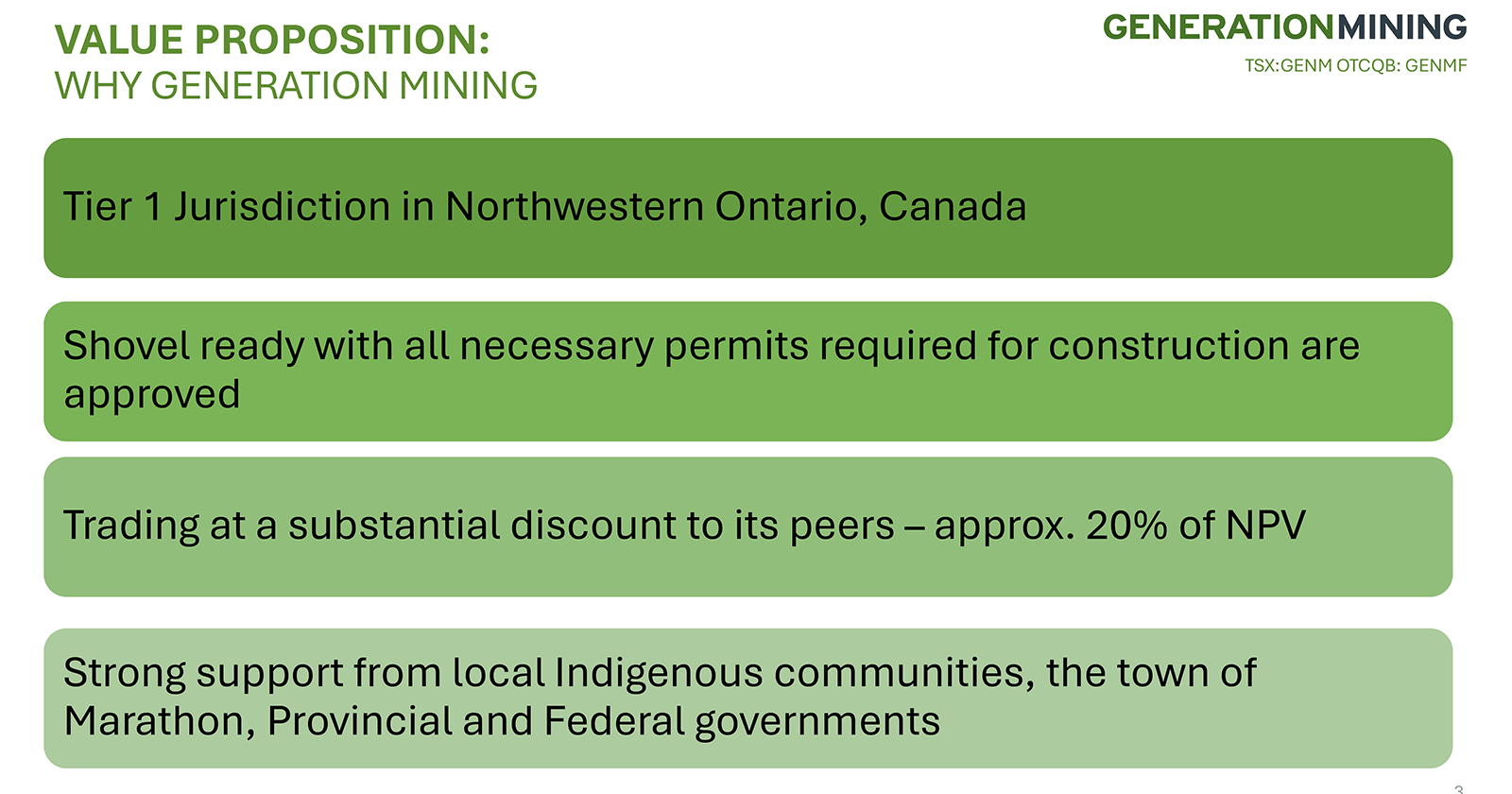
As Chairman Kerry Knoll points out in our exclusive interview, GENM isn’t just building a mine — it’s developing one of the only new domestic sources of a truly world-class metals mix of copper, palladium, platinum, gold, and silver — each critical to the modern economy.
And remember, at full production, the copper alone could be capable of generating revenues twice the company’s current valuation — all buoyed by the strategic backing of industry leaders Wheaton Precious Metals and Sibanye-Stillwater.
To reiterate, Wheaton’s US$240 million streaming agreement anchors Marathon’s project financing, while Sibanye’s 12% equity stake reinforces confidence in the project from one of the world’s top PGM producers.
That institutional confidence was reinforced earlier this year when GENM completed an oversubscribed C$11.5 million financing — a clear endorsement of Marathon’s path toward construction.
Now, consider the timing.
South Africa and Russia still control most global PGM supply. China dominates copper, lithium, and rare-metals markets, continuing to tighten its iron-clad grip.
In a world where Beijing can send shockwaves through global markets on little more than a whim, a premium is now clearly in play for North American metals production.
That’s what makes Marathon so important — and so deeply undervalued.
We’re talking about a fully permitted, construction-ready project with world-class backing and exposure to the key metals driving the global supercycle.
To top it off, Generation Mining is exceptionally well-structured with ~268 million shares outstanding (non-fully diluted) at a market capitalization of less than C$150 million — again, a mere fraction of its C$1.07 billion after-tax NPV.
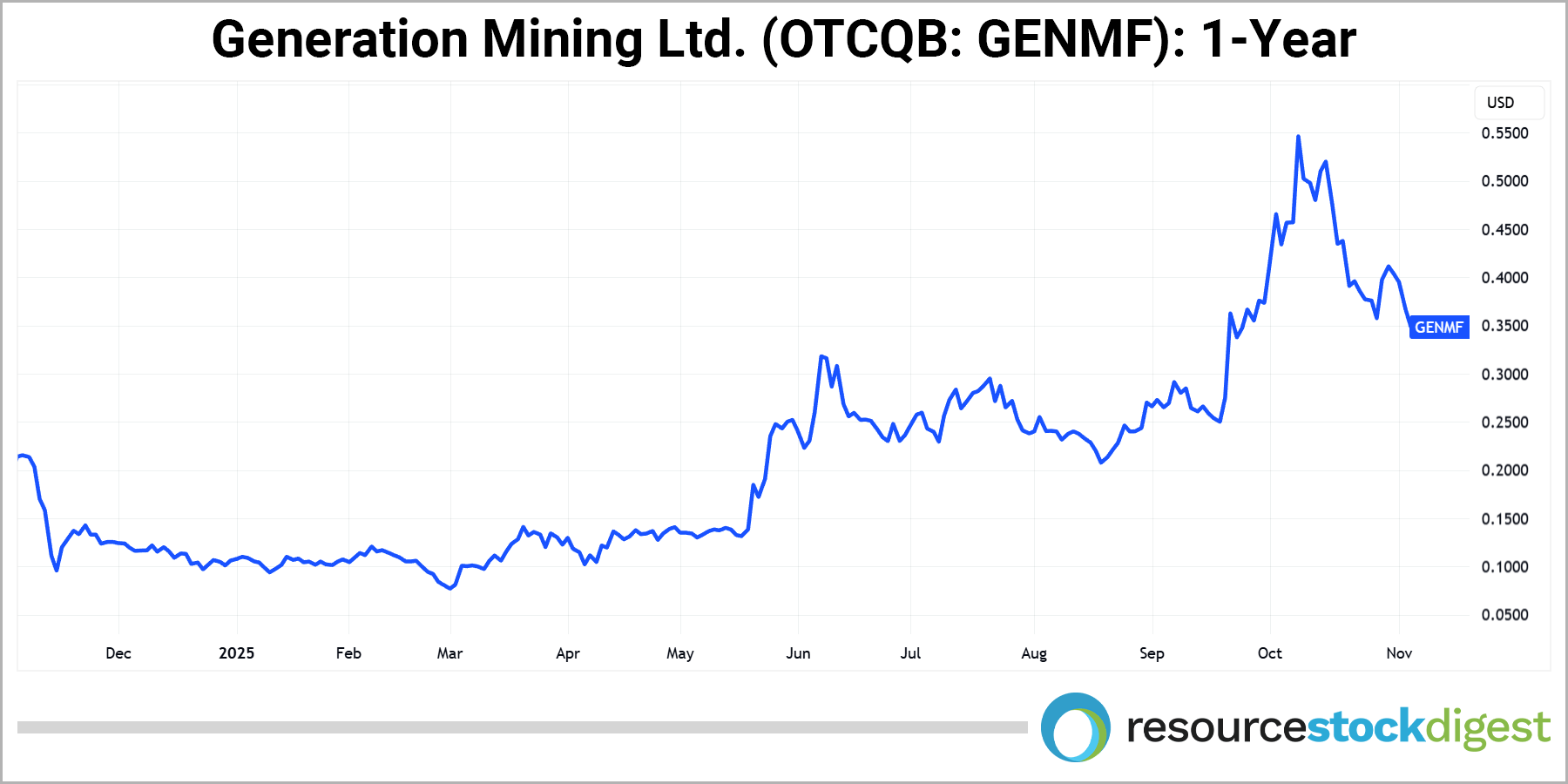
With copper, palladium, platinum, gold, and silver all strengthening as we close out a very tumultuous 2025, now is the perfect time to be taking a closer look at Generation Mining Ltd.
A great place to start is the company’s corporate website where you can explore the Marathon Project in detail, access the latest Corporate Presentation, meet the full team, and sign up for direct updates from the company.
Generation Mining Ltd. trades on the TSX under the symbol GENM and on the OTCQB under the symbol GENMF.
— Resource Stock Digest Research
Click here to see more from Generation MiningIMPORTANT DISCLAIMER & DISCLOSURES
Resource Stock Digest, as a publisher, is not a broker, investment advisor, or financial advisor in any jurisdiction.
Please do not rely on the information presented by Resource Stock Digest as personal investment advice.
If you need personal investment advice, kindly reach out to a qualified and registered broker, investment advisor, or financial advisor.
The communications from Resource Stock Digest should not form the basis of your investment decisions. Examples we provide regarding share price increases related to specific companies are based on randomly selected time periods and should not be taken as an indicator or predictor of future stock prices for those companies.
Generation Mining has sponsored this report.
The information in this newsletter does not constitute an offer to sell or a solicitation of an offer to buy any securities of a corporation or entity, including U.S. Traded Securities or U.S. Quoted Securities, in the United States or to U.S. Persons. Securities may not be offered or sold in the United States except in compliance with the registration requirements of the Securities Act and applicable U.S. state securities laws or pursuant to an exemption therefrom.
Any public offering of securities in the United States may only be made by means of a prospectus containing detailed information about the corporation or entity and its management as well as financial statements. No securities regulatory authority in the United States has either approved or disapproved of the contents of any newsletter. Neither Resource Stock Digest nor any employee of Resource Stock Digest is registered with the United States Securities and Exchange Commission (the “SEC”): as a “broker-dealer” under the Exchange Act, as an “investment adviser” under the Investment Advisers Act of 1940, or in any other capacity. Resource Stock Digest, its owners, directors, and employees are also not registered with any state securities commission or authority as a broker-dealer or investment advisor or in any other capacity.
HIGHLY BIASED:
In our role, we aim to highlight specific companies for your further investigation; however, these are not stock recommendations, nor do they constitute an offer or sale of the referenced securities. Resource Stock Digest has received cash compensation from Generation Mining and is thus extremely biased. It is crucial that you conduct your own research prior to investing. This includes reading the companies' SEDAR and SEC filings, press releases, and risk disclosures. The information contained in our profiles is based on data provided by the companies, extracted from SEDAR and SEC filings, company websites, and other publicly available sources.
Resource Stock Digest, and its owners, directors, employees, and members of their households may own shares of Generation Mining. Therefore, Resource Stock Digest is extremely biased. Measures are in place such that no shares will be sold during the active awareness campaign.
HIGH RISK:
The securities issued by the companies we feature should be seen as high risk; if you choose to invest, despite these warnings, you may lose your entire investment. You must be aware of the risks and be willing to accept them in order to invest in financial instruments, including stocks, options, and futures.
NOT PROFESSIONAL ADVICE:
By reading this, you agree to all of the following: You understand this to be an expression of opinions and NOT professional advice. You are solely responsible for the use of any content and hold Resource Stock Digest, and all partners, members, and affiliates harmless in any event or claim. While Resource Stock Digest strives to provide accurate and reliable information sourced from believed-to-be trustworthy sources, we cannot guarantee the accuracy or reliability of the information. The information provided reflects conditions as they are at the moment of writing and not at any future date. Resource Stock Digest is not obligated to update, correct, or revise the information post-publication.
FORWARD-LOOKING STATEMENTS:
Certain information presented may contain or be considered forward-looking statements. Such statements involve known and unknown risks, uncertainties, and other factors that may cause actual results or events to differ materially from those anticipated in these statements. There can be no assurance that any such statements will prove to be accurate, and readers should not place undue reliance on such information. Resource Stock Digest does not undertake any obligations to update the information presented or to ensure that such information remains current and accurate.