TSX-V: BYN | OTC: BYAGF
Advancing the 7 Million Ounce
AurMac Gold Project
in the New Yukon Gold Rush
Click Here to Read Sponsor Disclosure
Gold has been setting a series of all-time highs above US$2,400 an ounce as we head toward the second half of 2024. It’s all being driven by a positive shift in sentiment for the yellow metal as a powerful hedge against sticky inflation, long-term fiat currency debasement, and rising geopolitical uncertainty.
Investors are positioning for immediate and longer-term gains in the small-cap gold sector with a particular focus on companies with district-scale gold projects in favorable Tier-1 mining jurisdictions such as Canada, the United States, and Australia.
The small-cap gold company featured in this Special Report, Banyan Gold Corp. (TSX-V: BYN)(OTC: BYAGF), is advancing the flagship 7 million ounce AurMac gold project located in the Tier-1 mining jurisdiction of Canada’s Yukon Territory. The Banyan Gold team made the initial gold discovery at AurMac in 2019 and has since intelligently and systematically grown the Inferred resource to 7 Moz via the drill-bit.

Banyan Gold’s (“BYN”) AurMac project benefits from excellent infrastructure in place and is amenable to year-round drilling. The project is hosted within the Mayo Mining district — Canada’s newest and most rapidly growing precious metals district — nearby to multiple fully-permitted mines and large-scale deposits operated by mid-tiers and majors. With next-round drilling set to commence shortly, and with gold testing all-time highs, 2024 is setting up to be a very catalyst-rich and potentially transformative year for Banyan Gold and BYN / BYAGF shareholders.
2024 Gold Bull Market
Gold is continuing to test all-time highs in that US$2,400 per ounce range as sentiment has shifted strongly in favor of the yellow metal in the face of stubborn inflation and heightened geopolitical volatility.

In fact, in just the last several months, gold has rocketed from a year-to-date low of US$1,993 on 13 February to US$2,230 at the end of Q1 to currently above US$2,350 per ounce — a nearly 20% upward move from its February 2024 low.
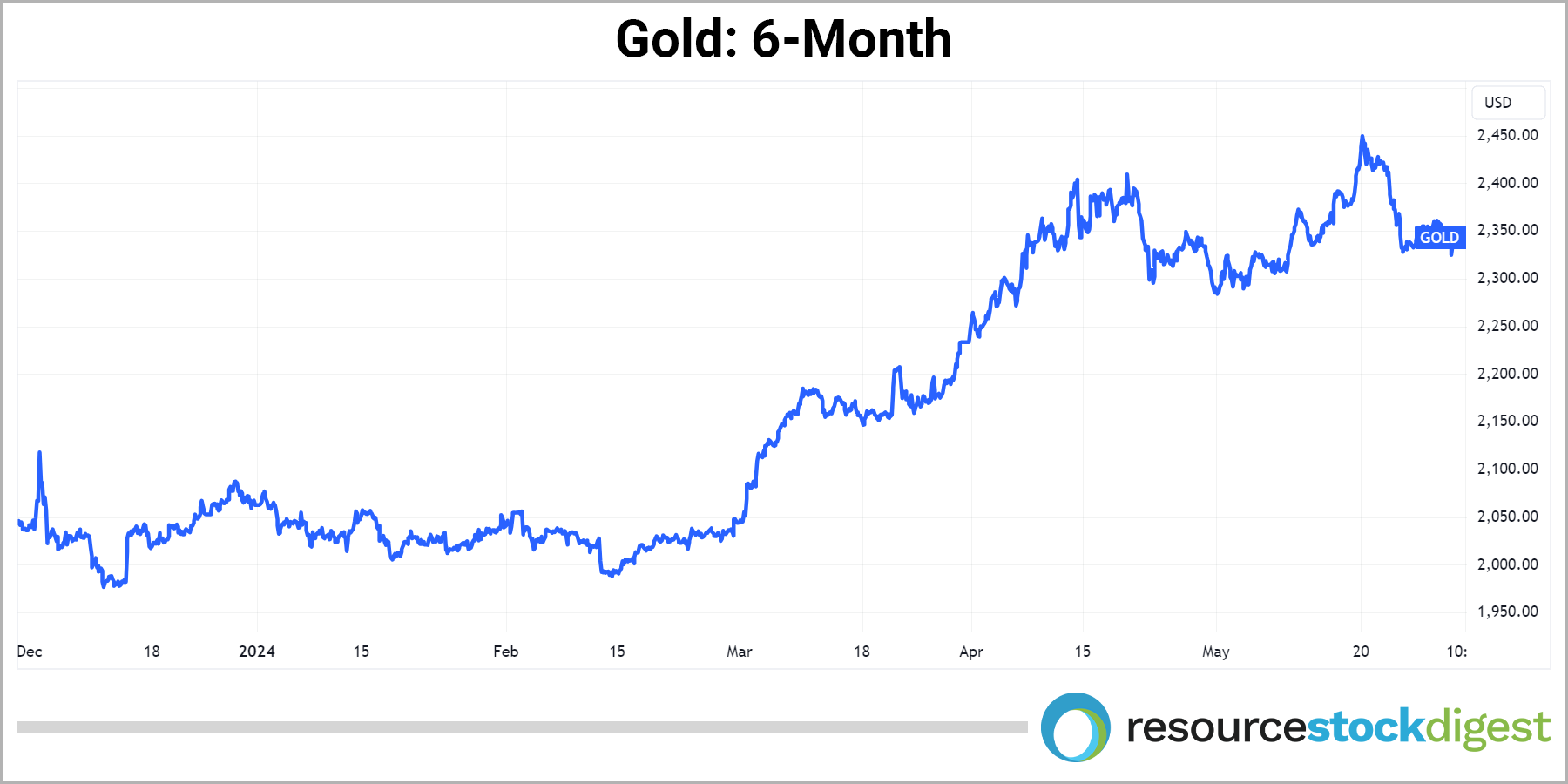
We believe a number of key fundamentals are firmly in play for gold to potentially trek even higher — potentially beyond US$3K per ounce — over the near to mid-term.
Among those key drivers is the high level of central bank gold buying we’ve been witnessing of late. In fact, over the last few quarters, central banks have been buying gold bullion at record levels — more than 3X the long-term average.

Factors influencing the stark increase in central bank gold buying include the pressing need to diversify reserves in light of potential sanctions and the risk of foreign exchange reserve seizures.
Looking at China alone, central bank gold purchases have been very strong, in fact, up 23% amid growing tensions with the United States coupled with a weakening Chinese economy.
Additionally, Chinese citizens bought over 600 tons of gold jewelry last year — a 10% increase from the prior year.
If you’ve been reading the headlines, then you know Russia has been buying gold hand-over-fist in an effort to fund its war machine in Ukraine amidst economic sanctions from the US, and others, targeting its energy sector. The country also recently pegged its currency, the ruble, to gold.
In terms of investor interest, we are finally beginning to see generalists return to the gold sector. For those who closely follow the precious metals space, this has been a long-time coming.
And by generalists, we’re referring mostly to Western investors who’ve all but shunned the yellow metal in favor of other non-traditional asset classes, including Bitcoin, for multiple years in a row now.
With pundits christening Bitcoin as the new “Digital Gold,” it seemed — until very recently that is — highly unlikely we’d get this level of Western-driven impetus in the gold price.
Yet, against most odds, and against virtually all talking heads, it does indeed look as though generalists are beginning to make their way back to the yellow metal.
There are a couple of clear signals that back up that premise.
One, open interest on COMEX has ratcheted higher in recent trading. And secondly, the GLD ETF (SPDR Gold Shares) has added to its holdings over the same timeframe. Those two factors combined represent the most illuminating proxy you can find for increased gold demand from Western coffers.
Another major tailwind forming in the gold space is an inevitable easing by the Fed. After suffering through one of the most oppressive rate hiking cycles in history, we look now to be heading into a cycle of rate cutting starting in the second half of 2024.
Of course, we don’t yet know the exact timing nor how aggressively the Fed will cut, especially with recent inflation and jobs numbers coming in a little hotter than expected. Yet, amidst that backdrop, Fed Chair Jerome Powell recently had this to say:
“We’re waiting to become more confident that inflation is moving sustainably at 2%. When we do get that confidence, and we’re not far from it, it’ll be appropriate to begin to dial back the level of restriction.”
Reading the tea leaves, it’s pretty clear that rate cuts are coming in 2H 2024 or in Q1 of next year at the very latest. And that brings us squarely back to the gold-US$3K question.
And while those tea leaves paint a slightly murkier picture, the current upward momentum in the gold price does feel different this time.
And thus, we can say with some degree of confidence that we’ll continue to see gold setting new all-time highs over the coming few quarters.
It’s worth bearing in mind, as well, that any spirited push toward US$3K and beyond will not come without a series of intermittent pullbacks. In essence, what we’ll be looking for is for the yellow metal to set a new higher floor, ideally above US$2,300 an ounce, from which to build off of.

Legendary resource financier, investor, and staunch gold proponent Rick Rule often says:
“The strongest bull markets don’t shoot straight up… they grind higher.”
We wholeheartedly agree.
And what it points to is that those intermittent pullbacks in the gold price should be looked at as a predictable and healthy component of a longer-term bull market for the world’s most sought after precious metal.
With all that being said, and with gold trading well above US$2,300 an ounce for the first time in history, an opportunity is arising for speculators seeking exposure to the yellow metal, particularly in the small-cap space.
Enter Banyan Gold Corp. (TSX-V: BYN)(OTC: BYAGF).
Banyan Gold: Flagship AurMac Gold Project

Led by president & CEO Ms. Tara Christie, M.Sc., P.Eng. — and whom you’ll be hearing from momentarily in our exclusive interview — Banyan Gold Corp. is advancing the flagship 7 Moz Au AurMac project in the Yukon’s Mayo Mining district — Canada’s newest and most rapidly growing gold-silver district.
Importantly, Banyan Gold made the initial discovery at AurMac back in 2019 (beginning with what is now the 6.2 Moz Au Powerline deposit) and has systematically grown the Inferred resource via the drill-bit ever since.
Vastly underexplored, only about 5% of the massive 173 sq km AurMac property has been drilled to-date. And we’re talking a very impressive 5 km of known strike length… so plenty of resource expansion potential in and around the main mineralized zones.
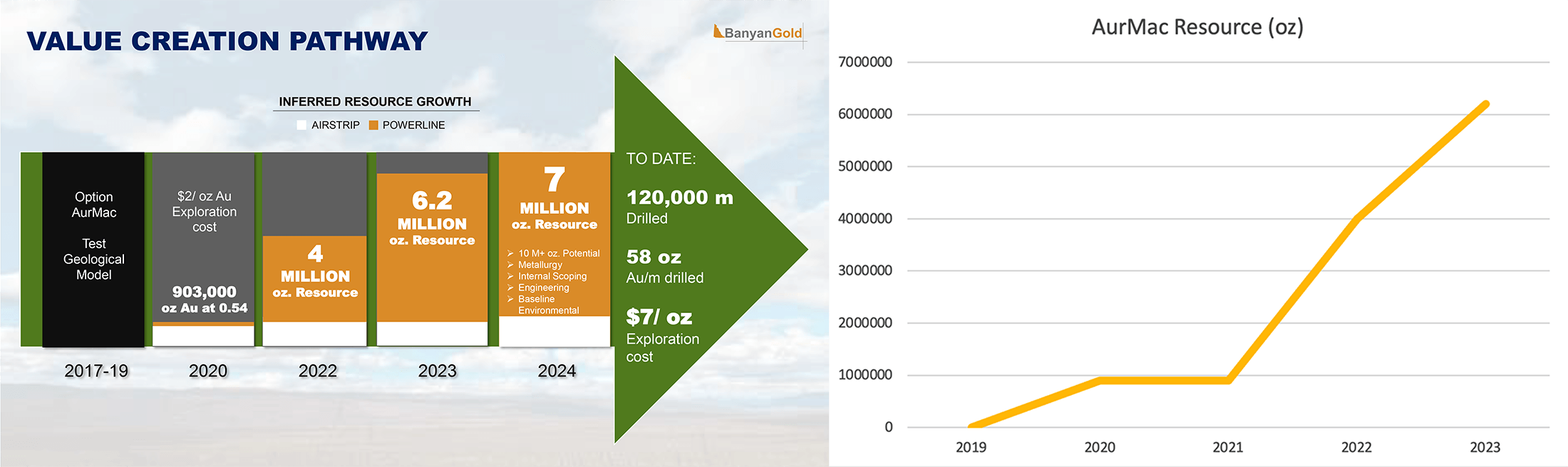
We mentioned the current 7 million gold ounces. That’s a very large Inferred gold resource in its own right, particularly for a small-cap “junior” gold firm with a sub-C$100 million market cap.
What’s even more compelling is that the BYN team has been able to grow the AurMac resource to 7 million ounces without yet finding what’s known in mining terminology as the intrusion — or the main “feeder-zone” to the below-surface gold mineralization.
These types of intrusion-related deposits are formed when a large intrusion comes up from deep below surface. That’s important as most of the other advanced deposits/mine projects in the district are on properties where the intrusion has indeed been located.
And that points to the very real potential for the BYN team to significantly expand the AurMac Inferred resource — particularly a deeper, higher-grade component of the below surface mineralization — by locating the intrusion.
Banyan Gold CEO Tara Christie notes that the team is presently exploring/drilling the metasedimentary rocks that are surrounding or above or beside the intrusion. Hence, as noted, it is quite an accomplishment to have amassed such a large Inferred resource without having yet intersected the intrusion. It also points to the project’s vast resource expansion potential.
In general, a gold exploration project needs to host a minimum of 5 million ounces in order to attract the interest of a major. Banyan Gold has already far surpassed that number.
And yes, that’s without intersecting the intrusion. And yes, the deposit is still growing by way of the drill-bit.
Jurisdiction, as noted, is highly favorable with the project situated within the Yukon’s prolific, yet underexplored Tombstone Belt, which lays host to multiple large-scale, intrusion-related precious metals deposits, including — right next door to AurMac — Victoria Gold’s producing Eagle Gold Mine (4.7 Moz Au) and Raven deposit (1.1 Moz Au) and Hecla Mining’s Keno Hill (224 Moz Ag) deposit (see below).

When you look at the Mayo Mining district, and the Tombstone Belt in particular, you can see that there are some 18 million ounces in gold-equivalent resources surrounding Banyan Gold.
The area’s roster reads like a who’s-who of the major miners with ongoing investment from the likes of Newmont, Barrick, Hecla, Kinross, Agnico-Eagle, and Osisko — among other top players.
Hence, the importance of jurisdiction really cannot be overstated. It's key for permitting. It’s important for raising capital and for keeping operating costs in check. It’s also key to bolstering shareholder confidence in the underlying asset from a regional perspective.
And, really, there’s no safer mining jurisdiction in the world than Canada, which boasts a long-established history of governmental support for the mining industry from province to province.
Another key benefit of operating in this particular region of the Yukon is that the land is under a single, self-governing First Nation with strong ties to the mining industry and already with symbiotic relationships in place with two existing mines within the Tombstone Belt.
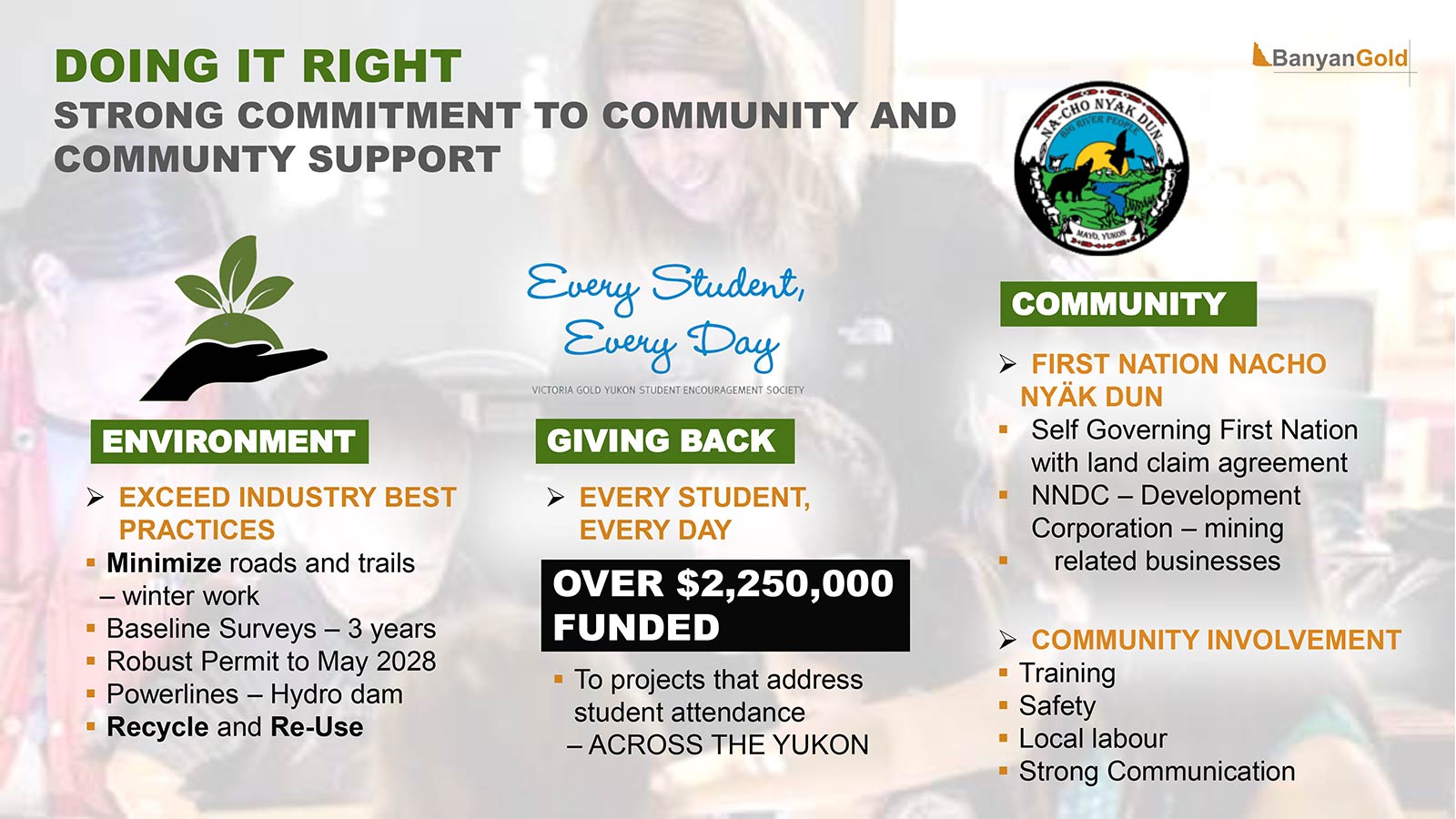
From the outset, the Banyan Gold team has built a solid working relationship with the local First Nation, and that’s important for a number of reasons, including maintaining a clear pathway through permitting.
As you’re about to discover in our exclusive interview coming right up, Banyan Gold CEO Ms. Tara Christie boasts a wealth of experience in working with First Nations, including having previously negotiated an agreement with eleven First Nations in the Yukon.
Infrastructure at AurMac is top-notch and includes year-round site access via the all-weather Silver Highway and the South McQuesten Road (the “Victoria Gold Access Road”).
A three-phase hydropower grid line (with the hydro dam located just 50 km away) also exists within the project boundaries. And, as mentioned, there are multiple fully-permitted mine projects nearby, including the Keno Hill Silver Mine and mill operated by Hecla Mining and Victoria Gold’s producing Eagle Gold Mine.
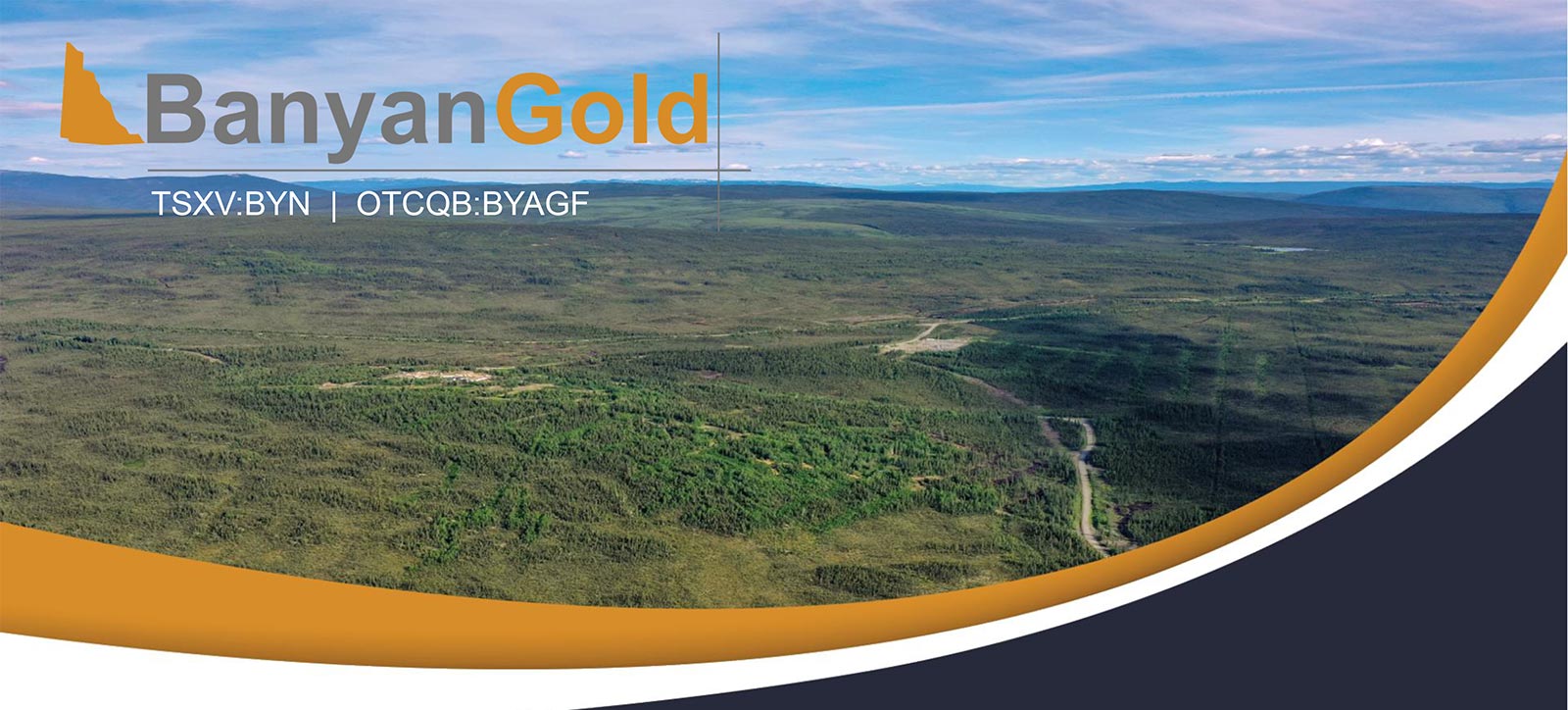
Also ideal, the topography at AurMac (see aerial view below) is considered moderate with no mountains or large lakes, rivers, or glaciers — making the mining model, which is anticipated to be primarily open pit, all the more simpler.
As noted, the AurMac property covers a very large area — 988 mining claims spanning 173 sq km — and contains three known deposits: Powerline, Airstrip, and the Aurex Hill zones (all discovered by Banyan Gold).
The project comprises the Aurex and McQuesten projects (hence, the name “AurMac”) optioned from Victoria Gold Corp. and Hecla Mining Company, respectively, as well as additional claims staked by Banyan.
To-date, Banyan has earned-in 51% of the Aurex property and 75% of the McQuesten property and holds the right to earn a 100%-interest in the underlying properties subject to royalties.
Drilling is considered year-round at AurMac, which is not something one might expect in the Yukon. Yet, a lot of that has to do with AurMac’s moderate topography and the infrastructure in place, which includes year-round, government-maintained roads right into the project area (see aerial view above)
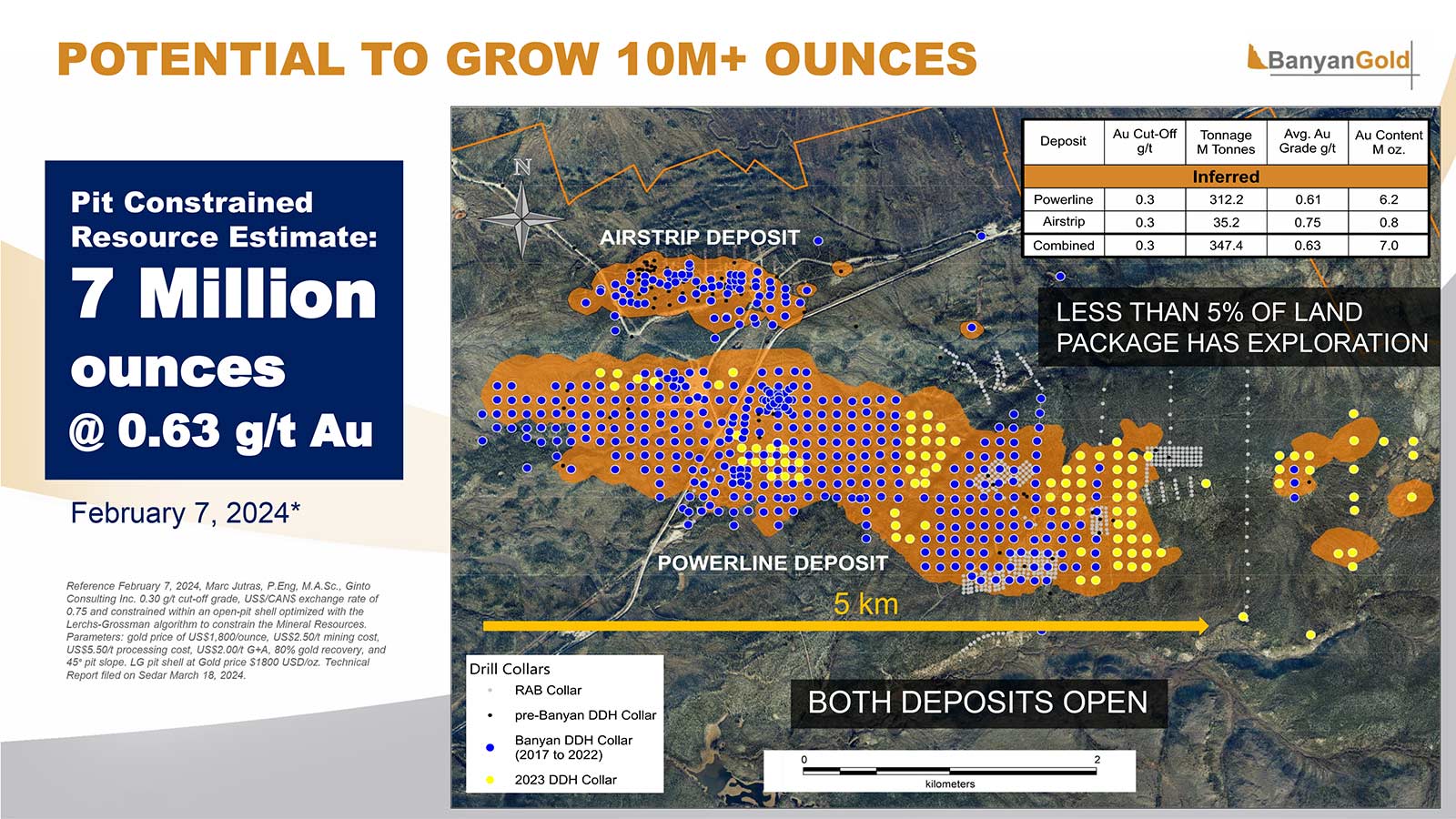
The main resource at AurMac spans two near/on-surface (~200 meters from surface) deposits — Powerline and Airstrip — with both deposits remaining open in all directions, and at depth, with potential for further resource expansion.
Banyan has also traced the deposit to around 400 meters from surface via a select number of drill holes. That’s important for future drill rounds — and for potential future production — as these types of intrusion-related gold deposits can be quite long-lived.
The standard approach is to focus on the upper “lower-cost” portion of the deposit in the early stages, which is vital for driving NPV. Later on, having potentially even higher-grade mineralization at depth is something that can contribute greatly to life of mine (LOM) and can be important to majors seeking to add gold ounces through strategic acquisition.
2024 Mineral Resource Estimate
On 7 February 2024, Banyan Gold issued an updated MRE (Mineral Resource Estimate) for the Powerline and Airstrip deposits, delineating 7.0 Moz Au combined in an NI 43-101-compliant, pit constrained, open-pittable Inferred resource across 5 km of strike length.
The Powerline deposit, which is the larger of the two, produced an Inferred Mineral Resource of 312.2 million tonnes at an average gold grade of 0.61 g/t for a total of 6.2 Moz Au.
The Airstrip deposit returned 35.2 million tonnes Inferred at an average gold grade of 0.75 g/t for a total of 0.8 Moz Au.
Banyan Gold president & CEO Ms. Tara Christie commented on the MRE update via press release:
“With the AurMac Resource now at 7.0 Moz gold; 6.2 Moz in the Powerline Deposit alone, we can focus on delineating higher-grade zones, increase the confidence in the resource and further de-risk the project. Metallurgical studies to date have demonstrated that Powerline mineralization is amenable to conventional mining processes, including Carbon in Pulp ("CIP”) and Carbon in Leach ("CIL”), flotation and heap leaching. Looking at the grade sensitivities, at a 0.60 g/t cut-off there are potentially 4 Moz at a grade of 1 g/t across AurMac, which highlights both the robust nature of the deposit as the cut-off grade is increased along with the potential for higher-grade zones.”
And speaking of targeting higher-grade zones, BYN has completed more than 24,000 meters of post-resource-update drilling wherein it has successfully connected the Powerline and Aurex Hill deposits.
That program also defined higher-grade zones at the Powerline deposit, including 31.8 meters of 1.80 g/t Au, 27.1 meters of 1.50 g/t Au, and 84.4 meters of 1.14 g/t Au.
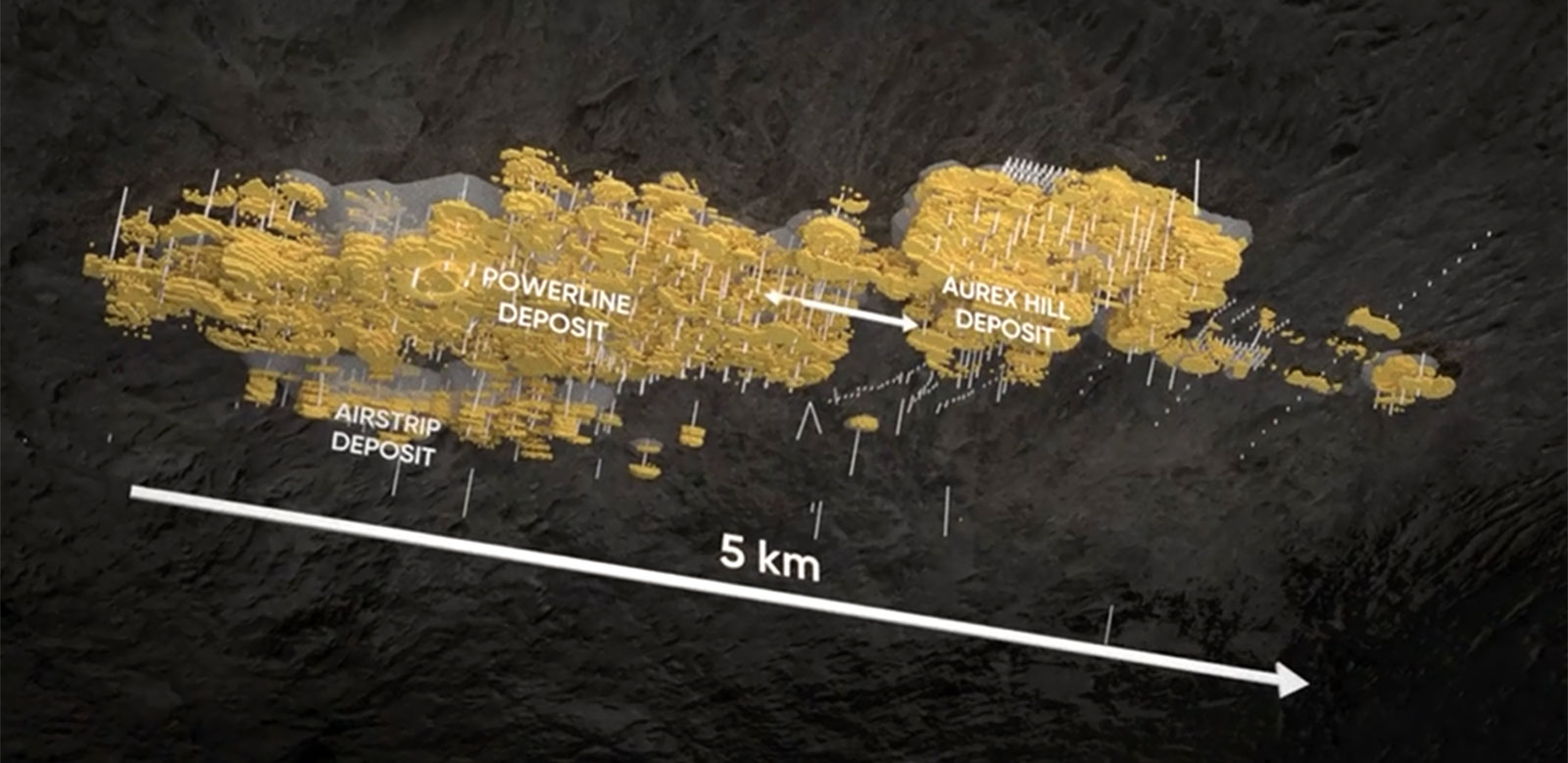
The deposits remain open with an opportunity to continue to add ounces to the Inferred resource. And the company’s track record for building ounces is highly impressive at less than C$7.40 per ounce of gold in the ground (or roughly 40 to 45 gold ounces per meter drilled).
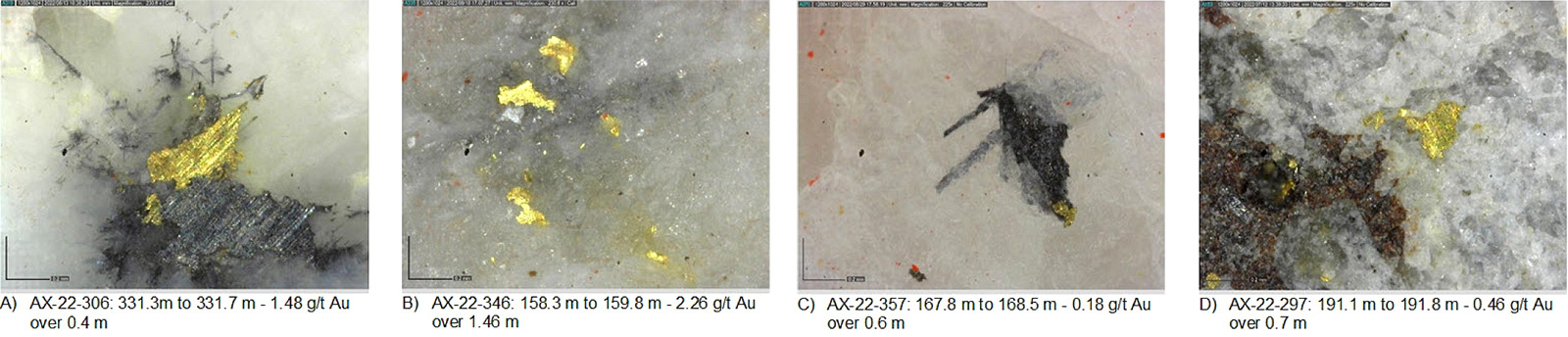
Drilling to-date has also intersected visible gold in multiple holes.
2024 Exploration Program
On 18 April 2024, Banyan Gold announced an update on its 2024 exploration and technical plans for its flagship AurMac gold project.
Before going into specifics, it’s important to note that the company has a long history of being highly responsible with shareholder dollars with 85% of funds raised to-date going into boots-on-the-ground exploration and drilling.
And that’s precisely what resource speculators want to see: dollars going into drilling — not G&A.
The project, which boasts excellent infrastructure in place including year-round access roads and green power, is situated just 30 km from Victoria Gold’s open-pit, heap leach Eagle Gold Mine and adjacent to Hecla Mining’s high-grade Keno Hill Silver Mine and mill.
The upcoming program calls for 5,000 meters of drilling via two rigs with the aim of proving up higher-grade mineralization while demonstrating grade continuity on the Powerline deposit while also seeking to expand both the Powerline and Airstrip deposits.
Drilling objectives include:
- Infill drilling of a higher-grade, near-surface zone within the Powerline Zone
- Testing mineralized structures and lithological horizons controlling the east-west grade continuity within the Powerline deposit
- Targeting extensions of previously-defined gold mineralization at the Airstrip deposit, which has not been drill-tested since 2020
Metallurgical work and internal-scoping-level engineering and environmental baseline programs are underway with a primary objective of laying the groundwork for future economic studies and permitting at AurMac.
Ms. Tara Christie added:
“AurMac is well-positioned in this current gold price environment with a 7 million ounce gold Resource, with near surface mineralization and with existing road and hydropower infrastructure on the Property. In 2024, Banyan will continue to add value through drilling, metallurgy, and engineering to prepare to demonstrate project economics and for the Project to be advanced rapidly and efficiently."
Key to this year’s drilling is the potential for the delineation of higher-grade material (potentially at the yet-to-be-discovered intrusion) within the known 7 Moz Au Inferred resource at AurMac, as that could unlock the economics for this large, near-surface gold deposit.
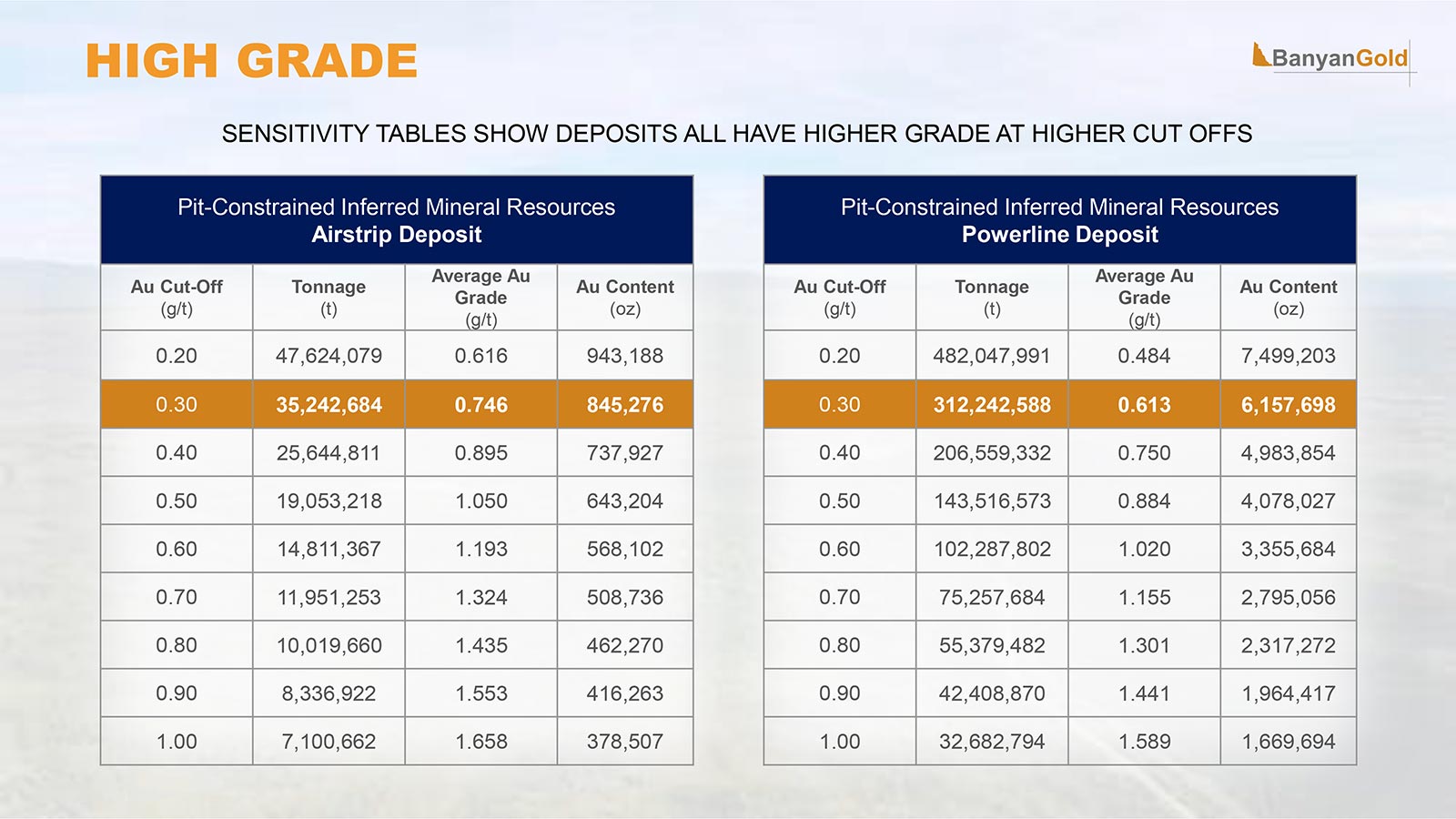
The updated MRE (Powerline and Airstrip combined) comprises an Inferred resource of 347.5 million tonnes grading 0.63 grams per tonne gold at a 0.3 g/t Au cut-off for 7 Moz Au.
The Banyan Gold team has further announced positive metallurgical test results from the Powerline deposit, resulting in robust gold recovery rates averaging 91% from multiple conventional recovery processes.
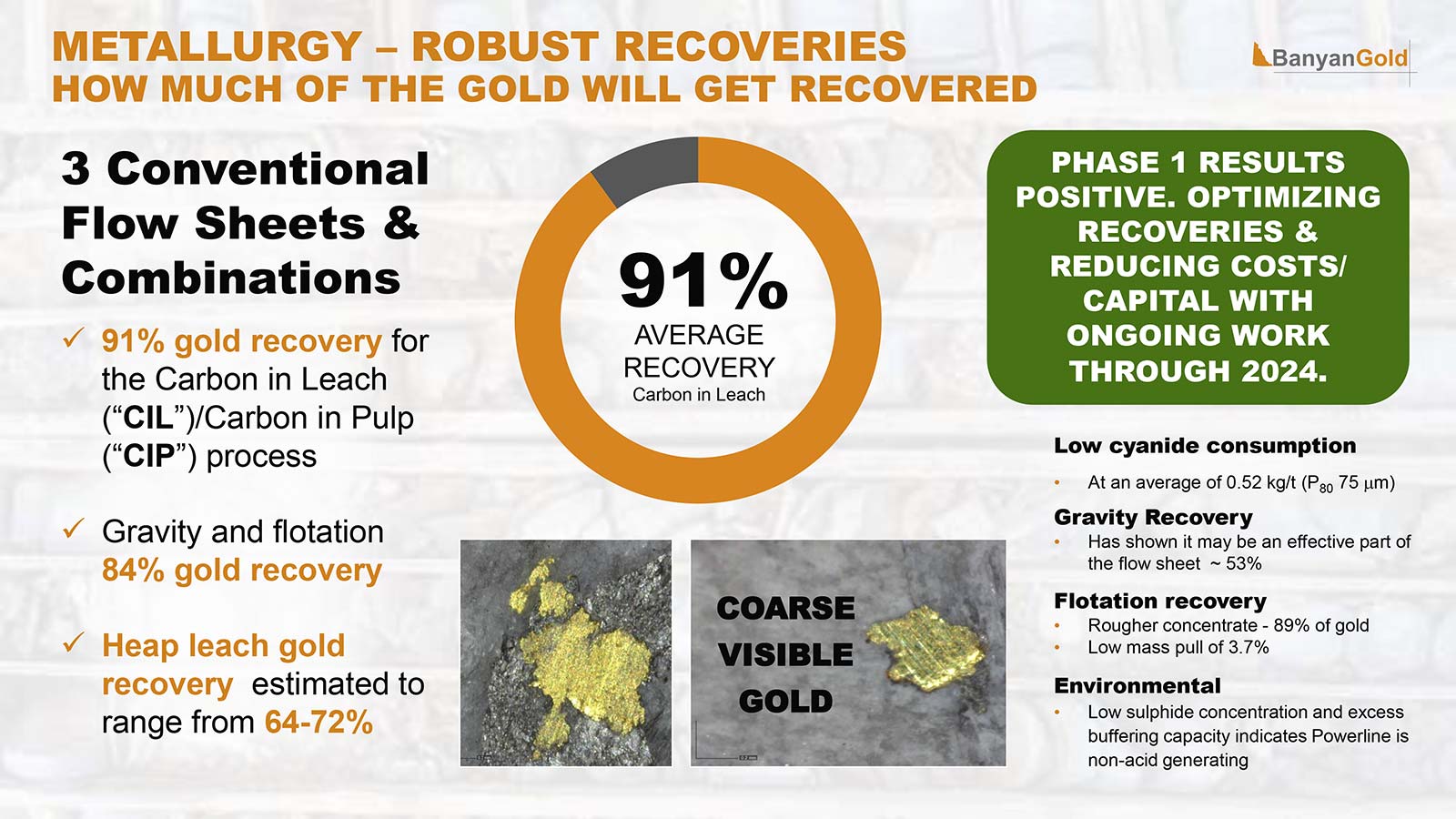
The team expects additional optimization to further increase gold recovery rates, which should, in turn, assist BYN in minimizing operating costs and maximizing value in future economic studies.
Importantly, to-date at AurMac, Banyan has only drilled to about 200 meters depth (with a treasure trove of drill data on 1,000-plus holes completed across the two main deposits), which greatly opens up the potential for significant resource expansion at-depth across the known 5 km strike length.
Speculators will soon have the opportunity to see those key catalysts in play as drilling resumes in 2H 2024.
A Robust Property Portfolio
Far from a one-trick pony, Banyan Gold also holds the Hyland gold project, located 70 km northeast of Watson Lake, Yukon, along the southeast end of the Tintina Gold Belt.
The wholly-owned project represents a sediment-hosted, intrusion-related gold deposit within a large land package spanning 125 sq km and is accessible by a network of existing gravel access roads.
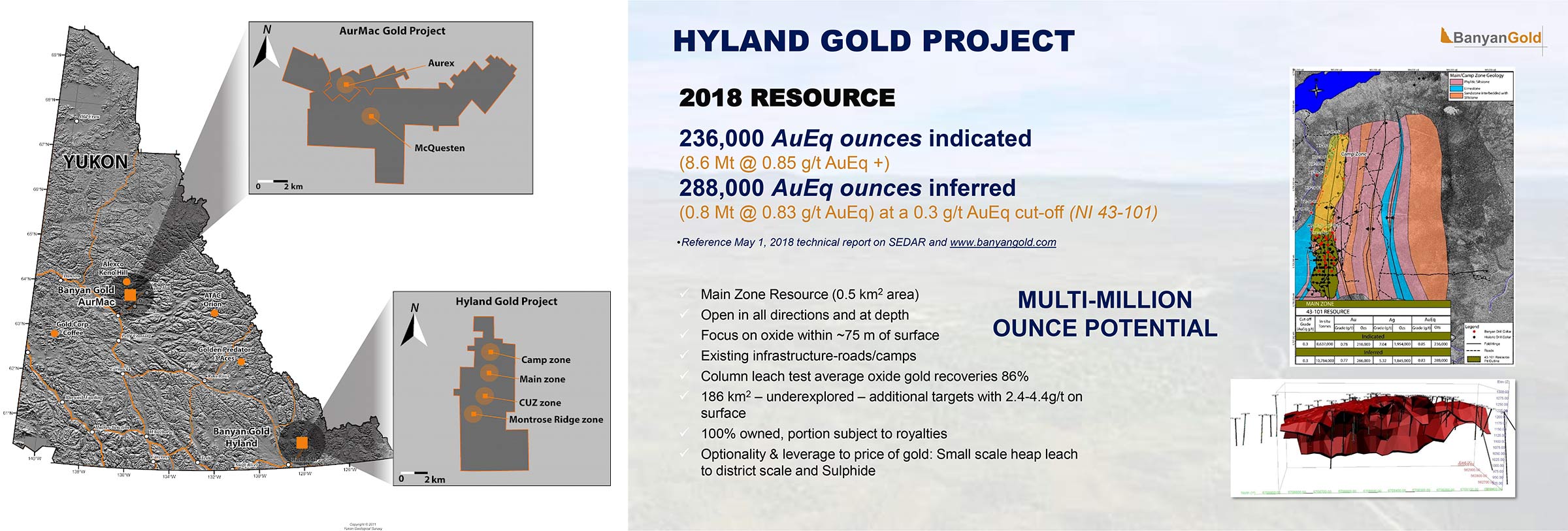
The Hyland project boasts an Indicated mineral resource of 8.6 million tonnes grading 0.85 g/t gold equivalent (AuEq) for 236,000 AuEq ounces with an Inferred mineral resource of 10.8 million tonnes grading 0.83 g/t AuEq for 288,000 AuEq ounces.
Last but certainly not least, Banyan’s impressive portfolio also includes the Nitra gold project, which is situated just 5 km to the west of the flagship AurMac project.
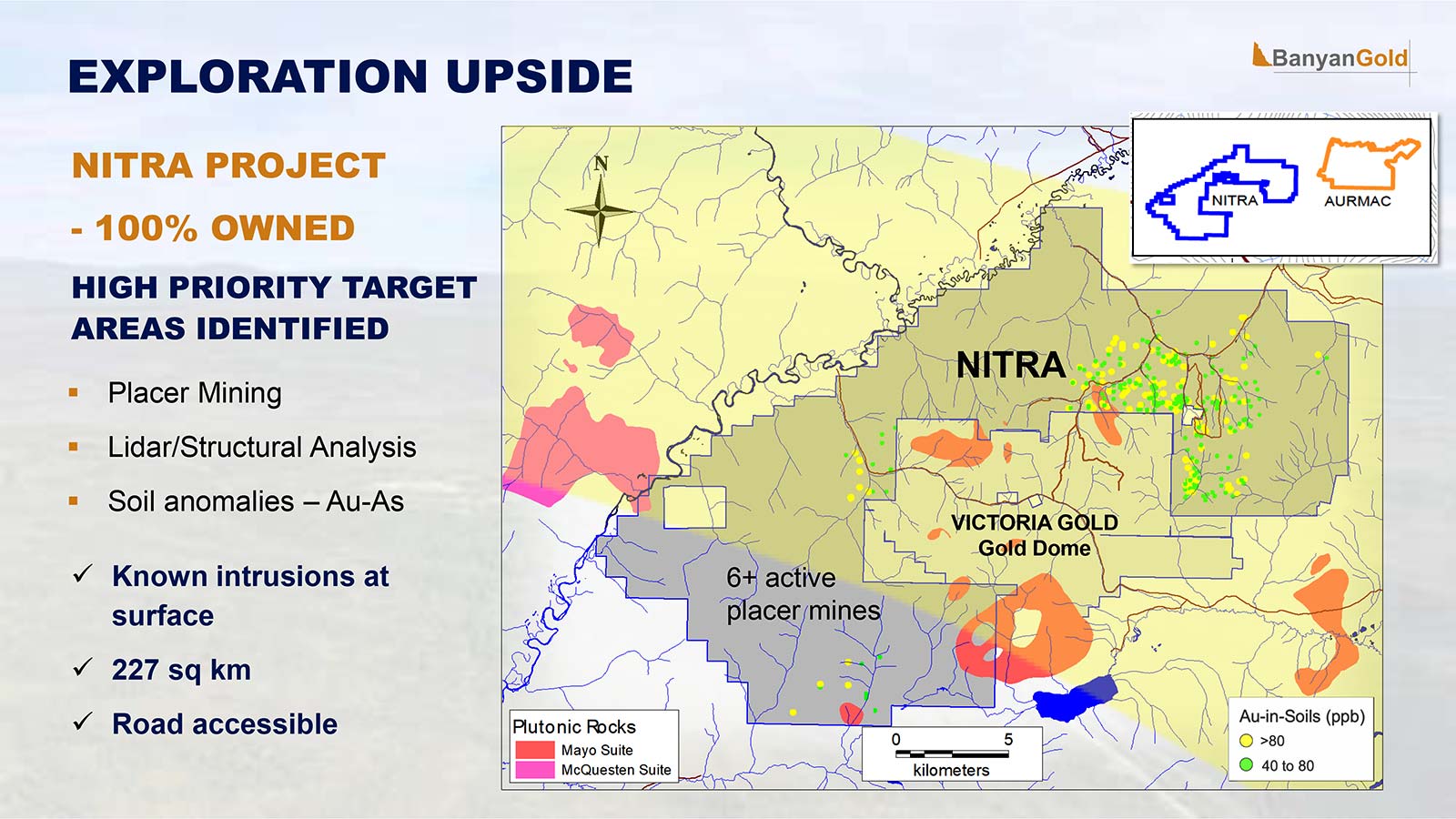
The 100%-owned Nitra property comprises 593 claims spanning 117 sq km and has known intrusions at surface. The Banyan team believes, based on prospecting, that the Nitra property exhibits similar geological potential to AurMac.
Exclusive Interview with Banyan Gold Corp.
President & CEO Tara Christie
Led by president & CEO Ms. Tara Christie, M.Sc., P.Eng., Banyan Gold boasts a highly-experienced management and technical team with decades upon decades of combined experience in the North American precious metals mining space.

The team includes vice president of project development and professional chemist Mr. Kai Woloshyn whose extensive experience in mine development, environmental assessment, and permitting, along with First Nation engagement, provides a strategic perspective to the approach required for the development of new mines in Canada’s north.
Kai previously served as environmental manager for Alexco Resource Corp. (acquired by Hecla Mining in 2022) for more than a decade and was responsible for all environmental management and permitting matters for the Keno Hill Silver District mining operations.

Mr. James Thom joins Banyan Gold as exploration manager and brings nearly 30 years of experience in developing drill targets from grassroots exploration surveys across multiple continents, as well as experience in developing geological models and target refinement from more advanced stages of exploration.
His expertise in the design and implementation of geochemical, geophysical, and geological surveys should go a long way in the continued advancement of the flagship AurMac project, as well as the other early-stage exploration projects in the BYN property portfolio.
Meet the full Banyan Gold team here.
As promised, our own Gerardo Del Real of Resource Stock Digest and Junior Resource Monthly took the opportunity to sit down with Banyan Gold president & CEO Ms. Tara Christie to go over the plans and process for advancing the 7 Moz AurMac gold project to the benefit of BYN / BYAGF shareholders.
Please enjoy our exclusive interview.

Gerardo Del Real: This is Gerardo Del Real with Resource Stock Digest. Joining me today is the president & CEO of Banyan Gold — Ms. Tara Christie. Tara, it's great to have you back on. How are you?

Tara Christie: I'm doing great, Gerardo. Thank you for having me back. I think it's a pretty exciting time for all of us in the gold business.
Gerardo Del Real: Well, listen, we chatted a few months back, and we talked a bit off-air, and it's amazing what a couple of months will do not just on the macro side but on the micro side as well.
We have a gold price well above US$2,300 per ounce as we speak. It has flirted with the US$2,400 level pretty consistently here recently. It looks to have a lot of momentum the rest of the year, and I think we're in for a pretty historic gold market.
I wanted to have you back on to talk about the current gold price environment and how Banyan is benefiting or not benefiting from that. And then, let's talk technical stuff and what comes next.
But before we get into all of that, you have one of the neatest backgrounds of any president and CEO in the resource space. And so I would love for you to tell our audience a bit about your background.
Tara Christie: Sure, so my dad is a geologist, and I grew up taking soil samples for assaying. I went to university thinking I was going to be a doctor and then got there and, despite all of the advice, discovered I loved engineering and I loved mining and exploration.
I went on to run a large-scale family alluvial mine for almost 20 years. I also did consulting work and worked with a lot with First Nations. I've actually negotiated an agreement with eleven First Nations in the Yukon, which is a really hard thing to do. And that really taught me a lot about understanding some of the challenges there.
It also set me up well for success because, through those experiences, I was able to gain an understanding of the private sector business and how to run a business and do everything from HR to balancing the books to getting loans and going through permitting and the bigger political context.
And through the course of my consulting, I’ve worked for Kaminak and Newmont. I was even a registered lobbyist. So a broad background, which, when I became CEO of Banyan in 2016, I found that I've needed just about every aspect of that. Not to mention the capital markets experience. So it's been a pretty exciting career so far.
Gerardo Del Real: Tara, you’ve positioned Banyan Gold perfectly in this higher gold price environment with the 7 Moz Au (Inferred) resource at AurMac.
The project has a ton of exploration upside along with excellent infrastructure. The team has done some really top-notch technical work that often gets overlooked in the retail market but is so critical when you're a takeout target the way I believe your company is.
Tara Christie: Yes, and that's wonderful context, Gerardo, as a lot of the juniors have yet to see the upward impact of these higher gold prices. Not only are gold prices up but central bank gold buying is up as well. This morning, I saw that central bank buying from China is up 23% over where it was last year even at these higher prices.
We're seeing cash flows increase. And we’re seeing some great numbers from the likes of Agnico-Eagle and Newmont and others that are making a lot of money at these higher gold prices. It’ll then be the next step down to the juniors.
We’re seeing some pretty exciting mergers and acquisitions. Some of them are still at bargain basement prices, which is not where I want to see Banyan, for sure, because I think we've got an asset that is very desirable. There are not very many places with 7 million ounces, road accessible, hydropower, exploration upside, and easy mining in a permittable jurisdiction.
In context, this is sort of what one might expect. Yet, a little further down the road — say, six months from now — we’re going to be seeing a very different market environment starting with more retail coming in. Retail has been a bit slow coming into the gold market. Interestingly enough, we’ve seen more Asian and US retail interest than Canadian, whereas, normally, it's the Canadian retail that’s first to come in.
Gerardo Del Real: You know what's interesting about that is there's so much central bank buying but it's not coming from the Western central banks. And so it's interesting to me that that's a trend that you're noticing even on the retail front.
You've positioned the company for 2024 to have catalyst after catalyst after catalyst. And I want to get into what the rest of the year looks like because, I mentioned some of the important technical work that you're doing, but you also have some pretty important exploration that I think is going to unlock a lot of value for shareholders this year.
Tara Christie: Absolutely, and it's a combination of those two things. So this past winter, we hadn’t been drilling but we had a lot of time to do some technical work and really look at what holes are going to add value.
We have a fairly strong treasury. And, unlike a lot of juniors, we've been able to conserve cash, and we also have revenue. 7 Moz Au is significant. And we wanted to wait for the results of our scoping study to help guide us so that we can really focus our drilling on what the key economic drivers are.
The metallurgical work we're doing is super important. Some of that will add percentages to our IRR when we do our PEA. We're not in a rush to do a PEA. We really want to understand the different processes first because we still have optionality.
People will say, ‘Well, why don't you just pick one and follow up on that?’ Well, that will actually scare away a few different potential acquirers or investors or strategics if we do that too soon. And really, the economics need to drive that.
Some companies might pay a higher upfront capital cost, and can, because it's a 30 or 40-year asset. And they'll put in that greater infrastructure. And there are some that are still in the ‘what's the lowest capital cost option’ camp, which is usually your heap leach or gravity flotation mill.
We’re actually in a really unique spot as not very many companies in the space have optionality on their projects. And so we've done that work, and we know the key drivers. We'll have our next phase of metallurgy happening throughout the year, which, I believe, will be a significant catalyst for us along with a very strategically planned drill program.
We've had time to look at every hole, including ones that are going to add some higher-grade material and confirm our structural geological model in our starter pit areas. And also ones that are going to show that we not only have 7 million ounces at AurMac but that there is, I believe, the potential to host 10 million-ounces-plus as we know the mineralization goes to depth.
We've only drilled to about 200 meters, and we've commenced some of the technical work to really hone in on the intrusive. And remember, that's the key difference between us and, say, Snowline Gold or Sitka Gold. They’ve found their intrusives; Sitka’s is pretty deep; Snowline’s is fairly remote. Where is ours? Well, we've really started to do some of the technical work to understand that.
And beyond that, we're going to continue to position this project so that it can be moved forward quickly through permitting. A lot of projects might miss the current gold cycle. Who knows how long the cycle lasts? Maybe it's prolonged because it has such momentum behind it.
The bottom line is that there are not very many North American projects, or projects in safe jurisdictions like ours, that could actually be in construction in four to five years from making your decision on the project and having a PEA completed. So that makes us unique… kind of a unicorn out there.
Gerardo Del Real: I couldn't agree with you more. Again, it's rare to have a 7 million ounce gold project with great exploration upside and with the infrastructure that you have and with the technical work that you've done.
You touched on finding the intrusive and understanding that a little better. In other words, you may not have even yet found the sweet-spot of the mineralization. So all of that has got to be music to Banyan shareholder ears.
Tara, anything else you'd like to add before I let you go? I appreciate the update, and I'm sure Banyan Gold shareholders will as well.
Tara Christie: Only that I feel that our team has worked really hard to manage our capital. You'll notice that 85% of our dollars go in the ground and that we have real skin-in-the-game.
For me, it matters what the BYN share price is. Dilution matters. I’ve had to buy my position in the market, and, hence, I'm very cognizant of what we are doing and what the long-term value is for shareholders. We're driven by that.
We have a great team that shares that view and really wants our legacy to be that this project adds a lot of value for our shareholders and is really positive for the community. And, ultimately, I'd love to see this project get built.
We’ve begun calling ourselves ‘Yukon's Next Gold Mine.’ Forward-looking, yes, but I think it's a great place to be, and I've worked most of my career to get here. So thanks for having me on, Gerardo. I really appreciate it… and look for another exciting year from Banyan Gold.
Gerardo Del Real: Always a great conversation and always insightful. And look, Banyan is by far one of the best-run gold companies in the entire space. Kudos to you and your team and the way you approach it. Thank you again, Tara.
Tara Christie: Thank you so much, Gerardo.
The Banyan Gold Opportunity
Banyan Gold Corp. (TSX-V: BYN)(OTC: BYAGF) is advancing the flagship 7 million ounce AurMac gold project located in the Tier-1 mining jurisdiction of Canada’s Yukon Territory.
The project is hosted within the Mayo Mining district — Canada’s newest and most rapidly growing precious metals district — nearby to multiple fully-permitted mines and large-scale deposits operated by and with investment from mid-tiers and majors within the prolific Tombstone Belt.
AurMac benefits from excellent infrastructure in place — including year-round site access via the all-weather Silver Highway plus grid hydropower — and is amenable to year-round drilling.
The bulk of the resource at AurMac spans two main deposits — Powerline and Airstrip — with both remaining open in all directions, and at depth, with potential for further resource expansion.
The Powerline deposit, which is the larger of the two, produced an Inferred Mineral Resource of 312.2 million tonnes at an average gold grade of 0.61 g/t for a total of 6.2 Moz Au.
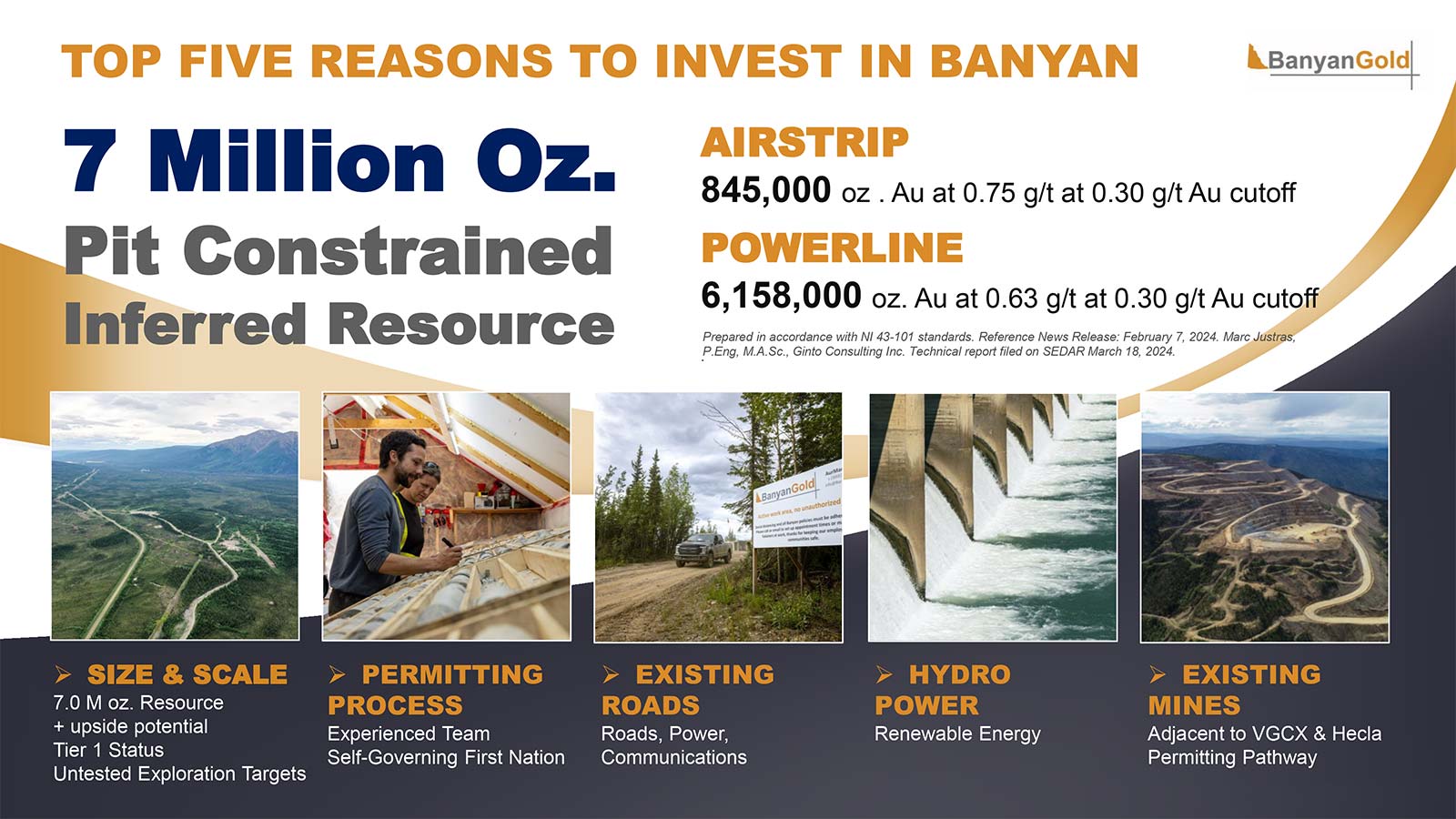
Importantly, Banyan Gold made the initial discovery at AurMac back in 2019 and has systematically and intelligently grown the Inferred resource via the drill-bit ever since.
What’s even more impressive is that the company has been able to successfully grow the resource to 7 Moz without yet intersecting the intrusion. To that end, advanced technical work is underway to hone in on what the BYN team anticipates will prove to be a main feeder-zone to the near-surface gold mineralization.
Building off the momentum of five consecutive years of resource expansion success, the Banyan Gold team is moving straight into a new round of drilling. And that means plenty of news flow ahead with which to potentially move the needle.
You heard directly from Banyan Gold CEO Tara Christie. She says:
“We've only drilled to about 200 meters, and we've started to do some of the technical work to really hone in on the intrusive … we're going to continue to position this project so that it can be moved forward quickly through permitting … there are not very many North American projects, or projects in safe jurisdictions like ours, that could actually be in construction in four to five years from making your decision on the project and having a PEA completed. So that makes us unique… kind of a unicorn out there.”
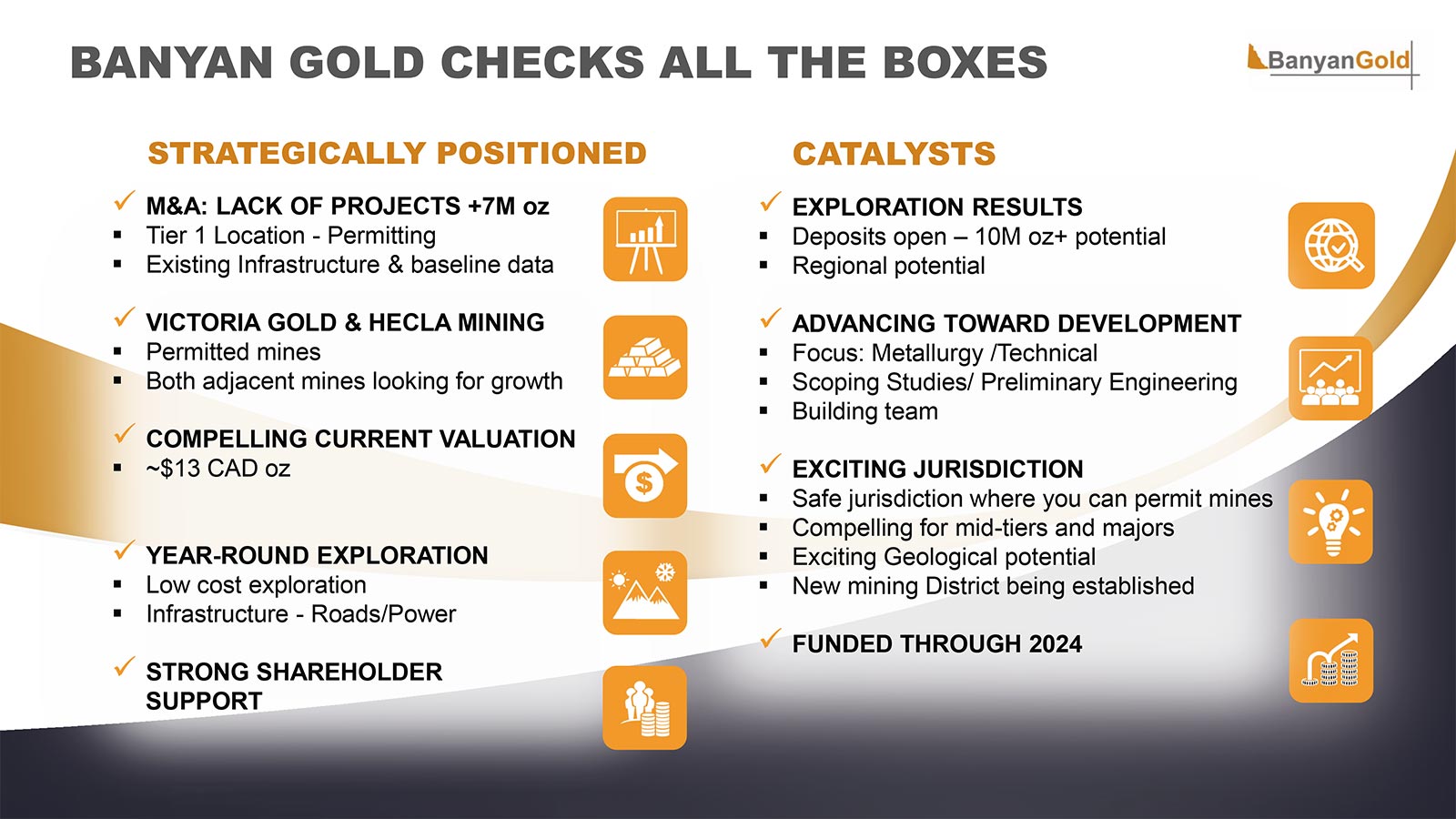
With the yellow metal setting record highs on a seemingly weekly basis, Banyan Gold — with its seven million ounces and counting — checks a number of key boxes majors generally look for when seeking to add ounces through strategic acquisition.
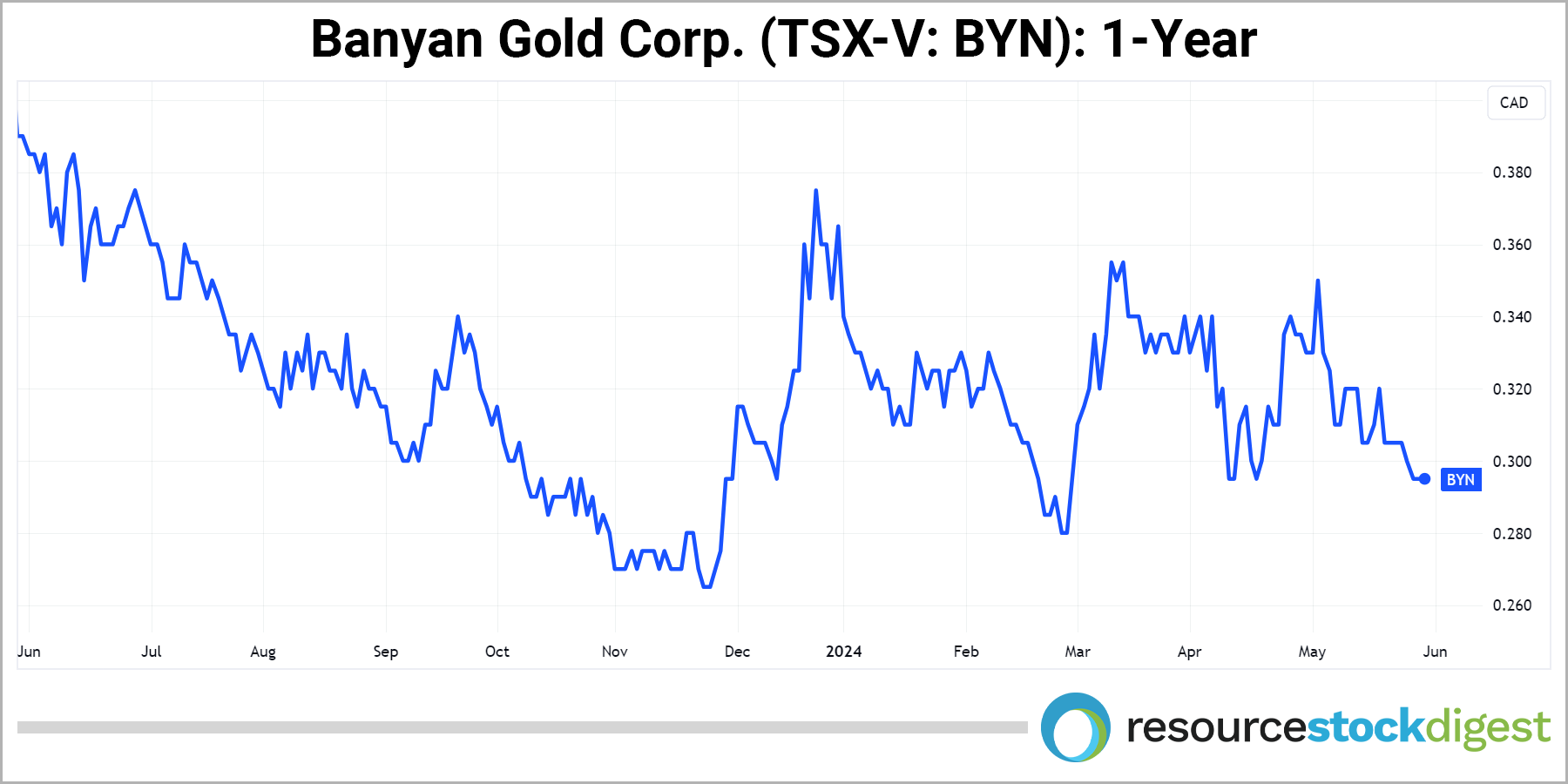
BYN is well-structured with approximately 286 million shares outstanding on a non-fully-diluted basis for a current non-fully-diluted market cap below C$100M.
The company is well-funded to complete its near-term objectives — anchored by a multi-rig, 5,000-meter drill program slated for 2H 2024 — with ~C$7 million in the treasury as of January 2024.
Also noteworthy, last year, Banyan generated ~C$700,000 from equipment rentals and other services, which is quite the rare feat for a small-cap precious metals explorer that’s yet to pour its first gold bar.
Maintaining a substantial pre-production income stream means that a greater percentage of shareholder dollars are able to go to what’s important — and that’s exploration and drilling as opposed to G&A.
Banyan Gold is also well-owned by financial institutions and larger mining firms (see below).
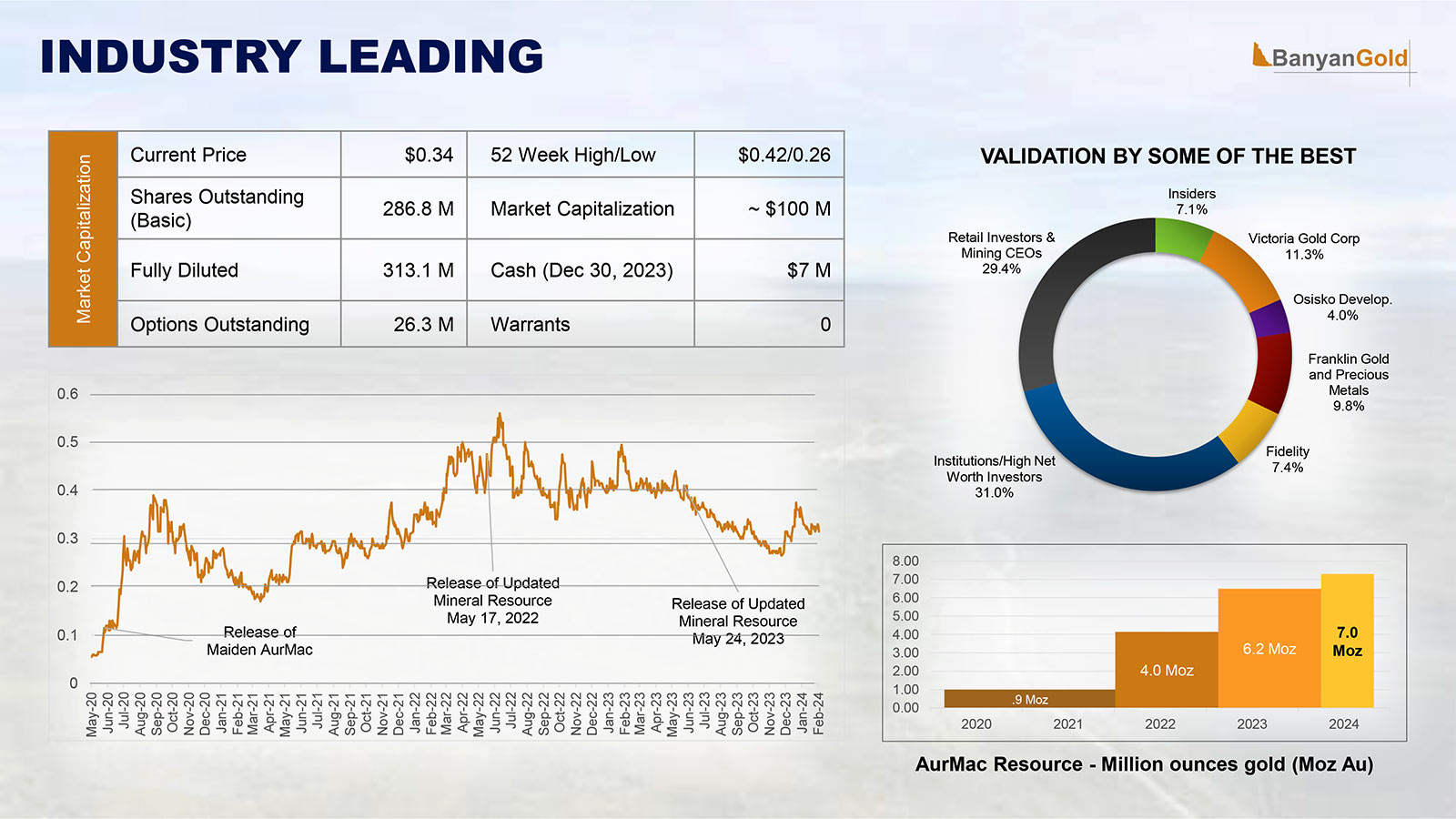
That includes Victoria Gold (with current Au production at the nearby Eagle Gold Mine), which has amassed an 11% ownership stake in BYN having vetted the AurMac project technically.
And what better company to vet Banyan’s Tier-1-hosted gold exploration project than an established producer with an operational gold mine right next door?
With gold continuing to test all-time highs as we head into the second half of 2024, now is an excellent time to begin conducting your own due diligence on Banyan Gold Corp. — symbol BYN on the Toronto Venture Exchange and symbol BYAGF on the US-OTCQB Bulletin Board Exchange.
A great place to start is Banyan Gold’s corporate website.
There, you can sign up to receive updates directly from the company, view the most recent Corporate Presentation and much more.
Be sure to also follow our ongoing coverage and our exclusive interviews with upper management here.
— Resource Stock Digest Research
IMPORTANT DISCLAIMER & DISCLOSURES
Resource Stock Digest, as a publisher, is not a broker, investment advisor, or financial advisor in any jurisdiction.
Please do not rely on the information presented by Resource Stock Digest as personal investment advice.
If you need personal investment advice, kindly reach out to a qualified and registered broker, investment advisor, or financial advisor.
The communications from Resource Stock Digest should not form the basis of your investment decisions. Examples we provide regarding share price increases related to specific companies are based on randomly selected time periods and should not be taken as an indicator or predictor of future stock prices for those companies.
Banyan Gold Corp has sponsored this report.
The information in this newsletter does not constitute an offer to sell or a solicitation of an offer to buy any securities of a corporation or entity, including U.S. Traded Securities or U.S. Quoted Securities, in the United States or to U.S. Persons. Securities may not be offered or sold in the United States except in compliance with the registration requirements of the Securities Act and applicable U.S. state securities laws or pursuant to an exemption therefrom.
Any public offering of securities in the United States may only be made by means of a prospectus containing detailed information about the corporation or entity and its management as well as financial statements. No securities regulatory authority in the United States has either approved or disapproved of the contents of any newsletter. Resource Stock Digest nor any employee of Resource Stock Digest is not registered with the United States Securities and Exchange Commission (the “SEC”): as a “broker-dealer” under the Exchange Act, as an “investment adviser” under the Investment Advisers Act of 1940, or in any other capacity. Resource Stock Digest, its owners, directors, and employees are also not registered with any state securities commission or authority as a broker-dealer or investment advisor or in any other capacity.
HIGHLY BIASED:
In our role, we aim to highlight specific companies for your further investigation; however, these are not stock recommendations, nor do they constitute an offer or sale of the referenced securities. Resource Stock Digest has received cash compensation from Banyan Gold Corp and is thus extremely biased. It is crucial that you conduct your own research prior to investing. This includes reading the companies' SEDAR and SEC filings, press releases, and risk disclosures. The information contained in our profiles is based on data provided by the companies, extracted from SEDAR and SEC filings, company websites, and other publicly available sources.
Resource Stock Digest, and its owners, directors, employees, and members of their households may own shares of Banyan Gold Corp. Therefore, Resource Stock Digest is extremely biased. Measures are in place such that no shares will be sold during the active awareness campaign.
HIGH RISK:
The securities issued by the companies we feature should be seen as high risk; if you choose to invest, despite these warnings, you may lose your entire investment. You must be aware of the risks and be willing to accept them in order to invest in financial instruments, including stocks, options, and futures.
NOT PROFESSIONAL ADVICE:
By reading this, you agree to all of the following: You understand this to be an expression of opinions and NOT professional advice. You are solely responsible for the use of any content and hold Resource Stock Digest, and all partners, members, and affiliates harmless in any event or claim. While Resource Stock Digest strives to provide accurate and reliable information sourced from believed-to-be trustworthy sources, we cannot guarantee the accuracy or reliability of the information. The information provided reflects conditions as they are at the moment of writing and not at any future date. Resource Stock Digest is not obligated to update, correct, or revise the information post-publication.
FORWARD-LOOKING STATEMENTS:
Certain information presented may contain or be considered forward-looking statements. Such statements involve known and unknown risks, uncertainties, and other factors that may cause actual results or events to differ materially from those anticipated in these statements. There can be no assurance that any such statements will prove to be accurate, and readers should not place undue reliance on such information. Resource Stock Digest does not undertake any obligations to update the information presented or to ensure that such information remains current and accurate.