Categories:
Base Metals
/
Precious Metals
Topics:
General Base Metals
/
General Precious Metals
Rick Rule on His Early Investment into Empress Royalty Corp., Gold Bull Market Strategy, and Upcoming Rule Resource Symposium
Editor's Note: Enjoy the interview with Rick, below. After that, catch even more of him at Daily Profit Cycle, where he recently told Nick Hodge that the $130 trillion U.S. debt will drive gold gigher for the next decade. See that interview here. --Gerardo
Gerardo Del Real: This is Gerardo Del Real with Resource Stock Digest. Joining me today is the future president of the Future Taxpayers Union, a man who needs no introduction — Mr. Rick Rule. Rick, thank you so much for your time today. How are you, sir?
Rick Rule: A pleasure, sir, and the better for being on with you. Thank you for having me with your audience.
Gerardo Del Real: Thank you for the kind words. I had the good fortune of speaking with a gentleman whom you're very familiar with. He's the executive chairman of Empress Royalty, Mr. David Rhodes. This was a couple of weeks back. And we were chatting about where he thinks gold and silver prices are headed.
And, of course, with gold over $3,400/oz today and with the dollar index below 100 and silver seemingly wanting to break out, I wanted to get his take just to hear what informed those opinions. And his take was that silver, by the end of 2026, could go to $50/oz and likely overshoot to $100/oz. And he saw gold closer to $5,000/oz than $3,000/oz.
I would be doing my audience a disservice if I didn't get your take on where you think we are in the gold cycle given the volatile nature globally and everything from currencies to society, right?
Rick Rule: Well, I'm older than David so I'm smart enough not to give you as accurate a price projection as he was willing to do. Let me say this, I believe that we aren't coming into a gold bull market. I think we're into a gold bull market now. And I think it started longer ago than people think.
When people ask me when the gold price is going to move, I say, the year 2000. It was 250 bucks an ounce. Now, it's at almost $3,500 today; a twelve-fold move in gold. And people say, ‘When is the gold price going to move?’ It's a really interesting question.
Maybe what people want to say is, ‘When is gold going to go hyper?’ And I think for that, people need to look at history. And I'm sorry to give you the long-winded answer but the truth is, you've asked me a big question so I have to give you an accurate answer.
Gerardo Del Real: I appreciate that.
Rick Rule: Gold moves historically over time because people are afraid of the maintenance of their purchasing power in fiat-denominated currency instruments. And those fears are real today, and, I would suggest, growing. The dominant reserve currency in the world is the US currency. And, by the way, I expect the US currency to perform at least as well as other currencies, which is to say, poorly.
We have, in the United States as a society, $100T in off-balance-sheet liabilities — net present value of off-balance-sheet liabilities; Medicare, Medicaid, federal pension, stuff like that — a hundred trillion dollars. To put that into perspective, our GDP per capita is less than $30T a year. We have on-balance-sheet liabilities of $36T.
To make a long story short, the only way that, politically, we can honor the nominal value of our obligations is to reduce the purchasing power of the US dollar. Traditionally, that has been very good for the gold price. In the decade of the 1970s — you weren't alive but I was — according to the congressional budget office, the purchasing power of the US dollar declined by 75% over 10 years. I think that's in front of us for the next 10 years; 75%, not coincidentally, when the US dollar's purchasing power declined by 75%, the gold price went up 30-fold.
Now, I'm not telling you the gold price is going to go up 30-fold. But it makes absolute arithmetic sense that, if the purchasing power of the dollar declined by 75%, the gold price could go up in commensurate fashion. Let's look at one more piece of arithmetic. The market share of gold and precious metals oriented securities in the US market is about one half of 1%, which is to say, one half of 1% of savings and investment assets in the United States is comprised of precious metals or precious metal securities. The four decade mean market share is 2%.
For gold merely to return to the four decade mean, demand for the stuff has to rise four-fold. What happens to the price if demand goes up four-fold with supply increasing by one and a half percent a year? So I think we're in for a time of higher gold prices.
I think what's of particular interest to you is that precious metals bull markets have a very, very, very well-established trajectory. The first thing that moves is the metal price, and we've seen the move in the metal price in the last two years pick up steam. In other words, while gold has been moving since 2000, the move has been noticeable for most people in the period of 2024 and 2025.
What has happened in past bull markets is that move in the bullion has increased real mining companies’ margins because the price of the product they sell increases faster than the cost of producing it. And two things happen then. The increasing margins, the increasing cash flow, and the increasing attention that gold has, increases the price of gold shares. We haven't seen that happen until the last 13 weeks, which suggests that we're very early in a gold bull market… and the market participation has been concentrated in the biggest and the best names.
Traditionally, again, over the last three cycles — which I've watched intently, by the way — the leadership in the gold bull market changes from gold, to the biggest gold producers, to the second-tier gold producers, to the developers, to the juniors in very predictable fashion. The smaller companies move later but they move faster and they move further. The type of move that attracts people to the type of stocks that you follow occurs later but it's much more dramatic.
Your test is two-fold. Identify the high-quality juniors rather than focusing on the flotsam and the jetsam… and having the courage to stomach the volatility and the patience to suffer through the time because, even though the move in your sector is inevitable, it might not be imminent. When people complain about the wait… they suffer and they forget about the reward they enjoy.
Because I'm 73 years of age, because I've done this three times before in my career, I've become much more patient because participating in activity where you can enjoy 1,000% gains or 1,500% gains justifies the torture of waiting for it to occur. So as a young man, what I say to you is… sit back, relax, and enjoy the process.
Gerardo Del Real: I love it. Listen, Empress, obviously, is a royalty and streaming company focused just on precious metals. One of your earlier investments — as was told to me by a friend and mentor and advisor to me — was Franco-Nevada. And he shared how you positioned and how you did.
Now, clearly, everyone knows you've benefited and researched your way into many, many 100-baggers… but can we talk about how that came about, how you positioned, and how you were able to take advantage of that?
Rick Rule: That was spectacular. First of all, it happened in 1982 and I was broke. I had no money, I mean broke. I went from having a lot of money in the '70s to losing it all in the commodities crash in the early part of the 1980s.
What I did have was a wonderful Rolodex. You all would call them contacts now. And one of my contacts, a man named Hugh Mogudson who worked for the people who put together Franco-Nevada, managed to get me a 10,000 share allocation at 35 cents. By the way, I struggled to put together $3,500 spare dollars at that point in time in 1982.
That stock, from 35 cents, split four times. So I don't know what the number was, and it sold out to Newmont, I think, at around $30 a share. So one share became two shares, became four shares, became eight shares from the split. And it went from 35 cents to 30 something dollars. Now it took time.
Gerardo Del Real: Sure, sure.
Rick Rule: And it doesn't matter that it took time. And I learned a couple of things from that. I learned, first of all, that the market rightly puts a much greater value on a royalty than they do on a working interest because your gross is your net. Franco-Nevada bought their original Gold Strike royalty — if my memory serves me well — for $2 million; that was a 5% royalty and a 5% net profits interest.
After they bought that royalty, Barrick discovered 40 million ounces of gold, which Franco didn't pay for. They have now recovered something in excess of $3 billion on that $2 million investment and recycled the money extraordinarily well. And after 40 years of production, they have many more reserve ounces than they had at the time that they bought the discovery. So two lessons. Royalty companies and streaming companies are better businesses, and big deposits always get better. Big deposits are the gifts that keep on giving.
What's happened since that point in time is that many people have been attracted to the royalty and streaming business. And probably half of them, frankly, aren't worth the powder to blow them to hell despite the fact that you're in a better business. If you're not a better business person, you blow the advantages. And beginning about 10 years ago, every butcher, baker, and candlestick maker in the junior stock space started a royalty and streaming company.
Gerardo Del Real: Sure.
Rick Rule: And most of them were junk. So in order to analyze companies, you had to look for small royalty companies that had definable business advantages; people who did something better than their competition. You interviewed David Rhodes. Empress has a definable business advantage. Empress came out of the Endeavor Financial Group who I used to compete with. I know them well.
They're formidable competitors, and the definable business advantage is two-fold. Endeavor sees transactions from around the world. Their deal flow is very high. And Empress doesn't have to pay for that. It comes for free. And then, Endeavor has a due diligence team, a technical team, to evaluate the opportunities that Empress also doesn't have to pay for. If you combine them with all of the other subscale royalty companies, their definable competitive advantage is access to deal flow and access to technical due diligence at a lower cost than the cost that's enjoyed by any of their competitors.
If you match that with what I believe is a less-tested but superb management team — led by a wonderful woman who started in the business at 14 years of age, a young woman with 35 years of experience in mining — for a speculator, this is an extremely attractive opportunity.
I'm not telling you that this is bound to be a success. Just at the same way that I participated in the initial public offering of Franco-Nevada, it was guaranteed to be a success. What it is is the opportunity to participate in the early stages of the gold bull market in the best part of the gold business with a team that has definable competitive advantages relative to their competitors.
What you are asking for is a set of circumstances that gives you the probability of outperformance relative to other opportunities, and I think that's the opportunity that presents itself to me.
Gerardo Del Real: That's a heck of an endorsement. I'd be remiss not to dig into the roster, including, obviously, yourself, of the 2025 Natural Resource Rule Symposium, which has to be one of the most timely put together events.

In my short time around this business — I've only been around it for about 16 or 17 years — but the lineup you've been able to put together, the keynote speakers, the networking opportunities… can you speak to the value there?
Rick Rule: It's so funny that you talk about timing, and I believe you're right, by the way. I believe the timing is propitious. What happens is… if you do something for 30 years, occasionally you get the timing right.
Gerardo Del Real: Imagine that!
Rick Rule: You do it every year for 30 years, you're bound to get some good ones, and we've had some great ones. The conference, by the way is — and I'll just say it's my conference so I won't beat around the bush — it’s the best investment symposium in the natural resource business. Simply put, the best.
So let me tell you why. First of all, we have the best macro thinkers, people who explain to you the way the world is, not the way that NBC or CBS or MSNBC wants you to believe it is, but the way it is. And these guys aren't journalists. I have David Stockman talking about the US budget. This guy isn't a failed journalist. He's the guy who ran the Office of Management and Budget for Reagan. He wrote a book called “The Triumph of Politics,” which explains the last failure of the Department of Government Efficiency. He lived it.
We have Nomi Prins who will talk about the structure of Wall Street from the belly of the beast because she was a partner at Goldman Sachs. She was part of the beast. We have Danielle DiMartino Booth talking about the Fed. Again, she's no failed journalist. She was a researcher at the Fed.
We have Jim Rickards talking about the corrupt intersection of Wall Street and Washington. He was general counsel at Long-Term Capital Management, a firm whose bankruptcy almost brought down Wall Street. He was in the room discussing the bailout of Long-Term Capital Management by the Fed and the New York Stock Exchange. Again, from the belly of the beast. You don't get this at other conferences.
After that, after we've explained the way the world is, which most people don't do, we move on to what you can do about it. And we have analysts and portfolio managers with decades of experience in natural resources, not flunkies who couldn't do supermarkets or long-term bonds, not flunkies who blew out in the pot market. But people like John Hathaway who've run portfolios in natural resources since the 1970s; Adrian Day of the same vintage.
We have more modern people too. We have very skilled geologists, the Brent Cooks of the world, the Joe Mazumdars of the world, talking about geology in a way that draws on three or four decades of successful experience rather than just experience.
Beyond that, every single public company exhibitor at our conference, including the aforementioned Empress, is owned in accounts owned by the conference sponsors. At every other investment conference in the world, every single one, the qualification to be an exhibitor is a pulse and a check that cashes in reverse order of importance. At our conference, our attendees have told us that the exhibitors are content too, not mere advertisers, so we vet them.
There's no guarantee, damn it, that because I own a stock, it goes up. But there is a guarantee that I have studied the stock before I put money in it, and that guarantee is your guarantee that every exhibitor has been vetted.
But there's more. Every year, we have a panel called The Living Legends. These are entrepreneurs who have built multi-billion dollar mining companies from scratch; the Robert Friedlands of the world, the Bob Quartermains of the world, the Ross Beatys of the World, the Sean Roosens of the world. And these people tell us how they did it. They tell us the mistakes they made, they tell us how those mistakes made them better investors. And they tell you how to identify 10 or 20 million market cap companies that could become $2 to $5 billion market cap companies. And you can follow these guys on the exhibit floor and see what booths they stop at in front of you. Use a little moxie.
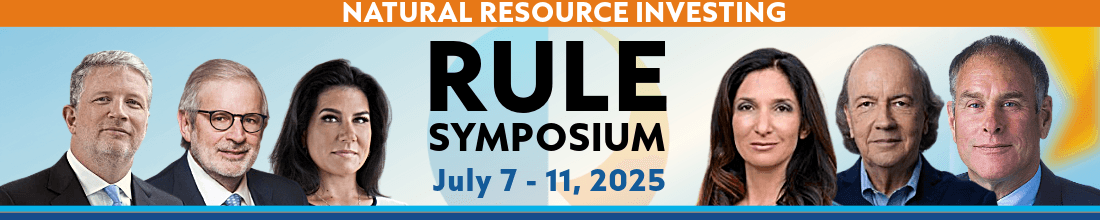
All of that together allows me to say to your listeners, if you attend my conference July 7th through July 11th in Boca Raton, Florida, either in person, which I would prefer, or join 2,000 other people from 33 countries and view the conference via live stream, we are going to give you more content in 50 hours than you can absorb.
So we make the recordings of the conference, every aspect of the conference, available to you for a year. We also interview every single exhibitor at the conference before the conference. Those interviews are available for free to you on YouTube whether or not you attend the conference but it allows you to use your time at the conference more efficiently to allocate your time and your capital more efficiently.
After the conference, at the Rule Classroom for a year, we maintain discussion groups about the conference and about the exhibitors so you can compare notes with other investors for free.
That value proposition — big picture thinkers, The Living Legends, vetted exhibitors, pre-conference interviews, post-conference discussions — allows me to say to your listeners this: If you attend my conference either live or via live stream and you think, for any reason whatsoever, I didn't earn the tuition I'm charging you to attend, simply tell me and I'll give you your money back. There's no other investment conference on the planet that is financially riskless to you.
In 30 years of making that promise, I've had to refund about one-tenth of 1% of the tuitions that I've charged. That'll tell you the high quality of the conference. But the guarantee of that high quality is that it's financially riskless to you. Satisfaction guaranteed or your money refunded.
Gerardo Del Real: It's a heck of a lineup. It's a heck of a network. It's a heck of a time in history with this commodity cycle that we're in right now. And again, I think it's absolutely perfectly timed. Rick, always a pleasure. Anything else you'd like to share before I let you go?
Rick Rule: Just one other thing. If a money-back guarantee isn't good enough, I'll give your listeners something that's absolutely positively free. Go to my website, ruleinvestmentmedia.com, list your natural resource stocks — please no pot stocks, please no crypto, please no tech stocks, just resource stocks — and I'll personally rank them 1 to 10; one being best, 10 being worst.
I'll comment on individual issues if I think my comments might have value. Please be a little patient as I am about 90 reviews behind. But go to Rule Investment Media and list your natural resource stocks. And for free, I'll personally rank them. Because there's no charge… your money cheerfully refunded.
Gerardo Del Real: That's a whole lot of value, folks, from someone who, frankly, doesn't need to provide that kind of access, that kind of network. Just out of this world! Congratulations, Rick.
Thank you so much for your time today. I look forward to chatting again, and, hopefully, we're able to join you in Florida to take advantage of an incredible, incredible network of people you've managed to bring together. Thank you.
Rick Rule: I look forward to that. Thank you.
Gerardo Del Real: Cheers.